Here's the reality B2B services companies must face: your prospects are no longer starting their research on Google's blue links. They're asking ChatGPT which consulting firms specialize in healthcare compliance. They're using Google AI Mode to compare IT managed services providers. And if your brand isn't being cited in those AI-generated answers, you're invisible during the most critical moments of the buyer journey.
The rules have fundamentally changed. Traditional SEO optimized for clicks. AI visibility optimization focuses on something different: getting your expertise embedded into the knowledge base that LLMs draw from when generating responses. For B2B services firms, this shift isn't optional. It's essential for survival in 2026 and beyond.
This guide breaks down exactly how B2B services companies can structure and publish content that positions them as citable authorities in AI search.
Why AI Visibility Is Non-Negotiable for B2B Services
B2B buyers now complete 70% of their research before ever contacting sales. Increasingly, that research happens inside AI interfaces. When a CFO asks ChatGPT "What should I look for in a fractional CFO service?" or a marketing director queries Google AI Mode about "best B2B content agencies for SaaS," the AI pulls from sources it considers authoritative.
The question is simple: Is your firm one of those sources?
For professional services, agencies, consultants, and healthcare services providers, AI visibility determines whether you're part of the consideration set or completely absent from it. No citation means no awareness. No awareness means no pipeline.

Start With Internal Alignment (Before You Touch Content)
The most common mistake B2B firms make is jumping straight into content production without establishing what the brand must be known for. AI systems reward consistency. If your website says one thing, your LinkedIn presence says another, and your third-party profiles contradict both, AI has no clear story to cite.
Before optimizing a single page, align your team on five foundational elements:
- Shared understanding of AI visibility – Everyone from marketing to sales to leadership must understand how LLMs evaluate and cite sources.
- Agreement on buyer questions – What questions drive your category? These become your content pillars.
- Clarity on facts AI must get right – What claims, differentiators, and capabilities must AI accurately represent?
- Message ownership – Who owns which topics across your content ecosystem?
- Brand Messaging Guidelines document – A single source of truth that ensures consistency across all channels.
This alignment ensures every page, profile, and piece of content tells the same story: making it dramatically easier for AI systems to understand and cite your expertise.
Structure Content as Machine-Readable Expertise
AI systems don't read content the way humans do. They extract entities, relationships, and facts. Your content must be structured accordingly.
Organize Around Buyer Questions
The most citable content directly answers the questions your prospects repeatedly ask. For a B2B IT services firm, that might include:
- "How does your SOC 2 compliance process work?"
- "What's your average response time for support tickets?"
- "Do you support hybrid cloud environments?"
Each of these questions should have a dedicated, comprehensive answer on your site: not buried in a general services page, but structured as distinct, findable content. This gives AI systems clear material to extract and cite.
Strengthen Information Architecture
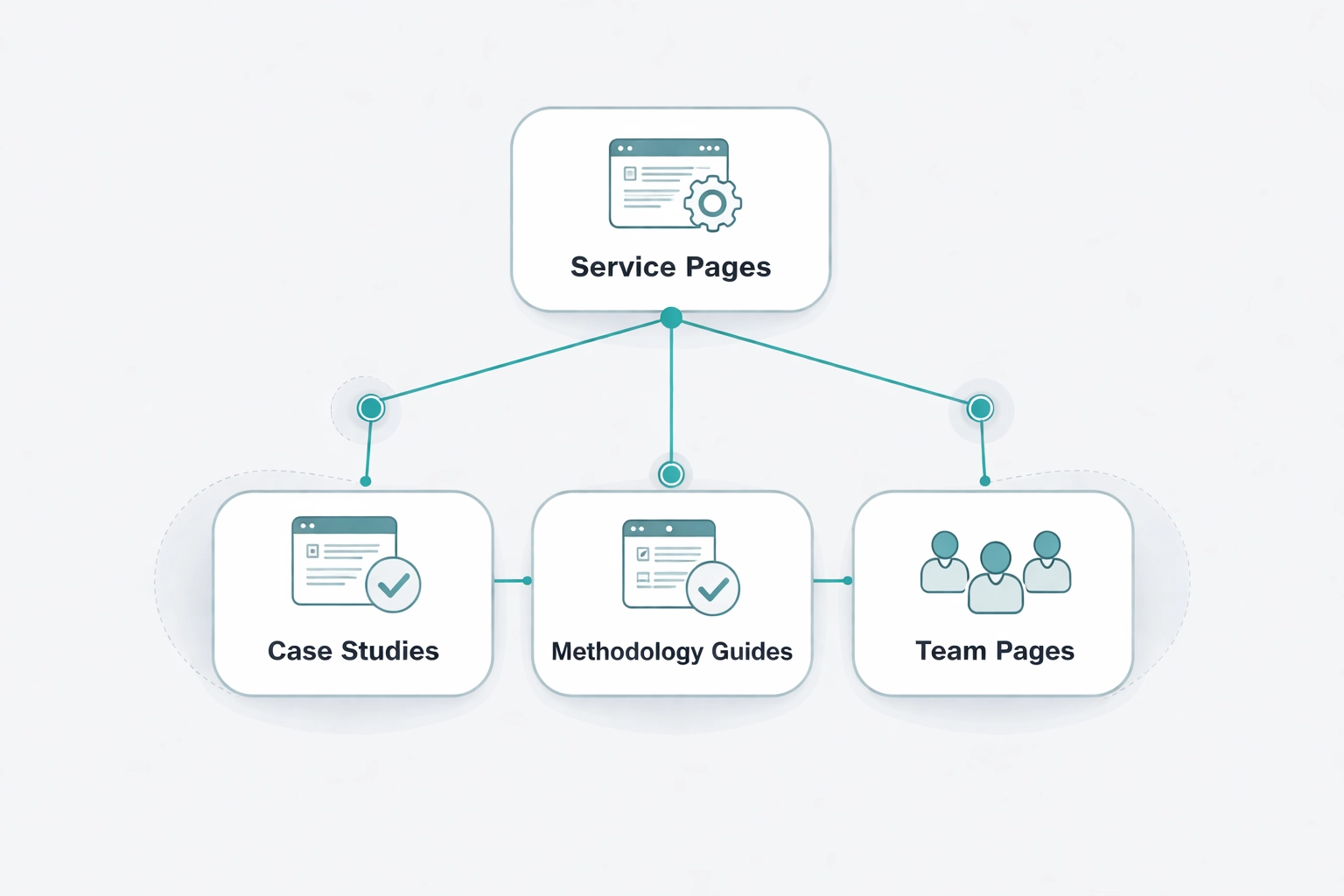
Internal linking and metadata clarify relationships for AI systems. When your service pages link to relevant case studies, which link to methodology pages, which link to team expertise pages, you're creating a knowledge graph AI can navigate.
Consider how your content connects:
- Service categories → Specific service pages → Case studies demonstrating results
- Industry verticals → Vertical-specific solutions → Client testimonials from that vertical
- Problem statements → Solution approaches → Implementation guides
This architecture signals to AI systems exactly what you do, who you serve, and how you deliver results.
Content Types That Get Cited
Not all content carries equal weight with AI systems. For B2B services, these formats consistently earn citations:
Service Pages With Specificity
Generic service pages get ignored. Specific, detailed service pages get cited. Instead of "Marketing Consulting Services," create pages like "Demand Generation Strategy for B2B SaaS Companies" or "Healthcare Revenue Cycle Consulting for Multi-Location Practices."
Include concrete details: methodologies used, typical engagement timelines, deliverables, and integration capabilities. The more specific and factual, the more citable.
Comparison and Alternative Pages
When prospects ask AI "What's the difference between fractional CMO and marketing agency?" or "Alternatives to [competitor]," you want to be the source cited. Create honest, balanced comparison content that positions your service within the broader landscape.
FAQ Content That Answers Real Questions
Deploy sitewide FAQs on priority pages addressing actual buyer questions: not keyword-stuffed placeholders. Pull questions from sales calls, support tickets, and prospect emails. These direct Q&A formats are precisely what AI systems look for when generating answers.
A content gap analysis can identify which questions your competitors answer that you don't: gaps that cost you citations.
Original Data and Research
Nothing earns citations like proprietary data. Annual surveys, benchmark reports, and industry analyses position your firm as a primary source. When AI systems need statistics to support an answer, they cite the original research: not the blog posts summarizing it.
Case Studies With Concrete Metrics
AI systems value specificity. "Increased revenue" means nothing. "Increased qualified leads by 340% over six months for a mid-market healthcare technology company" gets cited. Structure case studies around measurable outcomes with enough context for AI to understand the relevance.
Maintain Technical Accuracy and Freshness
AI systems use content freshness as a signal of reliability and active expertise. Documentation last updated in 2023 suggests abandonment. Content updated within the last quarter signals investment and current relevance.
Implement a content freshness protocol:
- Quarterly reviews of all service pages for accuracy
- Automated flags for outdated statistics, deprecated technologies, or old client references
- Update timestamps visible on pages to signal freshness to both AI and human readers
Additionally, audit third-party sources like Crunchbase, LinkedIn company pages, and industry directories. AI systems synthesize information from multiple sources: if those sources contain outdated or conflicting information, it undermines your authority.
Our AI Content Auditor can help identify which pages need immediate attention for AI visibility optimization.
How to Measure AI Visibility
Traditional metrics like organic traffic don't capture AI visibility. You need a modified measurement framework:
Brand Search Growth
When AI cites your firm, prospects often follow up with branded searches. Monitor brand search volume in Google Search Console as a leading indicator of AI visibility impact.
Citation Tracking
Manually query ChatGPT, Google AI Mode, and Perplexity with questions relevant to your services. Document when and how your brand appears. Track this monthly to identify trends.
Impression-to-Click Ratio Shifts
Rising impressions with flat or declining clicks often indicates AI is surfacing your content in answers without driving traditional clicks. This isn't failure: it's visibility success that requires different interpretation.
Inbound Quality Indicators
AI-influenced prospects often arrive more educated and further along the buyer journey. Track whether lead quality, conversation depth, and sales cycle length improve even as raw traffic metrics flatten.
For a comprehensive approach to understanding how AI search impacts your visibility, explore our guide on how to optimize content for AI.
The Path Forward
AI visibility for B2B services isn't about gaming algorithms. It's about becoming the clear, consistent, authoritative source on the topics that matter to your buyers. When you achieve that, AI systems have no choice but to cite you: because you're genuinely the best answer.
The firms that invest in this now will own the AI-driven consideration set. Those that wait will wonder why their pipeline dried up despite "good" SEO metrics.
Ready to ensure your B2B services firm gets cited when it matters most? Book a consultation to discuss an AI visibility audit for your content ecosystem.