Let’s be real: chasing a "number one ranking" in 2026 is like trying to win a race that’s already finished. If you’re still obsessing over how many people clicked a blue link to visit your homepage, you’re missing the forest for the trees, and the forest is currently being harvested by AI.
The reality is stark. Recent data shows that roughly 80% of consumers now rely on zero-click results for at least 40% of their searches. We’re talking about a world where organic web traffic has dropped by an estimated 15% to 25% across the board. Does that mean SEO is dead? Hardly. But it does mean the old playbook, the one where you obsess over search volume and pray for a 3% click-through rate, is officially a relic.
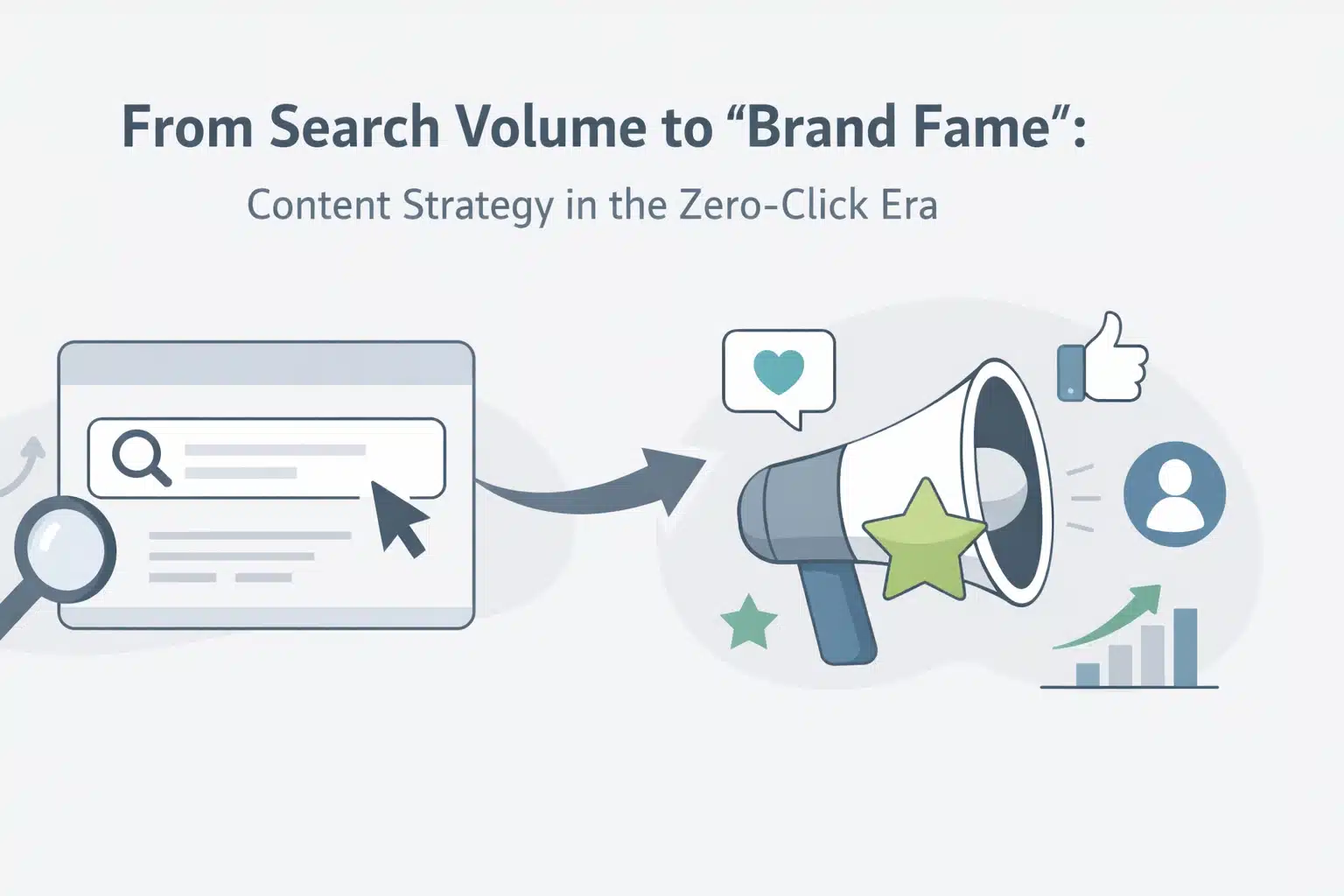
In the zero-click era, the game isn't about the click anymore. It’s about "Brand Fame." It’s about being the authority that the AI cites, the name that the LLM (Large Language Model) remembers, and the solution that users see before they even have a chance to scroll.
The Death of the Traditional Click
Think about how you search for things today. You ask a question, and Google’s AI Overview or a Featured Snippet gives you the answer right there. You don't need to click. You got what you needed, and the website that provided that information technically "lost" a visitor, but they gained something much more valuable: mental availability.
When a potential customer sees your brand name cited as the source of a definitive answer, you’ve won. You’ve established authority without needing them to spend three minutes digging through your blog. This is a fundamental, irreversible change in how digital marketing works. If you aren't optimizing for these citations, you’re becoming invisible.
Being a cited authority matters infinitely more than position #1 because position #1 is often buried under an AI-generated paragraph. If you aren't inside that paragraph, you’re just a footnote.
What Exactly is "Brand Fame"?
Brand Fame is the transition from being a "search result" to being a "known entity." It’s the difference between someone searching for "best SEO agency" and someone searching for "Expert SEO Consulting."
In the AI era, search engines are no longer just indexers; they are recommendation engines. They prioritize brands they trust. To build that trust, your Content Strategy needs to stop focusing on high-volume, low-intent keywords and start focusing on becoming the definitive source of truth in your niche.

Why Citations are the New Currency
If links were the currency of the 2010s, citations are the currency of the late 2020s. A citation occurs when an AI tool, be it ChatGPT, Claude, or Google Gemini, references your brand or your data to answer a user's prompt.
When you are cited, you aren't just getting "traffic", you are getting an endorsement from the most powerful information gatekeepers on the planet. Research shows that brands cited in AI overviews see a 35% lift in organic clicks compared to those that are simply listed in the search results below.
But how do you track this? Traditional tools like Google Search Console won't tell you how many times an LLM mentioned your name in a private chat. This is why we recommend moving toward specialized tracking. Using tools like CiteMetrix allows you to see how often your brand is actually being pulled into the conversation. Without this data, you're flying blind.
Moving Beyond Search Volume
For years, we’ve been told that search volume is the holy grail. "Look at this keyword! It has 50,000 searches a month!" That’s great, but if 45,000 of those searches are answered by an AI snippet, that "volume" is a ghost.
Success now requires measuring different metrics:
- AI Inclusion Rate: How often is your brand cited in AI responses for your core topics?
- Share of Voice: In a world of zero clicks, how often does your name appear compared to your competitors?
- Brand Search Volume: Are people searching for you by name? This is the ultimate sign of Brand Fame.
- Assisted Conversions: Is your content supporting the journey, even if the first touchpoint was a zero-click result?
If you want to know where you stand in this new landscape, an AI SEO Audit is no longer optional, it’s essential for survival. You need to know if the "robots" actually understand who you are and what you do.
How to Build a Strategy for the Zero-Click Era
So, how do you actually execute this? You can’t just keep writing 800-word blog posts that repeat the same thing everyone else is saying. You have to be better, sharper, and more "extractable."
1. Structure for Extraction
AI doesn't read your content the way a human does; it "scrapes" it for facts. If your content is buried in long, flowery paragraphs, the AI will ignore it. You need to use clear heading hierarchies, bullet points, and, crucially, direct definitions. If someone asks "What is Brand Fame?", your article should have a sentence that starts with "Brand Fame is…" This makes it incredibly easy for an AI to cite you as the authority.
2. Answer the 23-Word Query
The average ChatGPT query is now around 23 words long. People aren't searching "SEO tips" anymore; they're asking, "How do I adjust my content strategy to account for a 20% drop in organic traffic due to AI overviews?" Your content needs to reflect these long-form, conversational questions. Provide the nuance that a generic keyword-stuffed page can't.
3. Deep Value Over Surface-Level Fluff
Zero-click results satisfy basic informational queries. If your content just provides "basic info," you will lose that traffic to the snippet. To get people to actually click through to your site, you need to offer something the AI can’t summarize in a paragraph:
- Proprietary research and data.
- In-depth case studies with real numbers.
- Interactive tools or calculators.
- Unique frameworks (like our "Brand Fame" approach).
4. Digital PR and Community SEO
Google and other AI models are increasingly looking at "human" signals. They surface results from Reddit, Quora, and industry-specific forums. If your brand is being discussed and praised in these communities, the AI notices. Brand Fame isn't just built on your website; it’s built across the entire digital ecosystem. You want your experts on LinkedIn, your data on industry news sites, and your brand mentioned in the top five authoritative sources for your niche.
The Shift from "Traffic" to "Revenue Impact"
We have to stop equating pageviews with success. I’ve seen sites with 100,000 monthly visitors that generate zero leads, and I’ve seen sites with 2,000 visitors that dominate their industry because those 2,000 people are the right people searching for a specific brand.
When you focus on Brand Fame, you are building a moat around your business. You are making it so that even if Google changes its algorithm tomorrow (which, let’s be honest, it probably will), your customers will still find you because they know your name. They’ll search for you directly. They’ll ask the AI for your specific take on a problem.
Is Your Content Working Hard Enough?
Ask yourself: If Google stopped sending you any traffic tomorrow, would anyone still know your brand exists? If the answer is no, you don't have a content strategy: you have a dependency.
The goal of 2026 SEO is to become so famous in your niche that the search engine has no choice but to include you. You want to be the "Expert" in Expert SEO Consulting. You want to be the source that CiteMetrix flags as the leader in your space.
This transition isn't just a suggestion; it’s a requirement for small to large businesses that want to remain relevant. The "blue link" era was a great run, but the "Brand Fame" era is where the real money is made.
It’s time to stop chasing the ghost of search volume and start building an authority that lasts.
Ready to move beyond the click and start building your brand's authority in the AI age? Let's talk about a strategy that actually moves the needle.
Book a Consultation with Eric Richmond and the Expert SEO Consulting team today.