Google just fundamentally changed the rules of SEO measurement: and most businesses have no idea it happened.
With the rollout of Personal Intelligence in Gemini and AI Mode in Google Search, the search results your customers see are no longer the same search results you’re tracking in your rank monitoring tools. Every user now gets personalized AI-generated answers based on their search history, preferences, and behavior patterns: which means your position #3 ranking might not exist for half your audience.
Here’s the uncomfortable truth: if you’re still making SEO decisions based on traditional keyword position tracking, you’re flying blind. The metrics that drove your strategy for the past two decades are quietly becoming irrelevant.
Why Traditional Rank Tracking No Longer Tells the Full Story
Position tracking was built for a deterministic search engine: one where everyone searching “best CRM software” saw the same ten blue links in the same order. That world is gone.
Google’s Personal Intelligence layer means search results now adapt in real-time based on:
- Individual search and browsing history
- Location and device context
- Interaction patterns with previous AI-generated answers
- Personalized entity understanding and preferences
- Cross-platform behavior (YouTube, Gmail, Chrome, Maps)
When someone asks Gemini a question in AI Mode, they’re not getting a list of ten websites: they’re getting a synthesized answer pulled from multiple sources, with your brand potentially mentioned, paraphrased, cited, or completely bypassed.
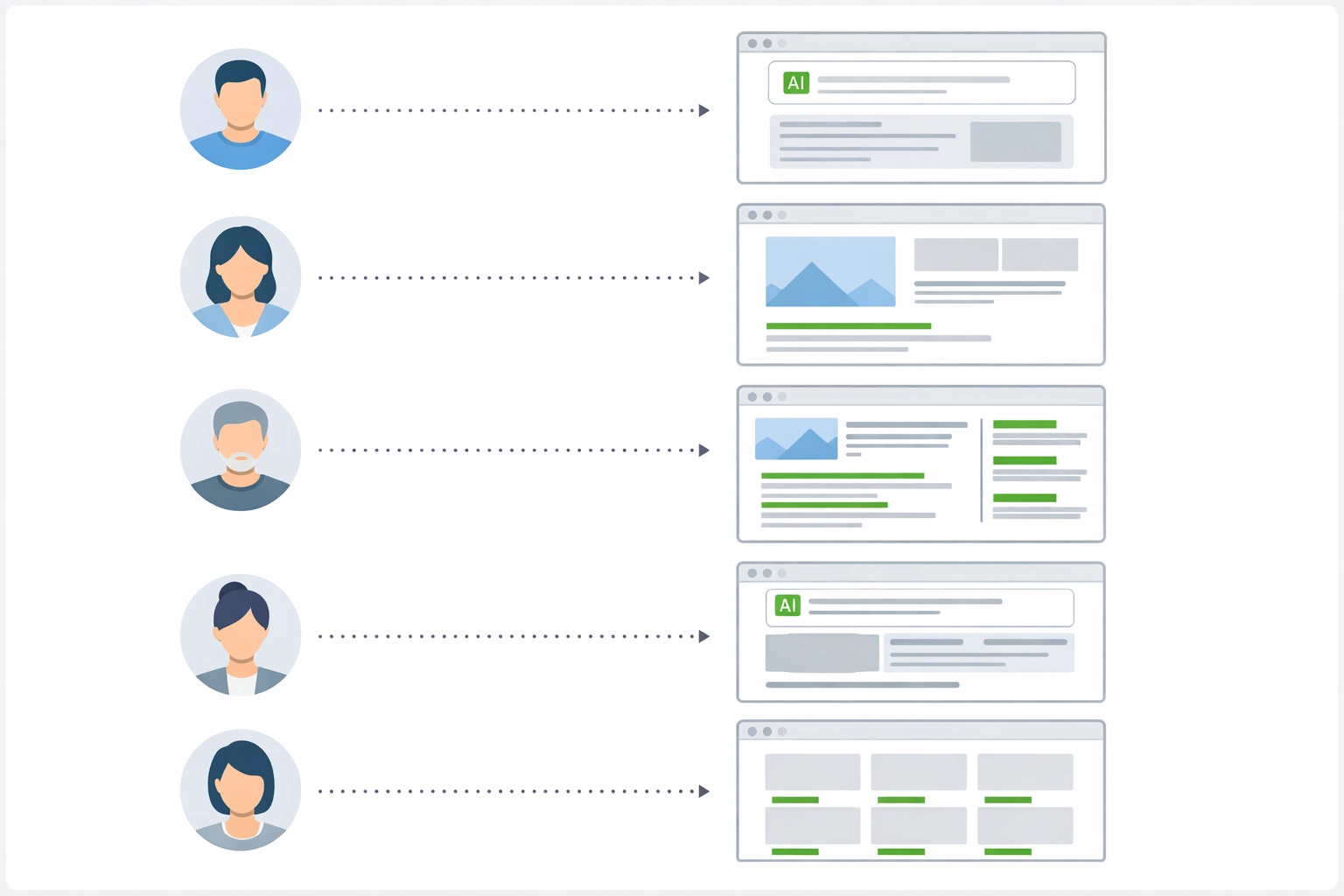
Your rank tracker shows you at position #4. But for User A, your content was summarized in the AI overview without attribution. For User B, a competitor was cited instead. For User C, your brand was mentioned but linked to a different page than the one you optimized. And for User D, your content wasn’t referenced at all because their personalization profile favored different sources.
Which of those scenarios does your rank tracking tool report? None of them.
This isn’t a minor measurement inconvenience: it’s a complete breakdown of the cause-and-effect relationship between rankings and business outcomes. You can “rank #1” and get zero traffic. You can rank nowhere and drive serious pipeline through AI citations and assisted conversions.
The New Metrics That Actually Matter in an AI-First Search Environment
If position tracking can’t tell you what’s really happening, what should you measure instead? Here’s the framework we’re implementing for clients who need visibility into their actual AI search performance.
1. AI Platform Visibility and Citation Frequency
You need to know where your brand appears across multiple AI platforms: not just Google. Your customers are getting answers from ChatGPT, Gemini, Claude, Perplexity, Google AI Overviews, and Bing AI. Each platform pulls from different sources and applies different ranking logic.
What to track:
- How often your content is cited in AI-generated responses
- Which specific pages and content pieces are being referenced
- Whether citations include attribution and links back to your site
- Comparative visibility across different AI platforms
Tools like citemetrix.com are specifically built for this. Unlike traditional rank trackers, citemetrix monitors how your brand shows up in LLM responses across ChatGPT, Google AI Overviews, Gemini, and other AI engines: giving you actual visibility into whether your content is being surfaced when it matters.
If you’re not tracking AI citations, you have no idea whether your SEO efforts are working in the channels where your audience is actually searching.
2. Share of Voice Across AI Engines
Position #1 in traditional search meant you captured the lion’s share of clicks. In AI search, there is no “position #1”: there’s only share of voice within synthesized answers.
You need to measure how often your brand is mentioned relative to competitors when AI platforms answer questions in your category. This is fundamentally different from keyword rankings because:
- Multiple brands can appear in the same AI response
- Prominence within the answer varies (first mention vs. buried in a list)
- Some queries trigger your content while closely related queries don’t
Track your share of voice across major AI platforms for your core topic clusters. If competitors are being cited 3x more often than you for the same queries, your traditional #2 ranking isn’t telling you the real story.
3. SERP Feature Presence and AI Overview Inclusion
Google’s traditional “ten blue links” now shares screen real estate with AI Overviews, featured snippets, People Also Ask boxes, and other SERP features: many of which are personalized.
Instead of obsessing over position, track:
- How often your content appears in AI Overviews for target queries
- Whether you’re triggering featured snippets (even if personalized)
- Presence in “Sources” carousels within AI-generated answers
- Video and image inclusion in multimodal AI responses
Your goal isn’t to “rank #1”: it’s to appear in the answer, regardless of format. We’ve seen clients optimize content for AI and see traffic increases even when traditional rankings stayed flat, simply because they started showing up in AI Overviews and other features.
4. Assisted Conversions and Multi-Touch Attribution
Here’s where most businesses completely miss the boat: they’re still measuring SEO success by “last-click organic traffic.”
AI search changes user behavior. Someone might:
- Ask Gemini a question and see your brand mentioned
- Search your brand name later (direct/branded traffic)
- Click a paid ad (paid search conversion)
- Fill out a contact form two weeks later (direct conversion)
If you only track last-click attribution, you’ll credit the paid ad or direct traffic: completely missing that the journey started with an AI citation you’re not even monitoring.
You need multi-touch attribution that captures:
- Branded search volume increases (indicating AI-driven brand discovery)
- Assisted conversions where organic SEO appeared earlier in the funnel
- Cross-channel journey analysis showing AI search touchpoints
- Time-lag reporting to understand how AI discovery influences later conversions
This is exactly why our SEO-to-revenue alignment work focuses on GA4 configuration, CRM integration, and attribution modeling: not just keyword rankings. If your analytics setup can’t connect AI visibility to actual pipeline, you can’t prove ROI.
5. Entity Recognition and Knowledge Graph Presence
Google’s personalization relies heavily on entity understanding: not just keywords. If Google doesn’t clearly understand who you are, what you do, and how you relate to other entities in your space, you won’t surface consistently in AI-generated answers.
Monitor:
- Your Google Knowledge Panel accuracy and completeness
- Structured data implementation across your site
- Entity associations in Google’s Knowledge Graph
- Wikipedia, Wikidata, and other authoritative data source accuracy
We use AI content auditing to identify where entity clarity is weak and where your content isn’t giving AI systems the clear signals they need to confidently cite you.
What This Means for Your Reporting and Strategy
If you’re still sending stakeholders a monthly report showing keyword rankings and calling it “SEO performance,” you’re measuring the wrong things.
The new reporting stack needs to show:
- AI visibility metrics (citemetrix or similar tools tracking LLM citations)
- Multi-platform presence (Google AI Overviews, ChatGPT, Perplexity, etc.)
- Share of voice comparisons vs. competitors in AI responses
- Assisted conversion data showing how organic touchpoints influence pipeline
- Entity health scores indicating how well AI systems understand your brand
This isn’t about abandoning traditional SEO: it’s about expanding your measurement framework to reflect how people actually search and make decisions in 2026.
How to Get Started Without Overhauling Everything Overnight
You don’t need to throw out your existing SEO stack. Start by layering in AI visibility tracking alongside your current metrics.
Immediate next steps:
- Set up citemetrix.com (or a similar AI visibility tool) to baseline where you currently appear in AI-generated responses
- Audit your GA4 setup to ensure you’re tracking assisted conversions and multi-touch journeys, not just last-click organic traffic
- Review your entity signals: structured data, Knowledge Panel accuracy, and how clearly your content defines who you are and what you do
- Start monitoring branded search trends as a proxy for AI-driven brand discovery that doesn’t show up in traditional organic reports
The businesses that adapt their measurement frameworks now will have a 12–18 month head start on competitors still optimizing for rankings that half their audience never sees.
The Bottom Line
Gemini Personal Intelligence and AI Mode didn’t just change search results: they broke the measurement systems we’ve relied on for two decades. Position tracking still has value for baseline visibility, but it no longer predicts traffic, conversions, or business outcomes the way it used to.
If you’re still making strategic decisions based solely on keyword rankings, you’re optimizing for a version of Google that no longer exists for most of your audience.
Need help building an AI visibility monitoring framework that actually connects to revenue? We’ve spent the past year rebuilding our reporting infrastructure to track what matters in an AI-first search environment: and we can do the same for you. Book a consultation and we’ll audit your current tracking setup and show you exactly what you’re missing.