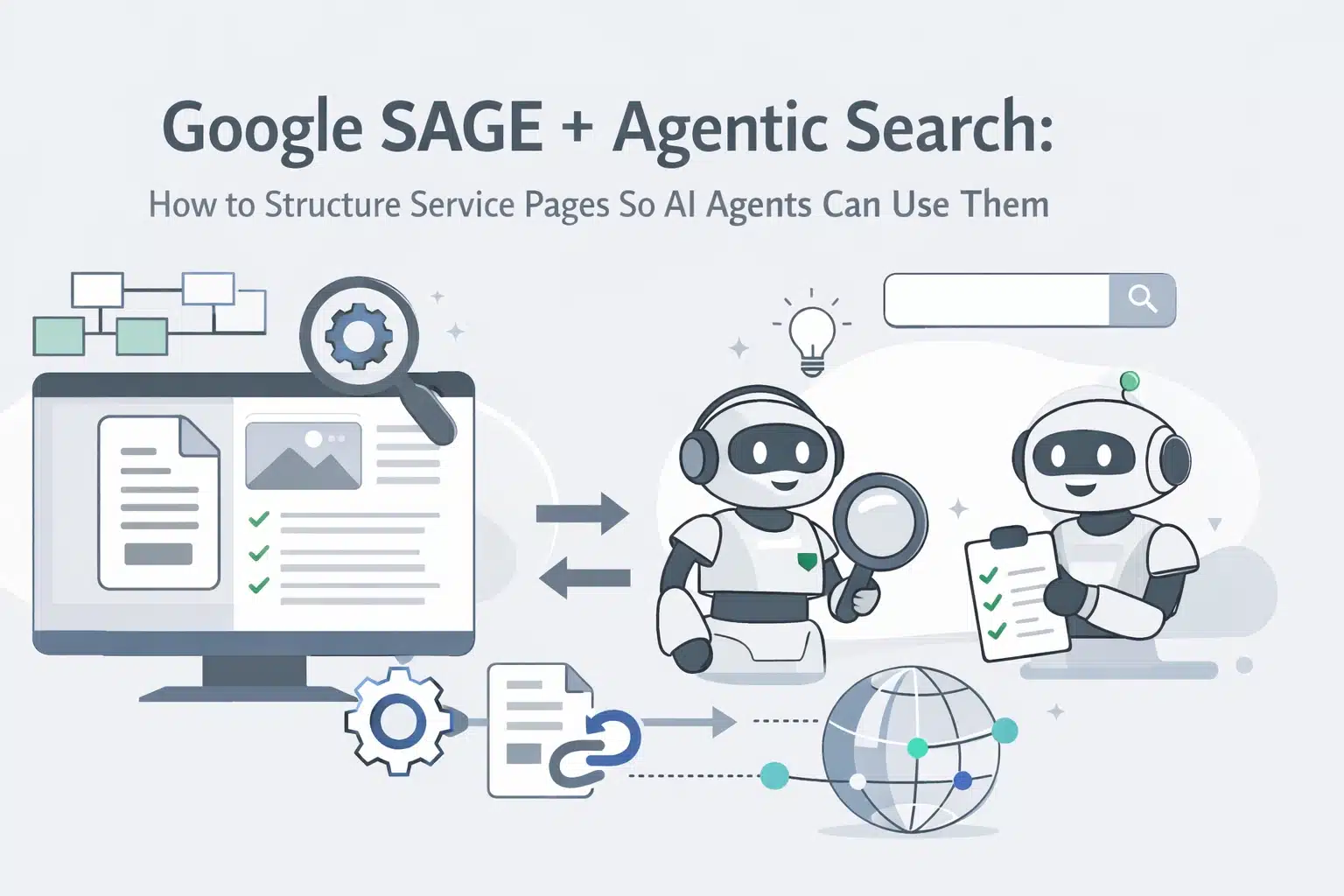
Here's the thing about service pages in 2026: they're no longer being read primarily by humans making buying decisions. They're being evaluated by AI agents determining whether you're worth surfacing to those humans in the first place.
Google's SAGE (Search-Augmented Generation Engine) project has fundamentally changed how search works. Instead of matching keywords and ranking pages, AI agents now break down complex queries into sub-tasks, search for information in parallel, and synthesize answers from multiple sources before a user ever clicks a link.
If your service pages aren't structured for this agentic search behavior, you're invisible: even if you technically rank well.
What SAGE and Agentic Search Actually Mean for Your Business
Traditional search was transactional: user types query → Google matches keywords → user clicks result → user reads page.
Agentic search is investigative: user asks complex question → AI agent decomposes it into sub-questions → agent searches multiple sources simultaneously → agent evaluates credibility and synthesizes answer → user sees compiled result (and maybe clicks through for details).
The SAGE research reveals something critical: information from different documents can be retrieved using a single query when content is structured properly. This phenomenon, called "multi-query collapse," means AI agents can pull everything they need from one well-structured page instead of hopping across multiple resources.
Translation: if your service page answers all the sub-questions someone might have about your service in a logically organized way, AI agents will use it. If it's just keyword-stuffed marketing fluff with no substantive information architecture, they'll skip it entirely.

Why Your Current Service Page Structure Doesn't Work
Most service pages follow an outdated template:
- Hero section with vague value proposition
- "Why choose us" section with generic benefits
- Feature list or service description
- Testimonials
- Contact form
This structure optimizes for human persuasion after someone has already found you. It does nothing to help AI agents determine whether your page contains the information their user needs.
AI agents use Natural Language Understanding to interpret full intent and context-based retrieval from vector databases: not keyword matching. They're looking for semantic relationships, comprehensive explanations, and logical information flow. Your five-bullet-point "what we do" section doesn't cut it.
Here's what works instead.
The Task-Completion Framework: How to Structure Service Pages for AI Agents
The most effective service page structure mirrors how people actually approach hiring a service: they want to understand the process, evaluate whether it's right for them, and determine what it takes to move forward.
Start with clear entity clarity
AI agents need to immediately understand:
- Who you are (business entity, authority signals, credentials)
- What service you provide (specific, not generic)
- Where you operate (geographic scope, delivery model)
- Who you serve (industry, company size, specific use cases)
Put this information in the first 150 words using clear, declarative language. Not "We help businesses succeed online" but "Expert SEO Consulting provides enterprise SEO audits, technical optimization, and content strategy for B2B companies generating $5M+ in annual revenue."
Structure content around task completion
AI agents are trying to help users complete a task: evaluate whether your service solves their problem. Structure your page to support that task:
-
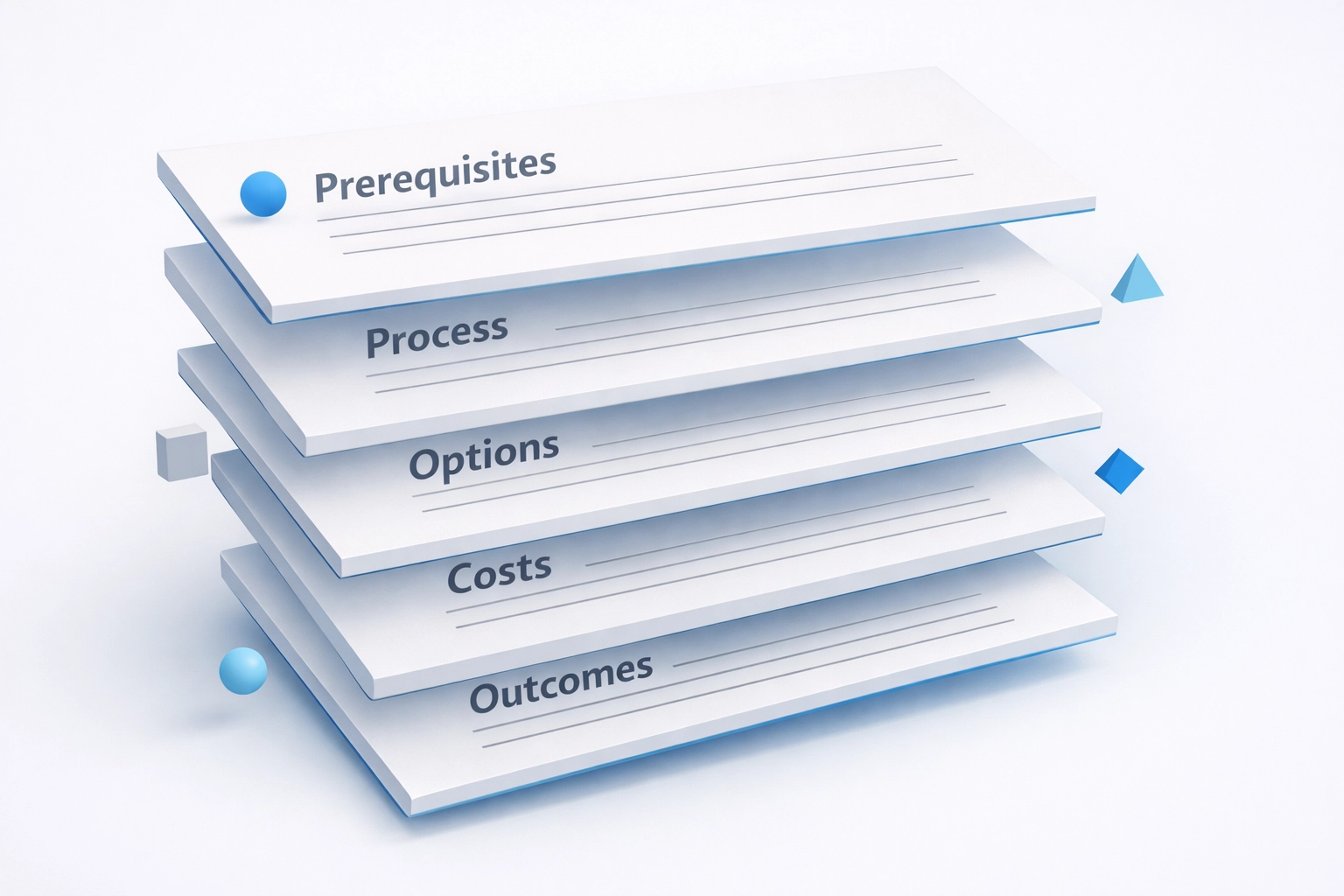
Prerequisites : What does someone need before engaging your service? (Budget range, existing systems, timeline requirements, decision-maker involvement)
-
Process steps : How does your service actually work? Break it into phases with specific deliverables and timelines.
-
Options and variations : What choices do clients make during engagement? (Service tiers, add-ons, customization points)
-
Costs and investment : Actual ranges, what influences pricing, payment structure
-
Expected outcomes and timelines : Realistic results with timeframes, not vague promises
-
Common obstacles and how you address them : What typically goes wrong and your mitigation approach
This isn't about being salesy: it's about being informative enough that an AI agent can confidently surface your page when someone asks, "How does an enterprise SEO audit work and what should I expect?"
Create scannable, semantically organized sections
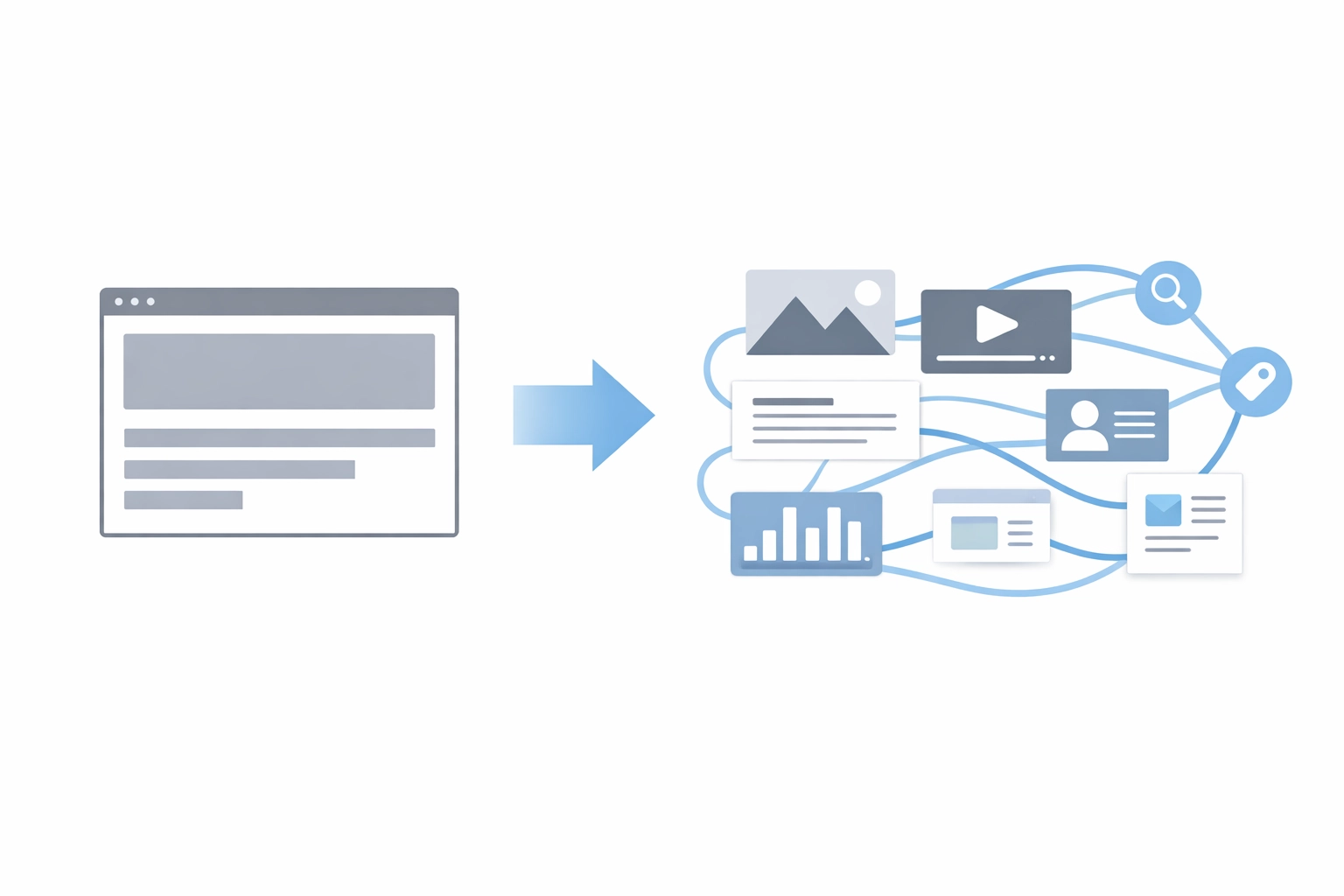
AI agents don't read linearly: they scan for relevant context. Use:
- Descriptive H2 and H3 headings that contain actual information, not marketing phrases ("How Long Does a Technical SEO Audit Take?" not "Our Process")
- Summary paragraphs at the beginning of major sections
- Logical grouping of related information so context isn't scattered
- Lists and tables for comparative information or step sequences
- Clear transitions between sections that show semantic relationships
The goal is to preserve context. If an AI agent pulls one section of your page to answer a sub-question, that section should make sense on its own while clearly connecting to the larger service narrative.
Build internal linking that establishes topical authority
AI agents evaluate credibility partially through how well your content ecosystem connects. Strategic internal linking demonstrates:
- Depth of expertise (linking to supporting content that goes deeper on sub-topics)
- Breadth of knowledge (connecting related services and concepts)
- Information hierarchy (clear paths from general to specific)
For a service page about SEO audits, you might link to:
- Supporting pages about specific audit components
- Related services (content strategy, technical optimization)
- Educational content explaining concepts referenced in your service description
- Case studies or examples demonstrating outcomes
Don't overdo it: 3-5 strategic internal links per 500 words, placed where they genuinely add value. AI agents can detect when you're link-stuffing for manipulation versus linking for user benefit.
Answer sub-questions together on one page
The SAGE research is explicit: when AI agents break down complex queries into sub-questions and search in parallel, they prefer pages that answer multiple related questions comprehensively.
If someone's trying to decide whether to hire an SEO consultant, their mental sub-questions might be:
- What does an SEO consultant actually do?
- How long does it take to see results?
- What's the typical investment range?
- Do I need technical capabilities on my team?
- How do I measure whether it's working?
If your service page answers all five questions with substantive explanations, you trigger multi-query collapse: the agent can retrieve everything from your single page instead of bouncing across multiple sources. This massively increases your chances of being surfaced.
Show your reasoning, not just your conclusions
AI agents conducting multi-step research evaluate source credibility based on depth of explanation. They favor content that demonstrates thorough reasoning over content that just makes claims.
Don't write: "Our SEO audits identify all technical issues holding back your rankings."
Write: "Our technical SEO audits use a combination of automated crawling tools and manual evaluation to identify indexing problems, site speed issues, and structural barriers. We prioritize findings based on estimated traffic impact and implementation complexity, so you can focus resources on fixes that drive measurable improvement rather than chasing every minor warning."
The second version shows how you think and why your approach works. That's what AI agents are trained to look for.
Classic SEO Still Matters (Unfortunately for Everyone Who Thought It Was Dead)
Here's what the SAGE research also reveals: AI agents still pull from top-ranked web pages when executing queries.
All this agent-ready structuring won't help if your page doesn't have the SEO fundamentals:
- Quality backlinks establishing domain authority
- Technical optimization (fast load times, mobile responsiveness, clean code)
- Relevant keyword usage in titles, headers, and content
- Proper structured data and schema markup
The difference now is that ranking alone isn't enough. You need to rank and be structured in a way that AI agents can actually use your content.
What This Means for Your Service Pages Right Now
If you're still using service pages built in 2021, you're optimizing for a search behavior that no longer dominates how people find and evaluate services.
The businesses winning in agentic search are the ones restructuring service content around:
- Comprehensive task-completion frameworks
- Clear entity and semantic clarity
- Multi-question answering on single pages
- Demonstrable reasoning and depth
- Strategic internal linking that establishes authority
This isn't a minor tweak: it's a fundamental content architecture shift.
Ready to Restructure for AI-Native Search?
We're running AI SEO audits specifically focused on how well your current service pages perform in agentic search environments. The audit evaluates entity clarity, information architecture, semantic structure, and multi-query collapse potential: then provides a prioritized restructuring roadmap.
If your service pages were built for 2020 search behavior, they're not competing in 2026.
Schedule an AI SEO audit consultation and we'll walk through exactly what needs to change.