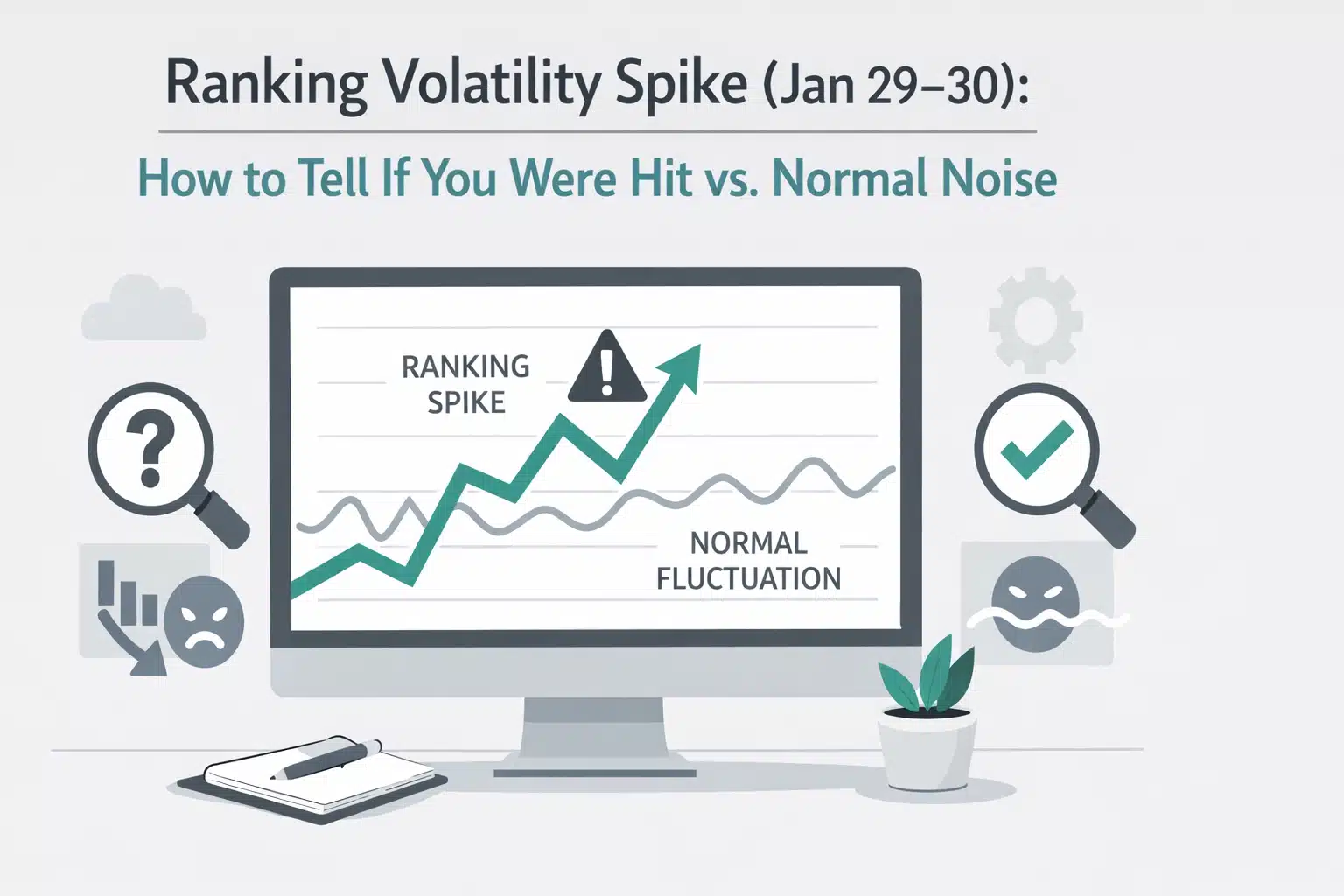
If you monitor your rankings closely (and you should), you probably noticed something on January 29-30. Rankings shifted. Sometimes dramatically. Search Engine Roundtable and the usual monitoring tools lit up with chatter about volatility spikes.
But here's the thing: Google's rankings fluctuate constantly. The algorithm tests variations, personalizes results, adjusts for location and device, and runs mini-updates that never make headlines. So when you see movement in your tracking dashboard, the first question isn't "What happened?" : it's "Did something actually happen to me, or is this just the usual noise?"
Because the wrong response to normal fluctuation is expensive panic. And the wrong response to a genuine hit is expensive inaction.
Here's how to tell the difference : and what to do about it.
What Actually Happened on January 29-30
Multiple tracking tools (SEMrush Sensor, Mozcast, RankRanger) registered elevated volatility across both mobile and desktop search results. The spike was most pronounced in certain verticals : health, finance, and e-commerce showed the biggest swings : but volatility was measurable across the board.
Google didn't announce an update. That's normal. Most ranking changes aren't "core updates" with official blog posts. They're adjustments to ranking factors, quality signals, or how the algorithm interprets user behavior. Sometimes it's infrastructure changes. Sometimes it's new features (AI Overviews, for example) claiming SERP real estate.
The volatility doesn't care whether Google tells you about it. Your traffic does.

Step 1: Check If You Were Actually Affected
Start with Google Search Console. Do not start with your rank tracker. Here's why: rank trackers show position changes, which can move for dozens of reasons that don't affect traffic. Search Console shows impression and click changes, which measure actual visibility.
Open GSC Performance report and:
- Set the date range to compare Jan 28-Feb 1 vs. the previous 5 days
- Look at total clicks and total impressions
- Filter by page to see which URLs gained or lost visibility
- Filter by query to see which keywords moved
What you're looking for:
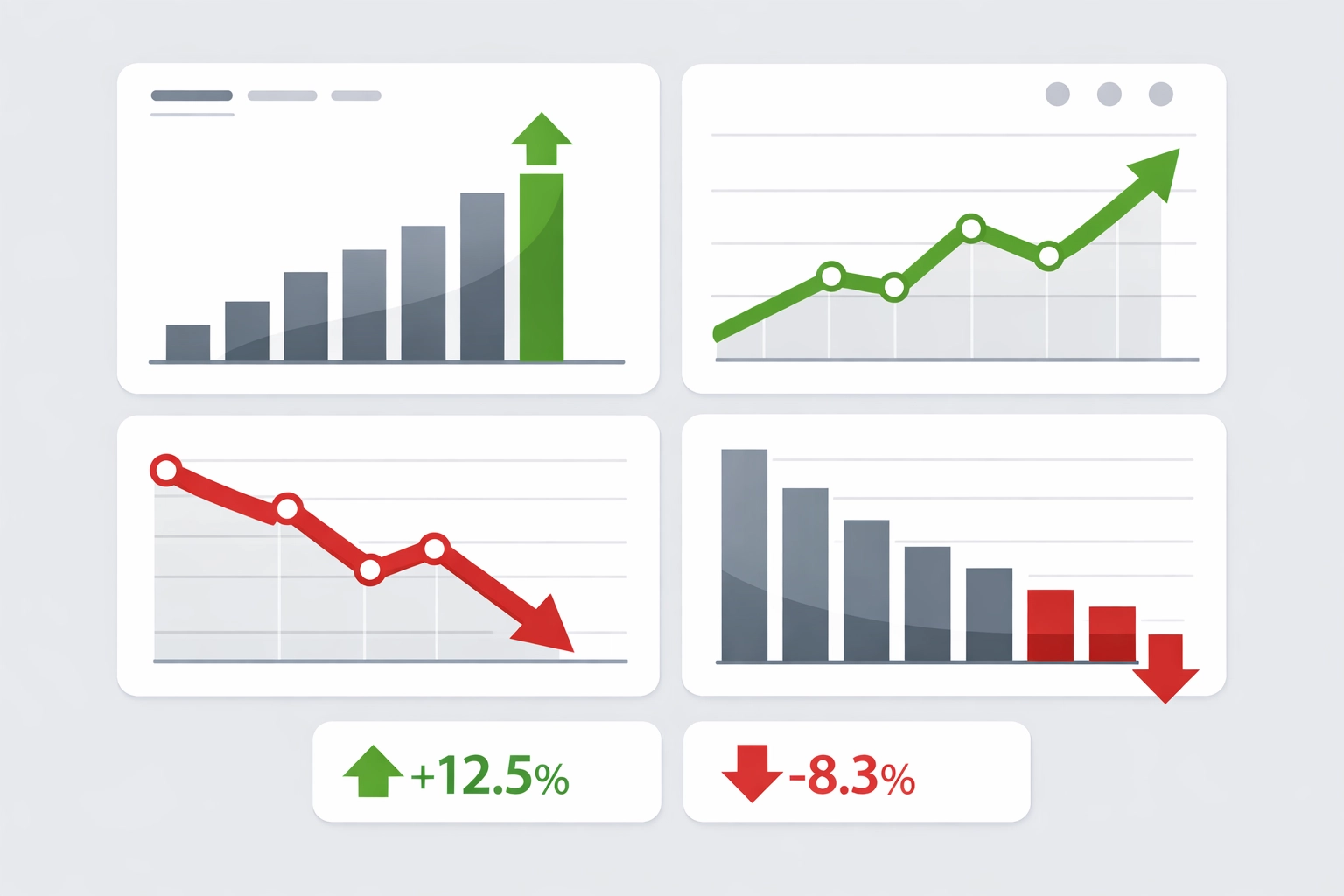
✓ Sustained drops or spikes : if impressions or clicks dropped 15%+ and stayed down for 3+ days, something changed
✓ Page-level patterns : did one category of pages lose visibility while others held steady?
✓ Query-level patterns : did you lose rankings for commercial queries but maintain informational ones (or vice versa)?
If your overall impressions are flat or only moved 5-10%, you're likely seeing noise. Rankings drift constantly within a few positions. A keyword moving from #4 to #6 feels dramatic in a tracker but often doesn't change click volume much.
If you see a 20%+ drop in impressions or clicks that persists beyond 72 hours, keep reading.
Step 2: Look for Page-Type Winners and Losers
Algorithmic changes rarely affect all your pages equally. Google adjusts how it evaluates specific page types, content formats, or user intent matches.
Break your GSC data down by page category:
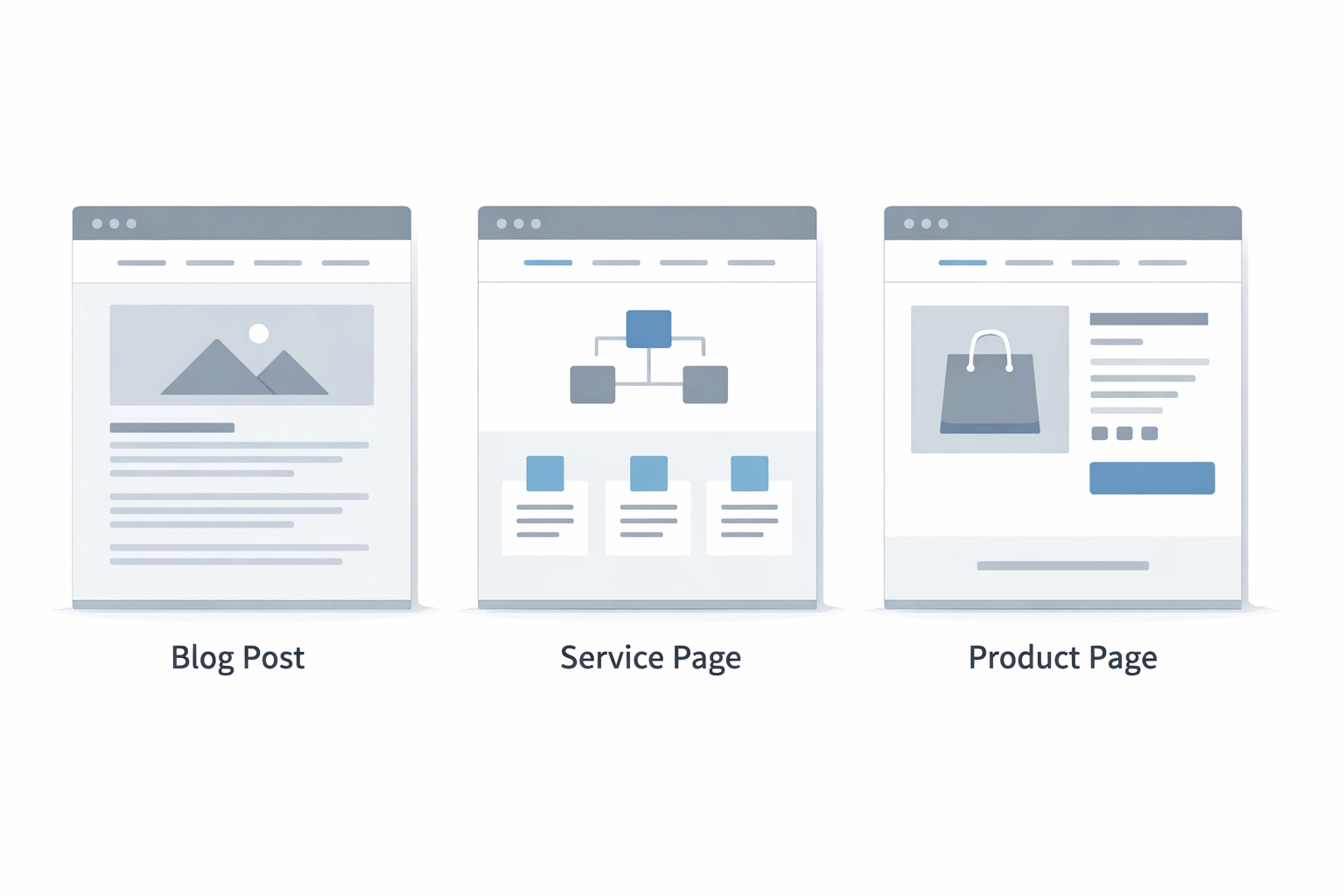
- Homepage vs. service pages vs. blog posts
- Product pages vs. category pages
- Long-form vs. short-form content
- Pages with video/images vs. text-only
If only your blog posts dropped but service pages held steady, that's a content quality or freshness signal. If only commercial pages dropped, it's likely a relevance or E-E-A-T issue. If everything dropped uniformly, it might be a technical or site-wide penalty (check your indexing status immediately).
Step 3: Diagnose Query Intent Shifts
Google constantly refines how it interprets search intent. A query that historically returned informational guides might start showing product comparison pages instead. A query that showed local results might go national.
Go back into GSC and filter by query. Ask:
- Did I lose visibility for queries where my page type doesn't match the new SERP layout?
- Are the pages now ranking for my keywords fundamentally different from mine (format, depth, angle)?
- Did Google shift the query from informational to transactional intent (or vice versa)?
Check the actual SERP for your top keywords. Open an incognito window and search. What's ranking now? If the entire first page is now product pages and you're ranking a blog post, Google re-classified the intent. Your content isn't worse : it's mismatched.
This is fixable, but it requires content restructuring, not link building.
Step 4: Check for Indexing and Crawl Anomalies
Sometimes volatility isn't algorithmic : it's technical.
In GSC, check:
- Coverage report : did pages suddenly drop out of the index?
- Crawl stats : did Googlebot stop crawling certain sections?
- Mobile usability : did Google flag new errors?
- Core Web Vitals : did your site speed degrade?
If pages fell out of the index or stopped being crawled, you have a technical issue (robots.txt block, server errors, redirect chains) masquerading as an algorithm hit.
Run a quick crawl with Screaming Frog or Sitebulb to confirm whether Google can still access affected pages. If your site had a deployment, plugin update, or hosting change in the 48 hours before Jan 29, that's your culprit.
When to Wait vs. When to Act
Wait if:
- Impressions/clicks fluctuated but returned to baseline within 3-5 days
- Movement was less than 15% and isolated to a handful of keywords
- You see similar volatility across competitors (use SEMrush or Ahrefs to check)
- No corresponding change in conversion rate or user behavior
Act immediately if:
- Impressions or clicks dropped 20%+ and stayed down for a week
- You lost visibility for your primary revenue-driving keywords
- Pages fell out of the index or show indexing errors
- Competitors clearly gained the rankings you lost (check the SERPs)
Here's the reality: most ranking volatility is noise. Google tests constantly. Rankings shift by a position or two, then shift back. If you chase every fluctuation, you'll spend more time reacting than building.
But when you see clear, sustained losses tied to specific page types or query categories, that's signal. And signal requires a response.
What a Forensic SEO Audit Actually Looks For
If you've determined this was a real hit (not noise), here's what needs to happen:
Content quality assessment : did Google downgrade thin, outdated, or low-value pages? Are competitors publishing deeper, better-structured content?
E-E-A-T signals : does your site demonstrate expertise, experience, authoritativeness, and trust? Do you have author bios, credentials, citations, and schema markup in place?
Technical health : are there indexing issues, canonicalization problems, or site speed degradation that coincided with the drop?
Link profile changes : did you lose high-authority backlinks? Did competitors gain them? (This is less common in sudden volatility spikes but worth checking.)
SERP feature displacement : did AI Overviews, featured snippets, or People Also Ask boxes push your organic listings down? (This shows up as impression loss without a ranking drop.)
A proper forensic audit doesn't just identify the problem : it maps the recovery path. If Google re-classified query intent, you need content restructuring. If it's an E-E-A-T issue, you need credibility signals. If it's technical, you need fixes deployed and re-indexed.
The Bottom Line
The January 29-30 volatility spike was real. But not everyone who saw rankings move was actually affected.
Most SEO software will flag volatility and send you a panicked email. Your job is to separate signal from noise before you start making changes. Because fixing problems that don't exist is how you create new ones.
If you're seeing sustained losses : especially on revenue-driving pages or queries : don't wait for it to "blow over." Google doesn't reverse algorithmic decisions just because you hope it will. You need a clear diagnosis and a recovery plan.
We've helped businesses recover from algorithm updates, technical disasters, and competitive displacement. If you're not sure whether this spike affected you or what to do about it, book a forensic SEO audit. We'll pull your GSC data, compare it to SERP changes, and tell you exactly what happened and what needs to be fixed.
Because the difference between volatility and a real hit is clarity. And clarity is what separates recovery from guesswork.