Have you ever looked at your Google Analytics and felt like you were staring at a crime scene where the body: and the weapon: were missing? You know the traffic is there. You see the leads coming in. You feel the phones ringing. But when you check your referral reports, it looks like your SEO efforts have flatlined.
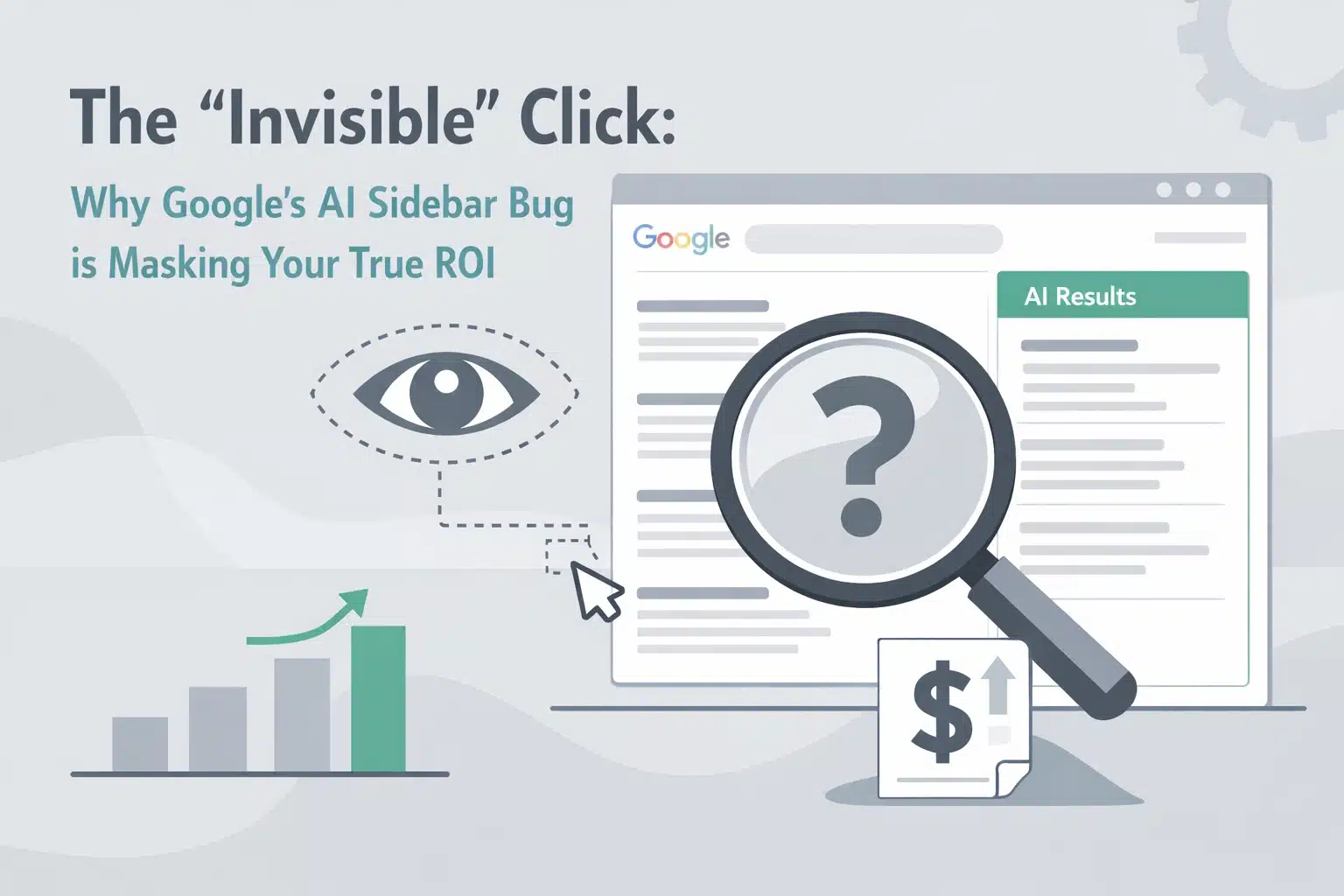
Welcome to the newest headache of 2026: The "Invisible" Click.
Since the rollout of Gemini 3 in late January, we’ve been tracking a massive shift in how users interact with search results. Specifically, the Google AI Sidebar: that nifty little conversational assistant that pops up on the right side of your browser: is currently suffering from a technical "bug" that is effectively stripping away your attribution data.
For business owners, this isn't just a technical glitch; it’s a financial blind spot. If you can't see where your customers are coming from, you can't accurately calculate your ROI. And if you can't calculate your ROI, you’re essentially flying your marketing budget into a storm without radar.
The January 27th Shift: When Sources Vanished
Let’s look at the numbers, because they are jarring. On January 27, 2026, Google pushed the Gemini 3 update. Almost immediately, the SEO community noticed something was broken. The "sourceless answer rate": the frequency with which Google’s AI provides an answer without citing a specific website: skyrocketed from a negligible 0.11% to a staggering 10.63%.
Even more concerning? Roughly 46% of previously cited domains simply vanished from the AI Overviews.

When Google’s AI provides a comprehensive answer in the sidebar and fails to link back to the source, that’s one problem. But there is a second, more insidious problem occurring when it does link back to you. We’re finding that links clicked within the AI Sidebar are frequently failing to pass "referrer" data.
In plain English: When a high-value customer clicks your link inside that AI chat, your analytics software sees it as "Direct" traffic: as if the user typed your URL into their browser manually. This is a classic example of the "Dark Traffic" challenge we’ve discussed before, and it’s masking the true performance of your digital presence.
Why Your Analytics Dashboard is Lying to You
You’ve spent years training yourself to look at "Organic Search" as your primary indicator of SEO health. But in the age of the AI Sidebar, that metric is becoming dangerously incomplete.
When a user engages with an AI Sidebar, they are often in a deep state of "intent." They aren't just browsing; they are asking specific, complex questions. If the AI recommends your business and the user clicks through, that is perhaps the highest-quality lead you can get. Yet, because of this attribution bug, that "Invisible Click" shows up in your reports as a mystery visit.
This creates a few major problems for medium to large businesses:
- Under-reporting SEO Value: Your marketing team looks like they are underperforming when, in reality, they are driving some of your best traffic.
- Misallocated Budgets: You might be tempted to cut spend on a Content Strategy that is actually working brilliantly, simply because the clicks are "invisible."
- Inaccurate Customer Journey Mapping: You lose the ability to see which specific AI-generated answers are leading to conversions.
This isn't just a possibility; it is the current reality of the search landscape in 2026. If you aren't accounting for this sidebar attribution loss, your ROI is being masked by as much as 15–20%.
The "Dark Traffic" Dilemma
We’ve talked about "Dark Traffic" before: that bucket of visits from private messaging apps, emails, and secure browsing that hides the source of the click. But the AI Sidebar bug has weaponized Dark Traffic on a scale we haven't seen.
Because Google is essentially "hijacking" the user journey within its own interface, the standard hand-off of data between the search engine and your website is being interrupted. This is especially prevalent in the Chrome Gemini panel, where recent vulnerabilities (like CVE-2026-0628) have shown that traffic interception and unexpected behavior in the sidebar are more common than Google would care to admit.
When a user interacts with the sidebar, they are in a "walled garden." If they click a link and the referrer is stripped, you are left in the dark. You can no longer see that the user found you because you were the top-cited authority on a complex industry topic. You just see a random person landing on your homepage.
How to Solve the Attribution Gap
So, how do you fix a problem that Google hasn't officially patched yet? You stop relying on basic, out-of-the-box analytics and start using tools designed for the AI era.
This is where CiteMetrix comes in. CiteMetrix is specifically engineered to measure this "Dark Traffic" and bridge the gap between AI citations and actual site visits. Instead of guessing how many people found you through a Gemini prompt, CiteMetrix allows you to see the footprint of those interactions. It’s the "radar" I mentioned earlier: the tool that lets you see through the storm of the Invisible Click.
Beyond just using the right tools, you need to rethink your overall AI SEO Audits. You must look at your performance not just through the lens of traditional "blue links," but through "share of voice" within the AI sidebar. If you are being cited, but the clicks are "invisible," you need to find ways to "brand" those clicks within the content itself (e.g., specific landing pages or unique offers mentioned in your content that the AI will likely relay).
Why This Matters for Your 2026 Strategy
We are past the point where AI in search is a "trend." It is the foundation. As Google continues to refine Gemini 3 and eventually moves toward even more integrated sidebar experiences, the traditional referral path will continue to erode.
For businesses with significant marketing budgets, the stakes are high. You cannot afford to make decisions based on 80% of the data. To truly understand your success, you must account for the "Invisible Click."
This requires a fundamental shift in how we view Organic SEO. It’s no longer just about ranking #1; it’s about being the "trusted source" that the AI chooses to reference, and then having the technical infrastructure in place to capture that attribution when the user finally clicks through.
What You Need to Do Now
The bug in the AI sidebar might be Google’s fault, but the loss of ROI data is your problem to solve. Here is your immediate checklist:
- Audit Your Analytics: Check for a sudden, unexplained spike in "Direct" traffic that correlates with the January/February 2026 timeframe.
- Implement Advanced Tracking: Use a solution like CiteMetrix to start identifying the sources of your Dark Traffic.
- Review Your Content: Ensure your Content Strategy is optimized for AI visibility, making it impossible for the sidebar to ignore your expertise.
- Get a Professional AI Audit: Traditional SEO audits don't cover the nuances of LLM citations and sidebar bugs. You need an AI SEO Audit to see where you are winning and where you are being masked.
The landscape of search has fundamentally changed. The tools we used in 2024 and 2025 are no longer sufficient for the complexities of 2026. If you want to stop the "Invisible Click" from draining your perceived ROI, you need to act now.
Don't let your marketing success stay hidden in the shadows of the AI sidebar. It's time to bring that traffic back into the light and prove the true value of your SEO investment.
Ready to uncover your "Dark Traffic" and fix your AI attribution? Book a consultation with us today and let’s get your ROI back on track.