
Here’s the thing: while you’ve been optimizing for Google’s traditional crawlers, a new class of AI systems has been quietly reshaping how users discover and interact with your content. ChatGPT, Claude, Perplexity, and other AI-powered search tools now influence millions of queries daily: and most websites aren’t equipped to communicate with them effectively.
The result? Your content gets ignored, misinterpreted, or used without proper context. That’s a problem you can no longer afford to overlook.
Enter the LLM.txt Generator: a tool designed to bridge the gap between your website and the AI systems that are fundamentally changing search behavior. If you want your brand to remain visible in this AI-first landscape, understanding and implementing LLM.txt is no longer optional.
What Is LLM.txt and Why Does It Matter Now?
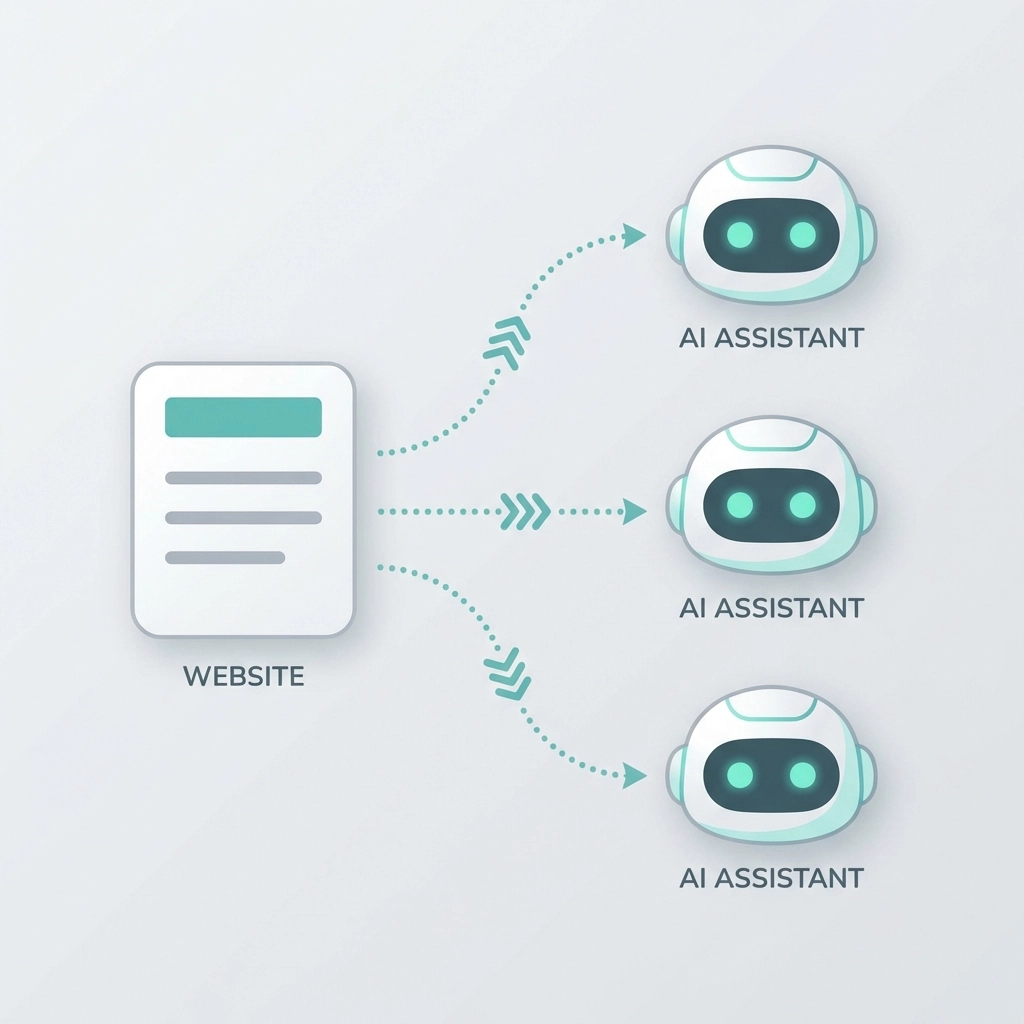
Think of LLM.txt as the robots.txt file for AI language models. While robots.txt has guided traditional search engine crawlers for decades, LLM.txt specifically instructs AI systems like GPTBot, ClaudeBot, and PerplexityBot about what content they can access, how to interpret it, and how to properly cite your site.
AI search systems face significant challenges when crawling traditional websites. Their context windows: the amount of text they can process at once: are limited to a few thousand words. That makes it nearly impossible for them to understand your entire site structure from raw HTML alone.
Without an LLM.txt file, your content exists in a gray zone. AI systems might:
- Skip your pages entirely due to parsing difficulties
- Use your content without proper attribution
- Misrepresent your expertise because they lack context about your site’s purpose
- Fail to recognize your most valuable pages
The bottom line: if AI can’t understand your website, it won’t recommend you: no matter how good your content is.
The Problem Traditional SEO Doesn’t Solve
You’ve likely invested heavily in content optimization for AI search. That’s essential, but it addresses only half the equation. Optimizing content quality means nothing if AI crawlers can’t efficiently access and interpret your site structure.
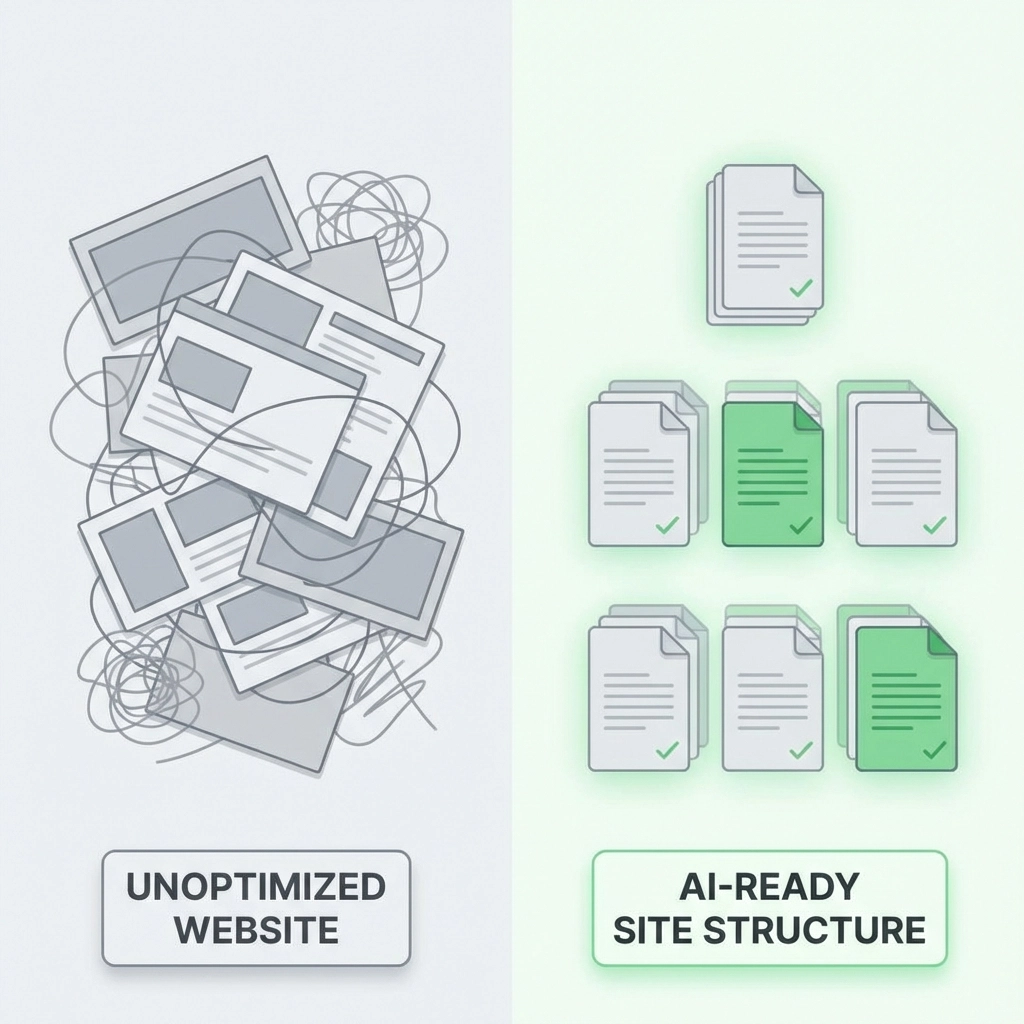
Traditional websites are messy from an AI perspective. Navigation menus, ads, JavaScript elements, and complex HTML all create noise that obscures your actual content. AI models struggle to convert this chaos into clean, usable text.
Here’s what happens when AI systems encounter an unoptimized site:
- Context collapse: Without clear guidance, AI can’t distinguish your cornerstone content from boilerplate pages
- Citation confusion: AI doesn’t know how you prefer to be referenced, leading to inconsistent or missing attribution
- Priority blindness: Your most important service pages get the same treatment as your privacy policy
This is the crawlability gap that LLM.txt closes.
How the LLM.txt Generator Works
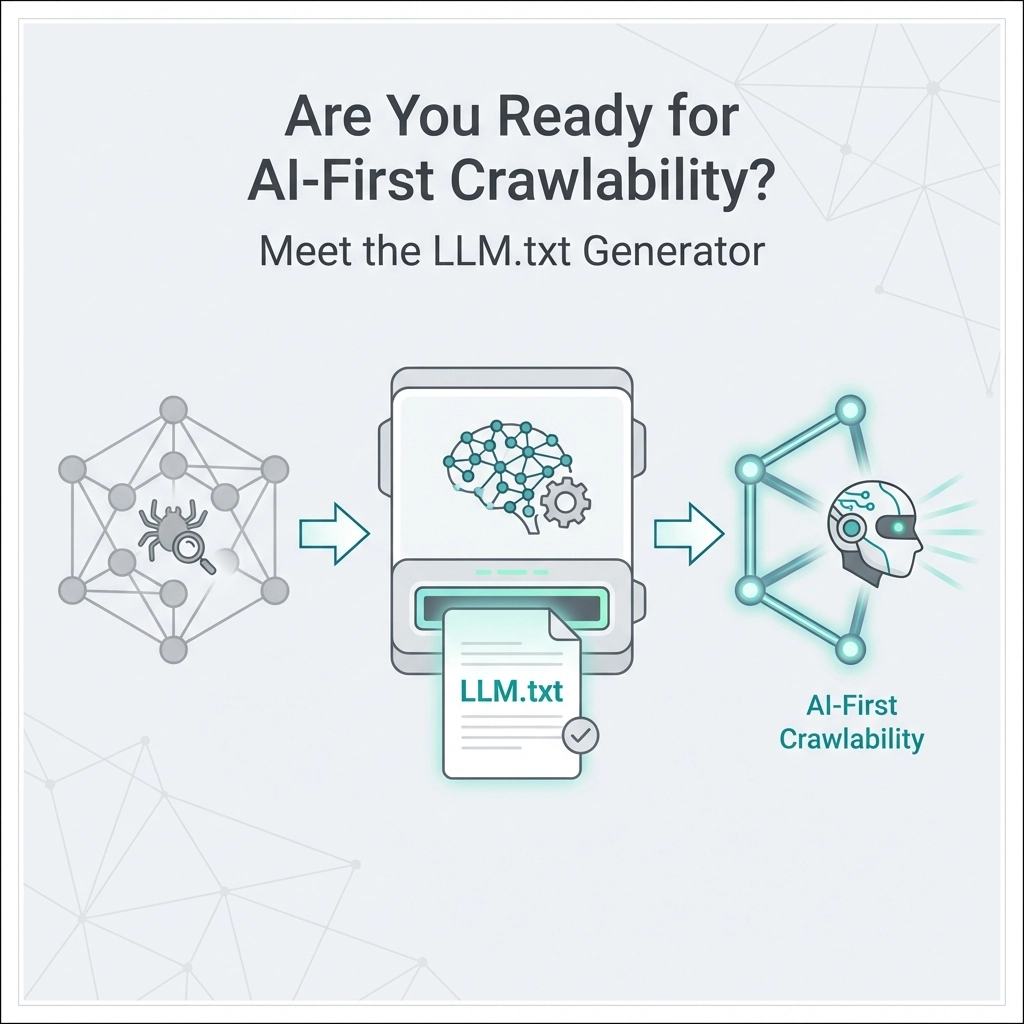
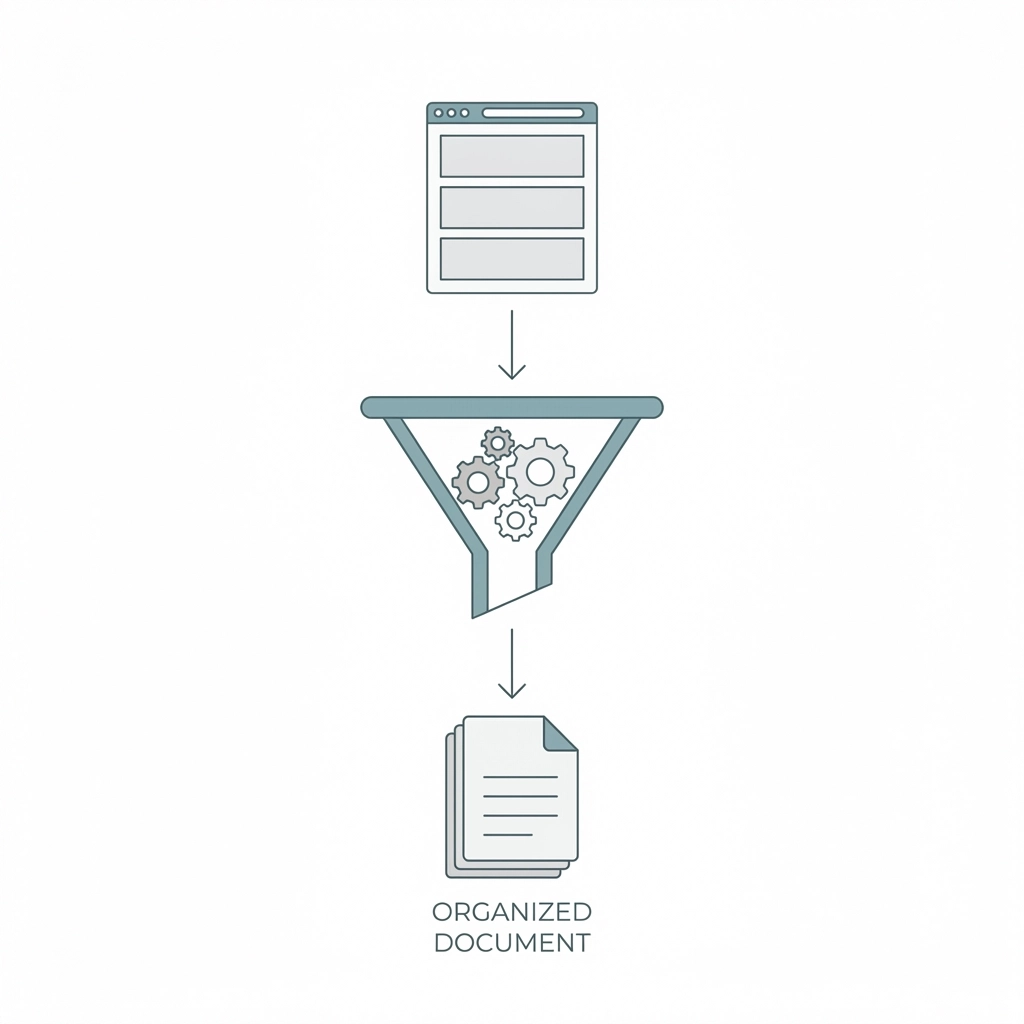
The LLM.txt Generator automates what would otherwise be a tedious, technical process. Instead of manually coding a file that meets the emerging LLM.txt standard, you let the tool do the heavy lifting.
Here’s the operational workflow:
Step 1: URL Analysis
Enter your website URL, and the generator scans your site’s page metadata, internal link structure, and content hierarchy. It identifies which pages matter most based on how your site is organized.
Step 2: Structured File Generation
The tool produces a properly formatted LLM.txt file using industry-standard conventions. This includes fallback patterns that ensure compatibility across different AI crawlers: GPTBot, ClaudeBot, PerplexityBot, and others.
Step 3: Customization Options
You maintain full control. Want to block certain AI crawlers while allowing others? Need to prioritize specific content categories? The generator lets you tailor the file to match your strategic goals.
Step 4: Download and Deploy
Download the completed file and upload it to your website’s root directory: exactly like you would with robots.txt. The entire process takes minutes, not hours.
What a Properly Configured LLM.txt File Contains
A well-built LLM.txt file isn’t just a list of URLs. It’s a structured communication layer that tells AI systems everything they need to engage with your site intelligently.
Essential components include:
- Site purpose and expertise areas: A clear declaration of what your business does and what topics you’re authoritative on
- Priority page hierarchy: Your most important content flagged for AI attention, ensuring service pages and cornerstone articles get referenced first
- Citation preferences: How you want AI systems to attribute your content when they use it in responses
- Sitemap location: A direct pointer to your XML sitemap so AI crawlers can navigate efficiently
- Page-level descriptions: Brief explanations of what users can learn or accomplish on each key page
This structured approach transforms your website from a collection of HTML files into an organized knowledge resource that AI systems can parse accurately.
Step-by-Step: Maximizing AI Crawlability with LLM.txt
Ready to implement? Here’s your action plan:
1. Audit Your Current AI Visibility
Before generating your LLM.txt file, understand where you stand. Use our optimization and analysis tools to assess how AI systems currently perceive your content. Are you being cited? Ignored? Misrepresented?
2. Identify Your Priority Content
Not every page deserves equal AI attention. Focus on:
- Core service pages that drive conversions
- Cornerstone blog content that establishes expertise
- Resource pages that answer common industry questions
- About and trust-building pages that establish credibility
3. Generate Your LLM.txt File
Use the LLM.txt Generator to create your file. Review the output carefully: ensure your priority pages are properly flagged and your citation preferences align with your brand guidelines.
4. Upload to Your Root Directory
Place the file at yourdomain.com/llms.txt. This standard location ensures AI crawlers can find it automatically, just as they find robots.txt.
5. Monitor and Iterate
AI crawl patterns evolve. Check your AI content auditor results regularly to see if your visibility improves. Adjust your LLM.txt configuration as needed based on performance data.
The Competitive Advantage of Early Adoption
Full disclosure: LLM.txt is still an emerging standard. Most of your competitors haven’t implemented it yet. That’s precisely why acting now creates disproportionate advantage.
Benefits of early implementation:
- First-mover visibility: AI systems that support LLM.txt will prioritize sites that provide clear guidance
- Brand protection: Control how your content gets used and attributed before AI systems make those decisions for you
- Future-proofing: As AI search grows, sites with proper LLM.txt configuration will be positioned to capture traffic others miss
- Credibility signals: Demonstrating AI-readiness signals technical sophistication to potential clients and partners
The websites that establish clear AI communication protocols today will dominate AI-generated recommendations tomorrow. That’s not speculation: it’s the logical trajectory of how these systems learn to prioritize content sources.
What Happens If You Wait?
Ignoring AI crawlability doesn’t pause its impact on your business. Every day without LLM.txt means:
- Lost citation opportunities when AI answers questions in your expertise area
- Continued ambiguity about how AI interprets your brand
- Competitors who do implement gaining ground in AI-driven discovery
The shift toward AI-first search is accelerating. Waiting for the standard to “mature” means watching early adopters capture visibility you could have claimed.
Take the Next Step
AI-first crawlability isn’t a future concern: it’s a present reality that demands attention now. The LLM.txt Generator makes implementation straightforward, giving you control over how AI systems access, interpret, and cite your content.
Want to ensure your website is fully optimized for both traditional and AI-driven discovery? Book a consultation with our team to discuss your AI search strategy and get personalized guidance on maximizing your visibility across every platform that matters.
The question isn’t whether AI will change how your content gets discovered. It’s whether you’ll be ready when it does.