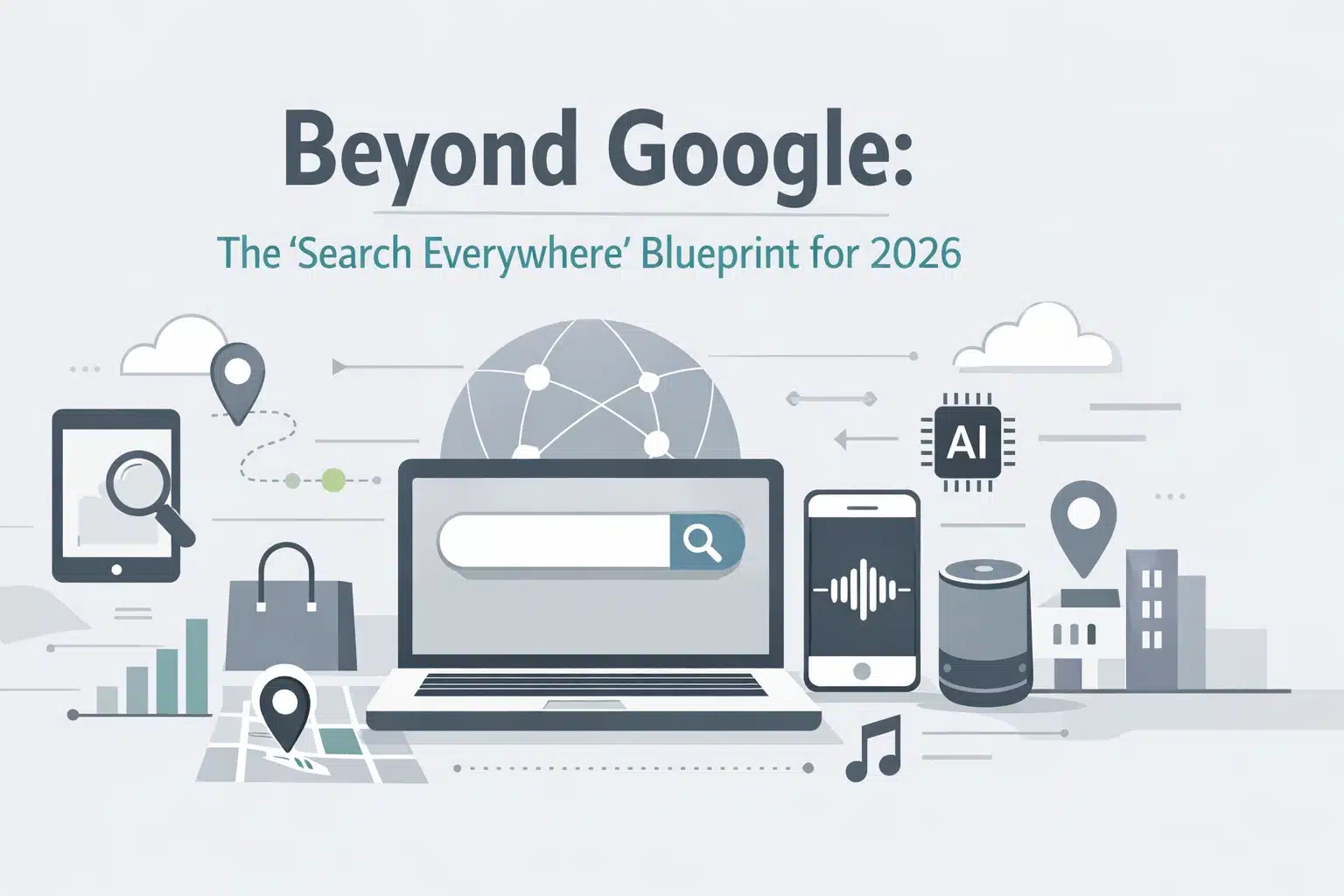
The era of "Google or bust" is officially over. If your digital marketing strategy still treats Google as the beginning and end of the customer journey, you aren’t just behind the curve: you are invisible to a massive segment of your target market.
As we navigate the landscape of 2026, the data is undeniable: search has fragmented. Consumers no longer wait to sit at a desk and type three words into a white search bar. They are searching within TikTok for product reviews, asking Perplexity to plan their travel itineraries, and deep-diving into Reddit threads to find "real" human opinions that haven't been sanitized by corporate PR.
For brands, this shift represents a fundamental, irreversible change in how we define visibility. To win today, you must adopt a "Search Everywhere" mindset. This isn't just about diversification; it’s about survival in an ecosystem where AI agents and community-driven platforms now dictate who gets noticed and who gets ignored.
The Fragmented Search Journey: By the Numbers
To understand why this shift is happening, look at the behavior of the modern consumer. Recent research indicates that the average person now interacts with over seven different platforms during a single research cycle. For high-stakes purchases, that number jumps to 25 or more.
Perhaps most tellingly, the nature of the "query" itself has transformed. In the traditional search era, the average query was a mere four words. Today, with the rise of Large Language Models (LLMs) and voice-activated AI assistants, that average has exploded to 23 words. Users are no longer looking for "best hiking boots"; they are asking, "What are the best waterproof hiking boots for wide feet that won't break the bank and are available for shipping in the next two days?"

This level of specificity requires content that is more than just "optimized" for keywords: it requires content that is extractable, authoritative, and present exactly where the conversation is happening.
The Reddit Revolution: Why Community is the New Authority
If you’ve noticed your Google search results looking a lot more like a forum lately, you aren’t imagining it. Reddit citations in AI-generated answers and traditional search results have jumped a staggering 73% recently.
Google’s algorithm has made a hard pivot toward rewarding "human" perspectives. In an age where AI-generated content can be mass-produced at the click of a button, search engines are desperate for the authenticity that only community discussions provide. This is why Reddit and Quora have become the gold standard for "hidden gem" advice and unbiased reviews.
For your Content Strategy, this means your brand cannot afford to be an outsider. You must establish a presence where these conversations are occurring. This doesn’t mean spamming threads with links; it means fostering topical relevance and authority by participating in the ecosystem. When your brand is cited as a solution by a trusted member of a community, that signal carries more weight than a hundred low-quality backlinks.
The AI Layer: Optimizing for Agentic Search
We have moved beyond simple "Search Generative Experiences" into the realm of agentic search. AI agents are now searching, comparing, and even transacting on behalf of users. When a user asks an AI assistant to "find the best SEO consultant for a mid-sized e-commerce brand," the AI isn't just looking for a meta description. It is scanning the entire public information ecosystem.
To be the brand that the AI recommends, your content must be "extractable." This means:
- Structured Data: Making it easy for machines to understand your offerings.
- Clear Value Propositions: Using direct, declarative language that AI can summarize without losing the nuance.
- Cross-Platform Consistency: Ensuring your brand’s "story" is the same on LinkedIn as it is on your blog.
While the delivery method has changed, it is important to remember that why Google's AI search still rewards the SEO basics is still a vital concept. The foundations of technical health and clear communication remain the bedrock, even as the "search box" disappears.

Social Search: The New Discovery Engine
For Gen Z and Millennials, TikTok and Instagram have effectively replaced the Yellow Pages. Whether it’s finding a local restaurant or researching a new SaaS tool, social search is the primary discovery channel.
Social search is visual, immediate, and heavily reliant on social proof. If your brand doesn't have a video strategy, you are missing out on a primary search surface. YouTube, in particular, remains the second-largest search engine in the world, and its integration into the broader AI search ecosystem makes it a non-negotiable part of the 2026 blueprint.
Your content must be adapted for each platform's "packaging." A deep-dive technical whitepaper on your blog might be the source material, but its "Search Everywhere" version includes a 60-second TikTok summary, a detailed YouTube tutorial, and a summarized LinkedIn carousel.
Link Building in 2026: From Quantity to Topical Authority
The old-school approach to link building: chasing sheer volume: is dead. In a "Search Everywhere" reality, the focus has shifted entirely to topical relevance and authority.
Search engines and AI models are looking for "clusters of trust." If you have links coming from high-authority industry publications, citations in relevant Reddit threads, and mentions from influential YouTube creators, you are building a profile of topical dominance.
This multi-dimensional Link Building strategy signals to both humans and algorithms that you are a leader in your niche. It’s no longer about just getting a "click" to your website; it’s about being the most cited and trusted name across the entire web.
Your 2026 'Search Everywhere' Blueprint
Transitioning from a Google-centric model to a fragmented search strategy requires a systematic approach. Here is what you need to do now:
- Map the Journey: Ask your last ten customers exactly how they found you. You might be surprised to find that while the final click came from Google, the discovery happened on a podcast or a niche subreddit.
- Audit Your Surface Area: Are you present on TikTok, YouTube, Reddit, and Pinterest? If your audience is there, you should be too.
- Optimize for Extraction: Ensure your website content is formatted for AI summary. Use clear headings, bullet points, and schema markup.
- Prioritize Human Proof: Encourage your customers to share their experiences on third-party platforms. Community citations are the new high-value backlinks.
- Coordinate Visibility: Don't treat your platforms as silos. Ensure your SEO team is talking to your social team and your content creators.
The Bottom Line: Be Where the User Is
The fundamental goal of SEO hasn't changed: we want to connect people with answers. What has changed is where people are looking for those answers. If you continue to ignore the 73% growth in community citations or the shift toward 23-word AI queries, you are choosing to limit your growth.
The "Search Everywhere" reality is here. It is no longer optional to have a cross-platform presence; it is essential for survival. By building a strategy that prioritizes topical authority and platform-native content, you ensure that no matter where your customer starts their search, they end up finding you.
At Expert SEO Consulting, we specialize in navigating these complex shifts. We don't just optimize for a search engine; we optimize for the entire digital ecosystem.
Is your brand ready for the post-Google world?
Book a consultation today and let's build your 2026 blueprint together.