Here’s the thing: if you’re still measuring SEO success by watching your traffic graph climb, you’re playing a game that ended two years ago.
I’ve had three calls this month with business owners staring at flat traffic numbers, convinced their SEO investment is failing. Full disclosure: their SEO is actually working. The problem isn’t their strategy; it’s their scorecard.
Google’s AI Overviews now answer 60% of informational queries directly in the search results. Users get what they need without clicking. Your brand gets exposure, authority, and even conversions: but your analytics dashboard shows a flatline.
That disconnect is costing business owners sleep, budget, and confidence in strategies that are genuinely performing. It’s time for a new measurement framework built for how search actually works in 2026.
Why Flat Traffic Is the New Normal (And Why That’s Okay)
Let’s get specific about what changed.
In 2024, Google rolled out AI Overviews to the majority of search queries. By late 2025, users trained themselves to scan those AI-generated answers first. The click became optional: not because your content failed, but because your content succeeded so well that Google borrowed it.
This isn’t a bug in the system. It’s the system working exactly as designed. We covered this shift in depth in our piece on how to optimize content for AI: zero-click impressions are a feature of modern search, not a failure of your SEO.
The real question isn’t “how do I get more clicks?” It’s “how do I measure the value I’m actually creating?”
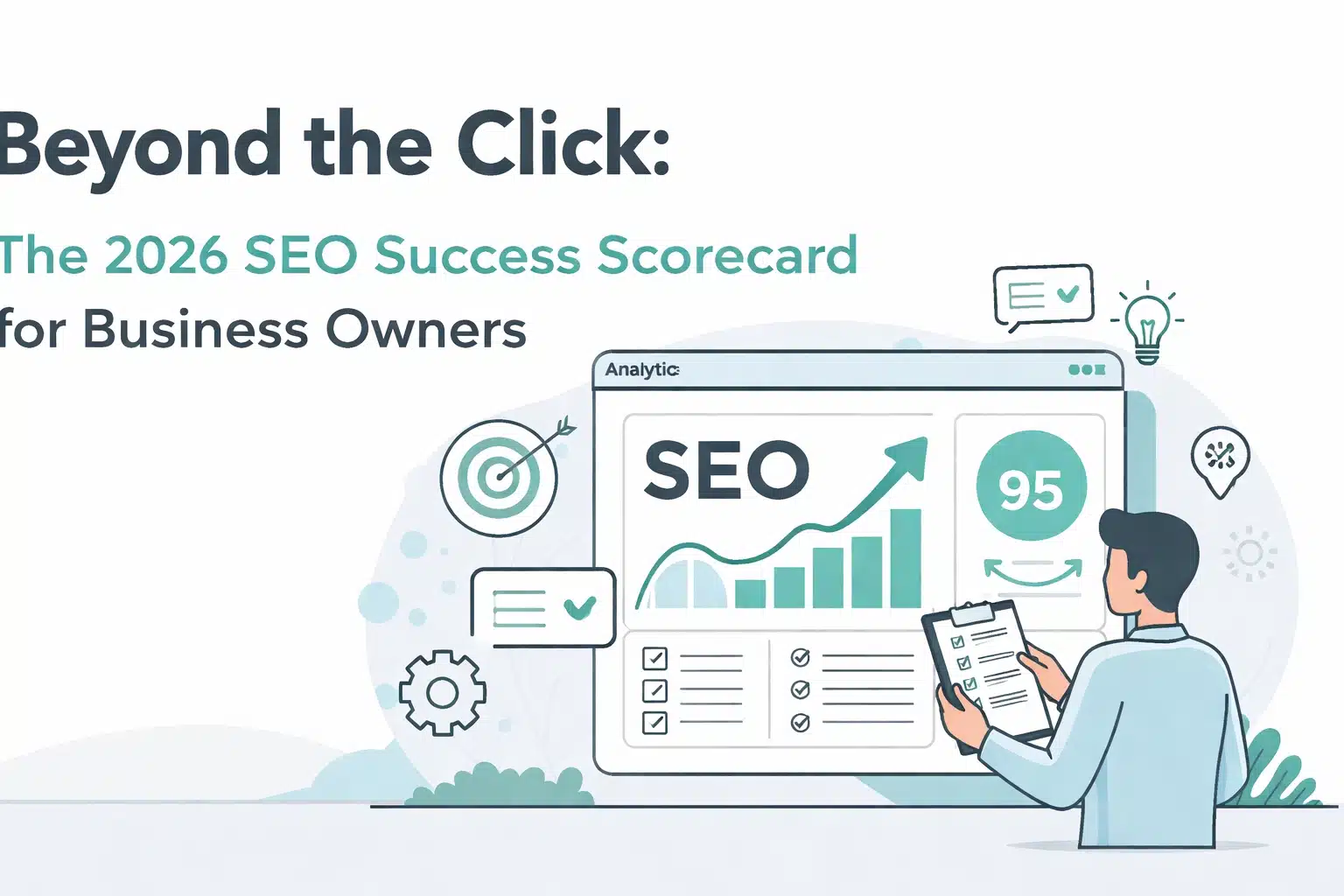
That’s where the 2026 SEO Success Scorecard comes in.

The 2026 SEO Success Scorecard: Four Metrics That Actually Matter
Traditional SEO reporting focused on rankings, traffic, and maybe conversions if you were sophisticated. That framework assumed a linear path: rank → click → convert.
Today’s path looks more like: appear → influence → remember → convert (eventually, through a channel that might not even be trackable as “organic”).
The scorecard below captures that reality. These four metrics replace the old traffic obsession with measurements that connect directly to business outcomes.
Metric 1: Share of Model (AI Visibility)
What it measures: How often your brand appears as a cited source in AI Overviews, ChatGPT responses, Perplexity answers, and other AI-powered search experiences.
Why it matters: If AI is answering questions without sending clicks, the brands that get cited in those answers still win. They build authority, trust, and top-of-mind awareness: even when users never visit their site.
How to track it:
- Manually sample 20-30 priority queries monthly and document which brands appear in AI Overviews
- Use third-party AI visibility tools that monitor LLM citations
- Track whether AI descriptions of your brand align with your positioning (sentiment matters)
For most business owners, this metric is invisible right now. Start tracking it immediately: you’ll be shocked at what you discover. Our AI content auditor can help identify where your content is being cited and where gaps exist.
Metric 2: Brand Demand (Branded Search Volume)
What it measures: How many people search for your company name, product names, or branded terms each month.
Why it matters: When your content appears in AI Overviews and SERP features, users often don’t click. But they remember. Later, they search your brand name directly. Growing branded search volume is one of the clearest signals that your visibility is converting into recognition.
How to track it:
- Google Search Console → Filter by queries containing your brand name
- Track month-over-month and year-over-year trends
- Compare branded search growth against non-branded visibility
Here’s the pattern we see constantly: impressions rise, clicks stay flat, but branded searches increase 15-30%. That’s not failing SEO: that’s SEO building brand equity in a zero-click world.

Metric 3: Conversion Quality (Leads vs. Traffic)
What it measures: The ratio of qualified leads and conversions to total organic traffic, plus the revenue value of those conversions.
Why it matters: 100 visitors who convert at 5% beat 1,000 visitors who convert at 0.3%. When traffic flattens but lead quality improves, your SEO is actually getting more efficient: not less effective.
How to track it:
- GA4 → Conversions by landing page and traffic source
- CRM integration → Tag leads by original organic landing page
- Calculate cost-per-lead and compare against other channels
This is where forensic SEO analysis becomes essential. You need to trace the full journey from first organic touch to closed deal. The businesses doing this discover their “flat traffic” is generating more revenue than last year’s higher traffic ever did.
Metric 4: SERP Real Estate (Feature Ownership)
What it measures: Your presence across Featured Snippets, People Also Ask boxes, Local Pack listings, image carousels, and AI Overview citations for your priority keywords.
Why it matters: A #1 ranking used to mean dominant visibility. Today, a page can rank #1 and still appear below the fold, buried under AI Overviews, ads, and SERP features. Owning multiple features for a single query multiplies your visibility exponentially.
How to track it:
- Rank tracking tools with SERP feature monitoring
- Manual audits of your top 50 keywords monthly
- Document which features you own vs. competitors
Pro tip: People Also Ask boxes are massively undervalued. Appearing in PAA for a query you don’t even rank for extends your reach without requiring new content. A thorough content gap analysis reveals these opportunities.
How to Actually Measure This (The Practical Stack)
Scorecards are worthless without measurement systems. Here’s the minimum viable stack for tracking these four metrics:
CiteMetrics (Freemium)
- Real AI Citation Tracking
- Citation Rate Analytics
- Actionable Optimization Insights
Google Search Console (Free)
- Impressions by query and page (Share of Model proxy)
- Branded vs. non-branded search trends (Brand Demand)
- Click-through rate by query type
GA4 (Free)
- Conversions and assisted conversions by organic landing page
- Engagement metrics: scroll depth, time on page, return visits
- Landing page → conversion path analysis
CRM Integration (HubSpot, Salesforce, etc.)
- Original organic source tracking on lead records
- Revenue attribution to organic landing pages
- Lead quality scoring by entry point
Rank Tracking + SERP Feature Monitoring
- Visibility scores across keyword clusters
- SERP feature ownership tracking
- Competitor share of voice comparison

Your 2026 SEO Success Scorecard Template
Here’s the scorecard format we use with clients. Review monthly, report quarterly:
| Metric | What to Track | Target Direction |
|---|---|---|
| Share of Model | AI Overview citations for top 20 queries | Increasing citations |
| Brand Demand | Branded search volume (GSC) | 10%+ YoY growth |
| Conversion Quality | Organic leads ÷ organic sessions | Improving ratio |
| SERP Real Estate | Features owned for priority keywords | Expanding presence |
The goal isn’t perfection across every metric. It’s progress in the metrics that connect to your business outcomes.
The Bottom Line
If your traffic is flat but your branded searches are rising, your conversion rate is improving, and your brand appears in AI Overviews: your SEO is working.
The businesses panicking over flat traffic while their competitors build AI visibility are making a strategic error that compounds over time. By 2027, the brands that figured out this measurement shift will dominate search visibility. The ones still chasing 2019’s traffic metrics will wonder what happened.
You don’t have to figure this out alone. Our team of SEO consulting experts specializes in building measurement frameworks that capture real business value: not vanity metrics that looked good five years ago.
Ready to build your own 2026 scorecard? Book a consultation and let’s audit what’s actually working in your SEO: and what’s being measured wrong.