
Remember when users typed one query, clicked through a few blue links, then started a brand new search for their next question? Yeah, Bing just threw that playbook in the trash.
Microsoft has rolled out multi-turn search globally, and it's fundamentally changing how users interact with search results. Instead of treating each query as an isolated event, Bing now maintains context across an entire search session, letting users ask follow-up questions without resetting the conversation. For content creators and SEO professionals, this shift means your content strategy needs to evolve beyond capturing single keywords to addressing entire research journeys.
Here's what you need to know, and more importantly, what you need to do about it.
What Multi-Turn Search Actually Means
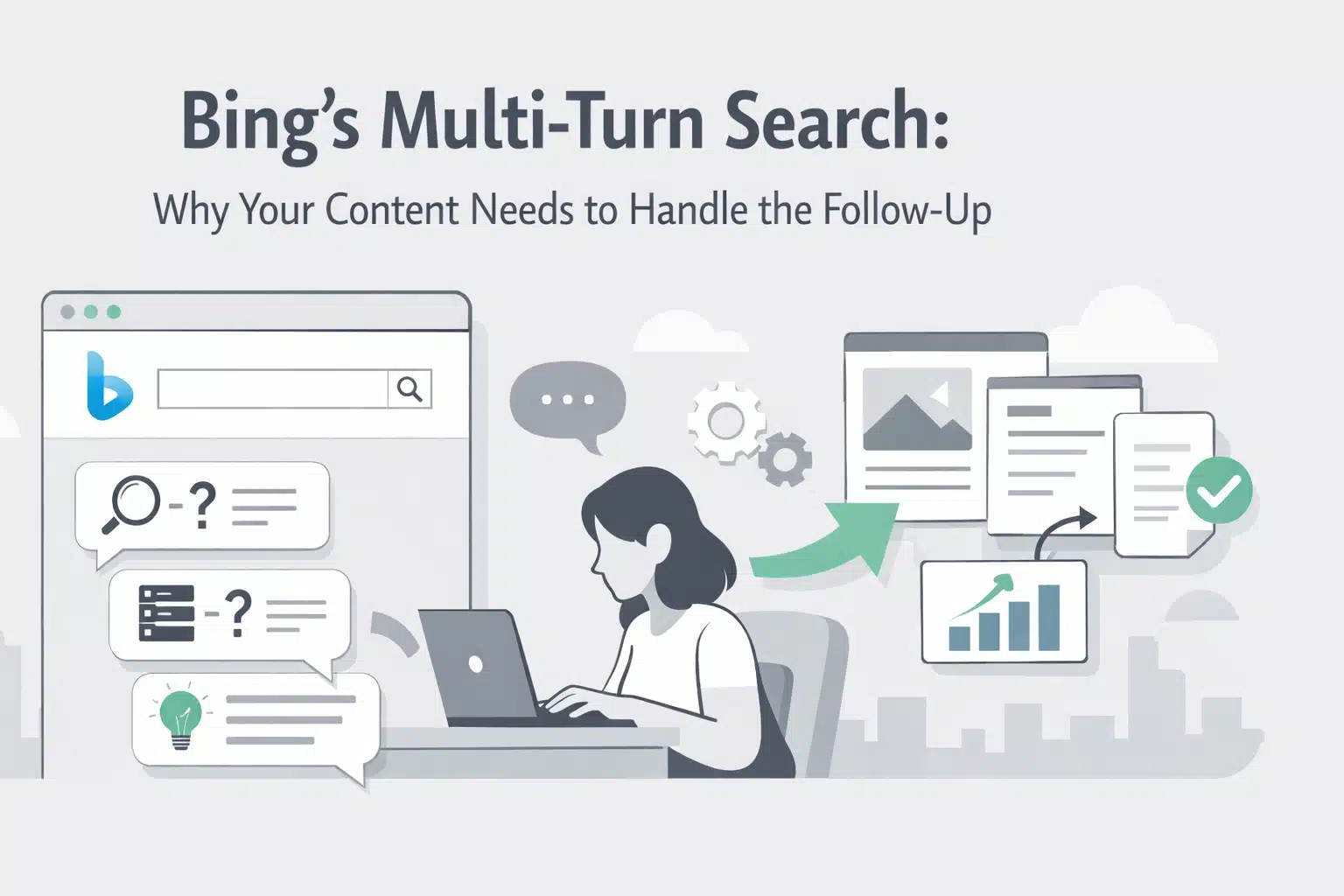
Multi-turn search introduces a persistent Copilot search box that follows users as they scroll through results. Instead of scrolling back to the top to refine their query, users can ask follow-up questions right where they are. The crucial part? Bing maintains the context of the entire conversation.

Let's say someone searches for "best CRM software for small teams." In the traditional model, their next search might be a completely new query: "CRM software under $100 per month." They'd have to re-establish the "small teams" context.
With multi-turn search, they simply ask: "Which ones are under $100 per month?" Bing already knows they're talking about CRM software for small teams. The conversation continues naturally, just like talking to a human expert.
According to Microsoft, this approach has already driven "gains in engagement and sessions per user." Users are staying on the results page longer because the search interface has transformed from a one-time destination into a persistent research workspace.
Why Traditional Keyword Optimization Isn't Enough Anymore
For years, SEO has operated on a fundamental assumption: each search query is independent. We optimized pages for specific keywords, created landing pages for particular phrases, and measured success based on individual query rankings.
Multi-turn search breaks that model.
Conversational refinement now replaces keyword precision. Users are no longer thinking about finding the perfect keyword combination. They're thinking about the natural progression of their research. They ask a broad question, get some information, then naturally ask follow-up questions to drill deeper.
Your content needs to anticipate this behavior. It's no longer enough to rank for "best project management tools." Your content must also address the logical follow-ups:
- "What's the pricing?"
- "Which ones integrate with Slack?"
- "Do any offer free trials?"
- "How do they compare on mobile?"
If your content only answers the initial query, you're leaving the follow-up questions for your competitors to capture.
Complex Research Becomes Multi-Layered Conversations
Here's the thing: people conducting serious research don't just have one question. They have a sequence of questions that build on each other.
In the old model, a user researching marketing automation might execute ten separate searches:
- "marketing automation platforms"
- "HubSpot vs Marketo comparison"
- "email marketing automation features"
- "marketing automation pricing"
- "best marketing automation for B2B"
Each search started fresh. Each required the user to re-establish context.

Multi-turn search collapses this into a sustained dialogue. After the initial "marketing automation platforms" search, the user can simply ask:
- "Compare HubSpot and Marketo"
- "What email features do they have?"
- "Show me pricing"
- "Which is better for B2B?"
Your content strategy must shift from capturing isolated queries to supporting entire research journeys. This means creating comprehensive resources that don't just answer one question well, they answer the ten questions that naturally follow.
How to Optimize Content for Multi-Turn Search
The good news? The fundamentals of great content haven't changed. The better news? You now have a framework for what "comprehensive" actually means.
1. Map Out Question Sequences, Not Just Keywords
Start by thinking about the natural progression of questions in your topic area. What's the first thing someone asks? What are the three most common follow-ups? What objections or concerns arise next?
For each pillar topic on your site, create a question map that shows how users naturally move through their research. This becomes your content architecture blueprint.
2. Structure Content for Scannable Depth
Multi-turn search rewards content that addresses multiple dimensions of a topic. Use clear section headers that signal different aspects of the topic:
- Overview sections for initial queries
- Comparison sections for "which one" follow-ups
- Pricing/cost sections for budget questions
- Implementation sections for "how do I actually do this" questions
Each section should be comprehensive enough to answer that specific follow-up question while contributing to the overall content depth.
3. Write in Natural, Conversational Language
Bing's AI is designed to understand natural language queries. This means your content should sound like it's answering real questions, not keyword-stuffed queries.
Instead of: "CRM software pricing small business affordable options"
Write like: "If you're running a small business and need affordable CRM software, here's what you can expect to pay…"
The latter naturally matches how users ask follow-up questions in multi-turn search.

4. Use FAQ Sections Strategically
FAQ sections aren't just for schema markup anymore (though that's still valuable). They're perfect for addressing the follow-up questions users are likely to ask in a multi-turn search session.
Place FAQ sections strategically throughout your content: not just at the end. After explaining a concept, include 2-3 FAQs that address the natural follow-ups to that specific section.
5. Create Content Clusters, Not Orphan Pages
Multi-turn search sessions often span multiple related topics. Your internal linking structure needs to support these natural progressions.
Build content clusters around core topics, with comprehensive pillar pages and supporting content that addresses specific sub-questions. This architecture helps search engines understand your content depth and supports users moving through multi-turn research sessions.
At Expert SEO Consulting, we help businesses develop content strategies that anticipate user behavior shifts like multi-turn search. Our approach focuses on building content ecosystems that support entire research journeys, not just isolated query captures.
The Measurement Challenge
Full disclosure: measuring success in a multi-turn search world is more complex. Traditional metrics like "keyword rankings" and "clicks per query" don't capture the full picture when users are conducting sustained research sessions across multiple follow-up questions.
You need to start tracking:
- Session depth: How many follow-up queries occur in a single session?
- Topic coverage: Are users finding answers to multiple related questions on your site?
- Return visits: Do users come back to continue research started in previous sessions?
- Content engagement patterns: Which sections get the most attention during multi-turn sessions?
These metrics tell you whether your content is successfully supporting the entire research journey: not just capturing initial search traffic.
What This Means for Your Content Roadmap
If you're planning content for the next quarter, multi-turn search optimization needs to be part of your strategy. This doesn't mean throwing out your existing content: it means evolving how you structure and develop it.
Start by auditing your top-performing content:
✓ Does it only answer one narrow question, or does it address follow-up questions too?
✓ Is the structure scannable enough for users conducting multi-turn research?
✓ Does your internal linking support natural question progressions?
✓ Are you using natural, conversational language that matches how people actually ask questions?
Where you find gaps, you've found opportunities to expand and optimize for multi-turn behavior.

The Conversational Search Revolution Is Here
Multi-turn search isn't just a Bing feature: it's a preview of where all search is heading. As AI-powered interfaces become more sophisticated, the ability to maintain context across multiple queries becomes table stakes.
Your content needs to evolve from answering single questions to supporting entire conversations. That means thinking beyond keywords to question sequences, beyond individual pages to content ecosystems, and beyond click-through rates to engagement across entire research sessions.
The brands that win in this environment won't just have better keyword targeting: they'll have better content that genuinely serves users throughout their entire decision-making journey.
Need help restructuring your content strategy for the multi-turn search era? Book a consultation with our team. We'll analyze your content ecosystem, identify gaps in your question coverage, and build a roadmap for capturing entire research journeys: not just isolated queries.
Because in a world where follow-up questions are just as important as initial searches, your content strategy needs to handle the conversation, not just the introduction.