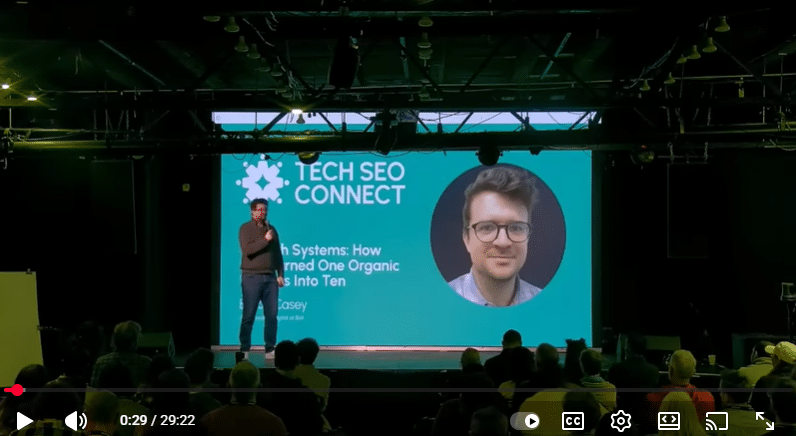
Bryan Casey from IBM opened with a self-deprecating note: “I am one of seven current or former IBMers here today. And unfortunately for all of you, I am the worst technical SEO of all of them.” What followed wasn’t a technical talk—it was a masterclass in building and selling an enterprise-scale owned media program.
Over six years, IBM built what they call the “Inbound Empire”—a system combining SEO, YouTube (1.5 million subscribers), newsletters (growing by tens of thousands monthly), and podcasts. The thesis: in an AI-disrupted world, a diversified owned media system is more durable than any single channel.
The Advertiser Mentality Problem
Casey identified the biggest structural barrier to owned and organic investment: the advertiser mentality. Marketing teams build brand campaigns, then treat channels as vehicles to execute those campaigns. That works for paid media. It doesn’t work for owned channels.
“The thing you have to be successful in owned and organic channels is you have to start with what is this channel and how do you be natively successful in this channel,” he said. “Every channel has rules you have to follow. You have to build each one from the ground up.” Campaign thinking doesn’t translate.
The Trade: 10x Efficiency Against Paid Media KPIs
IBM’s strategy was simple: crush the advertising KPIs. “We took all the advertising KPIs and said we’re going to crush them. We tried to present as clean a trade as possible for what was large budgets on the paid media side. We looked at that as the war chest we were going to raid.”
The commitment: deliver the same outcomes paid media would commit to—at every level of the funnel—but 10x more efficiently. Year after year, that’s been the case they’ve made. The result is now tens of millions of annual visitors to IBM.com content, a newsletter growing by tens of thousands of subscribers monthly, and a YouTube channel with 1.5 million subscribers.
The Disney Chart: Growth Systems Thinking
Casey shared his primary inspiration: Walt Disney’s famous synergy chart showing how all Disney properties reinforce each other. “This is more than omni-channel,” he explained. “Omni-channel just says you’re going to execute on all channels. This says the whole thing is a mutually reinforcing system.”
Every node in Disney’s system has complements. Every part accelerates its complements and is accelerated by them. Every addition expands total addressable market (TAM). Everything compounds.
He paired this with the “Playing to Win” strategy cascade: winning aspiration → where to play → how to win → capabilities → management systems. Most companies nail the aspiration but have no idea how to build the middle. Disney institutionalized how to do the middle well.
Starting from the Doghouse
IBM didn’t start by pitching a sophisticated growth engine. “The story was not like we’re going to build something like Disney. It was: we’re the worst. How do we become not the worst?”
Casey showed executives an Ahrefs traffic value chart with every IBM competitor, then IBM. “I showed how many hundreds of millions of dollars we’re leaving on the table because we’re not more competent.” That got attention.
They started with basics: topic clusters, pillar pages. And critically, they did it on web and YouTube simultaneously—those “lightboard” explainer videos many have seen. Two peer programs running together from day one.
No Shared Resources, No Ad Hoc BS
Early attempts to integrate SEO work into existing marketing teams failed completely. “We did that for three to six months and did not ship a single thing.”
This became a religious belief: “We only do fully contained programs. I’m not going to rely on ad hoc goodwill of anyone ever to get things done. If we say we’re going to do a thing, we will fund it end to end.”
The failure rate for asking existing teams to absorb new work? “100%. Not 50 or 40—100%.” So they stopped doing it. Either headcount reports to Casey’s team, or he negotiates dedicated allocation (one person, 10% of backlog, 50% of someone’s time). “I want to win that argument up front, then not have to win a bunch of other arguments.”
One more rule: “Content strategists? We don’t have them. You either write on this team or you’re not on the team.”
Evolution: From Explainers to News Organization
After two to three years of scaling explainer content, they looked at their team and realized they’d built a media organization. “All we had them doing was explainer content. We think we’re capable of more.”
The problem with top-of-funnel SEO content in B2B: it’s transactional traffic. Great for acquisition, but not sticky. They needed subscription products that build audience over time.
So they became a news organization. They launched an industry newsletter (now twice weekly), then podcasts covering weekly AI and cybersecurity news. The podcast motion required corporate culture change: “We’re going to decide what we’re talking about on Wednesday. Record Thursday. Out the door at 6 AM Friday. On 1,000 pages by 11 AM. No reviews.”
Legal and comms had concerns. The compromise: a disclaimer, and speed-dial access to government/policy comms for genuinely sensitive topics (“you have one hour to review this—go, no-go”).
The System in Action
Here’s how the pieces reinforce each other:
The newsletter’s entire audience is built from the website/SEO program. Podcasts get distributed across the relevant topic set on the website. Evergreen articles that might feel dated now have podcast episodes from two days ago embedded in them—strong relevance signals. The news team writes articles while sitting in on podcast recordings, which feed the newsletter and website.
“Our investments in search are now 40% more valuable because of investments in the newsletter,” Casey said. “I would not have properly understood that before getting into some of this.”
Developer Content and Hubs
IBM serves developers and engineers—technical audiences that editorial content doesn’t reach. They hired AI engineers, data scientists, PhDs in ML to create tutorials and practical use cases.
Problem: tutorial content got almost no distribution. The economics were bad—more expensive to create (PhDs writing code), less reach. “We don’t love this.”
The solution: hubs. Instead of unstructured blog posts, they organized everything into comprehensive topic hubs. An “agents hub” with 70 pages covering every dimension of the topic. Tutorials packaged alongside explainer content.
Results: tutorial distribution tripled or quadrupled. Returning user traffic to hub content spiked 50%. “They weren’t just articles anymore. They were durable references.” The hub structure also serves query fanout and AI visibility—comprehensive topic coverage in one navigable place.
Selling the Program Internally
Casey shared tactics for internal advocacy at a massive company:
Brand as “Inbound” not “SEO”: The team wanted flexibility to add podcasts, newsletters, video without people asking “why is the SEO team doing that?” Inbound creates a bigger tent.
Raid the media budget: Every fall plan, Casey shows fully burdened expense of organic programs versus working media dollars (no creative, retainers, or FTEs counted). “I don’t want anyone to take a big bet. I just want rational financial decisions.”
Educate on compounding: Visualize what happens when a URL compounds. When many URLs compound. Frame it like SaaS economics: “Paid media performs like a transactional business. This performs like a SaaS business.”
Blogs travel better than emails: In a company IBM’s size, a URL travels via Slack better than any other format. Internal blog posts on strategy get nearly 5,000 views and reduce noise from repeated questions.
Killer lines: When pitching the famous project to delete 80% of IBM.com, the framing was: “Navigation and structure on the website is the number one client experience problem in the company.” That creates terms for the rest of the conversation.
External recognition: Executives who aren’t SEO experts wonder if you’re BSing them. External recognition (end-of-year reports, industry rankings) provides credibility.
Celebrate link wins with the team: Writers need to know when their work gets cited on Wikipedia or in government documents. It builds pride and engagement.
My Takeaways
Casey’s talk was the most strategic of the conference—not tactics for ranking, but how to build and fund a program that compounds over years. The Disney chart framing (every node accelerates its complements) is a powerful mental model.
What I’m taking away:
1. Position against paid media budgets. That’s the war chest. Show 10x efficiency on the same KPIs they’re already committed to.
2. No shared resources, no ad hoc. 100% failure rate when relying on existing teams to absorb work. Fund end-to-end or don’t start.
3. Build systems, not channels. Every addition should expand TAM, accelerate complements, and create new capabilities. Channels alone have channel risk.
4. Hubs beat blog posts. Organized topic clusters became “durable references” with 50% higher returning traffic. Better for users, better for AI visibility.
5. Subscription products beat transactional content. B2B deal cycles are long. You need products that build audience over time, not one-time traffic.
6. Speed requires trust. Getting a news podcast live by Friday means no review cycles. That requires earned trust with legal and comms.
The underlying philosophy: build something more durable than any single channel. In a world where AI disrupts search, video, or any individual platform, a reinforcing system survives. As Casey put it: “We’re trying to build a dynamic and robust system that is more durable to disruption in any one given channel than just having insane channel risk parked in one place.”