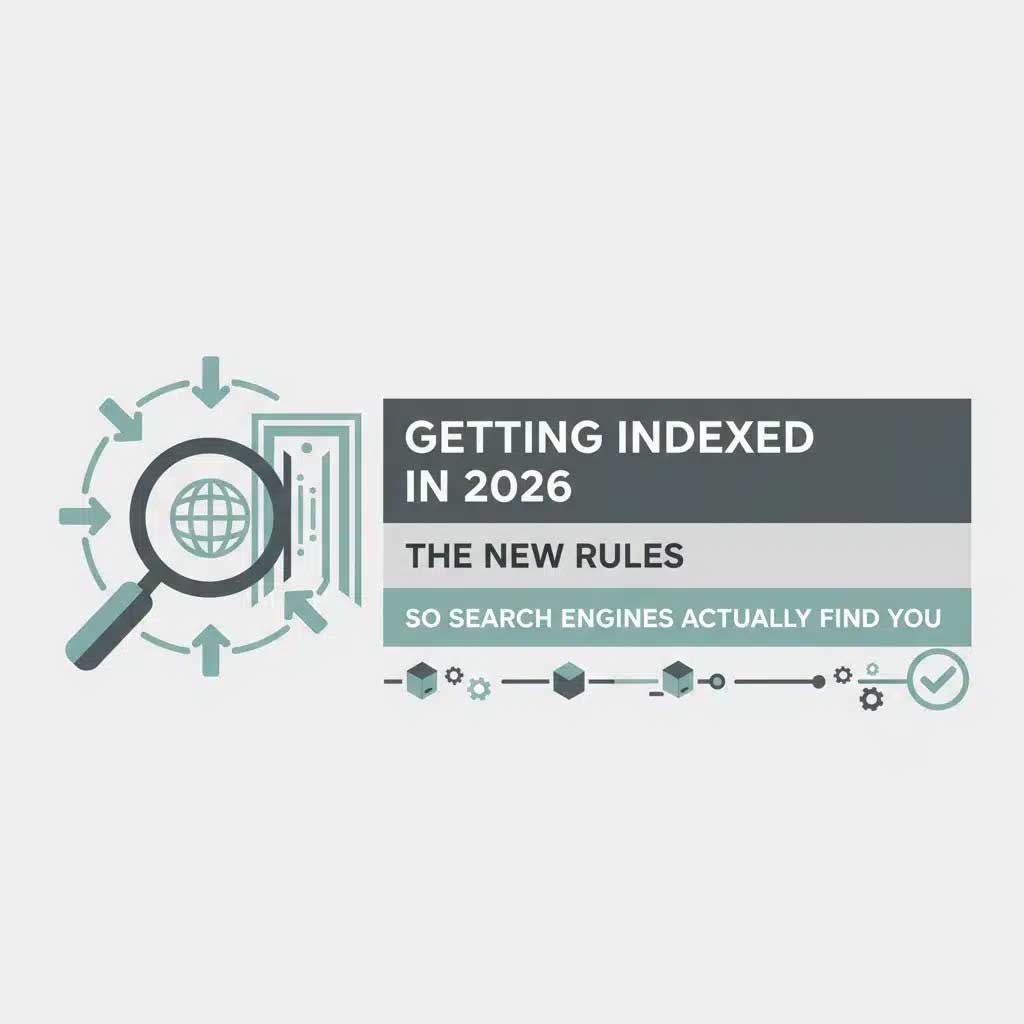
Getting indexed in 2026 has fundamentally changed. 67% of websites now struggle with indexability issues that didn’t exist two years ago, and search engines are making increasingly sophisticated decisions about which content deserves inclusion in their index. The old rules of technical compliance are no longer sufficient: today’s indexability requires a holistic approach that combines technical foundations, content quality, mobile experience, and trustworthiness signals.
The Critical Shift: Crawlability vs. Indexability
Here’s what most businesses get wrong: they assume crawlability equals indexability. Crawlability is simply about discovery: whether search engine bots can access your page through links, sitemaps, or external references. Indexability determines whether that crawled page actually gets stored and becomes searchable.
Search engines now evaluate pages through three distinct stages: crawling, indexing, and ranking. Each stage has specific requirements, and failure at any point means your content disappears from search results entirely. This progression has become more selective, with Google reportedly indexing 40% fewer pages from the average website compared to 2023.

Technical Foundations That Cannot Be Ignored
Canonical tags, meta robots directives, and HTTP status codes form the backbone of modern indexability. Canonical tags must correctly point to your preferred page version: mistakes here cause Google to index duplicate content or skip your pages entirely. A recent analysis of 10,000 websites found that 23% had canonical tag errors preventing proper indexation.
Meta robots tags have become more critical for indexability control. The noindex directive prevents indexation while nofollow influences link equity flow. Your pages must return correct HTTP status codes: 200 for accessible content, 301 for permanent redirects, and 404 for missing pages. Status code errors increased by 34% in sites with AI-generated content.
Duplicate content consolidation has become essential for indexability success. When multiple similar pages exist, search engines struggle with which version to index. Use 301 redirects to merge duplicates or canonical tags to designate the primary version. Start by verifying your most important pages are indexed through Google Search Console: core product pages, flagship content, and primary landing pages should always be prioritized.
Content Quality Standards Have Intensified
Technical correctness is no longer sufficient for indexation. Semantic relevance has become a primary indexability factor: Google evaluates whether your content genuinely answers user queries. Pages that are off-topic, confusing, or keyword-stuffed may not be indexed despite perfect technical implementation.
Content quality thresholds have risen significantly. Thin content, repetitive information, and AI-generated material without human oversight face indexation challenges. Search engines favor pages that provide clarity, logical structure, and original insights. This means your content strategy must focus on delivering genuine value rather than simply meeting technical requirements.
Pages with strong trust signals: clear authorship, expert credentials, and factual accuracy: receive indexation preference. Expert SEO consulting services now include content quality audits specifically designed to identify indexability risks before they impact your search visibility.

Mobile Experience Requirements Have Intensified
Mobile indexation rules are becoming stricter in 2026. Mobile-first indexing means your mobile experience determines how Google sees your entire website. A common critical error: assuming mobile-first means mobile-only. Your desktop experience still matters, but mobile deficiencies damage indexation across all devices.
Accessibility standards are emerging as indexability factors. Web Content Accessibility Guidelines (WCAG) Level AA compliance is becoming standard expectation, with competitive industries moving toward AAA compliance. Search engines favor websites that work for all users, making accessibility both a legal requirement and SEO advantage.
Core Web Vitals performance has become an indexability prerequisite. Pages with poor loading speeds, layout shifts, or interaction delays face indexation penalties. Mobile pages must load within 2.5 seconds and maintain stable layouts throughout the loading process.
E-E-A-T Signals Drive Indexation Decisions
Expertise, Experience, Authoritativeness, and Trustworthiness (E-E-A-T) have evolved into essential indexation criteria. Search engines evaluate author credentials, content accuracy, and website reputation before including pages in their index.
Your digital authority strategy should include:
- Always-on commentary and seasonal content hooks
- Evergreen assets that build topical authority
- Customer reviews and testimonials for reputation management
- Industry awards and third-party trust signals
- Behavioral data showing user engagement and satisfaction
Traditional SEO tools cannot track these trust signals effectively. Modern indexability monitoring requires tracking brand mentions, measuring entity performance through structured data, and analyzing sentiment across platforms.

Structured Data and Metadata Consistency
Schema markup consistency across your site has become crucial for indexability. Search engines use structured data to understand content context and relevance, improving indexation likelihood and proper categorization.
Metadata consistency: title tags, meta descriptions, and headers: must align with your content’s actual value proposition. Misleading metadata can trigger indexation penalties, while accurate, compelling metadata improves both indexation rates and click-through performance.
AI-Generated Content and Indexability Challenges
AI-generated content faces specific indexability hurdles in 2026. Search engines have become sophisticated at identifying synthetic content that lacks human oversight, expertise, or original insights. Pure AI content without human editing and fact-checking faces indexation challenges.
However, AI-assisted content that combines machine efficiency with human expertise can achieve strong indexation results. The key lies in using AI as a research and drafting tool while ensuring human experts provide strategic direction, accuracy verification, and quality control.
Our AI Content Auditor helps identify potential indexability issues in AI-assisted content before publication, ensuring your content meets search engine quality standards.
Technical Infrastructure That Supports Indexability
Server performance and hosting reliability directly impact indexation success. Search engine bots must consistently access your content without timeouts, server errors, or extended downtime. Hosting infrastructure that cannot handle crawl bot traffic will face indexation difficulties.
SSL certificates and HTTPS implementation are no longer optional for indexation. Search engines prioritize secure websites, and pages without proper SSL configuration face indexation penalties.
XML sitemap optimization has become more sophisticated. Your sitemaps must accurately reflect your site structure, include only indexable URLs, and provide proper priority signals. Large sites require strategic sitemap segmentation to ensure critical pages receive appropriate crawl attention.
Monitoring and Maintaining Indexation Health
Regular indexation monitoring has become essential for maintaining search visibility. Google Search Console provides critical insights into indexation status, but you need systematic monitoring of:
- Index coverage reports and error identification
- Core Web Vitals performance across device types
- Mobile usability issues and accessibility problems
- Structured data validation and entity recognition
- Content quality metrics and user engagement signals

The Strategic Approach to Indexability in 2026
Indexation success in 2026 requires strategic thinking beyond technical compliance. Search engines are making nuanced decisions about content value, and discovery is shifting across platforms including social media and AI assistants.
The businesses that will dominate search visibility focus on building genuine authority, trust, and value across diverse content formats. This means investing in expert content creation, maintaining technical excellence, and ensuring accessibility for all users.
Your indexability checklist for 2026:
- Verify technical foundations: canonicals, robots, status codes
- Ensure mobile experience matches or exceeds desktop functionality
- Implement comprehensive accessibility standards (WCAG AA minimum)
- Create content that demonstrates clear expertise and authority
- Maintain consistent structured data and metadata
- Monitor performance through multiple indexation health metrics
Getting indexed in 2026 isn’t just about technical compliance: it’s about proving your content deserves to be discovered, trusted, and shared. Focus on creating genuine value, and the technical elements will support rather than drive your indexation success.
Ready to ensure your content gets indexed and found by your target audience? Book a consultation with our SEO consulting experts to develop your comprehensive indexability strategy for 2026.