Google's December 2025 core update has fundamentally changed the search landscape, delivering a decisive blow to thin content across the web. Starting December 4th and completing its rollout over approximately 12 days, this algorithm update has sent shockwaves through the SEO community: particularly for e-commerce sites that relied on minimal-value pages to capture search traffic.
If your rankings took a nosedive in early December, thin content might be the culprit. Here's what happened, why it matters, and what you need to do about it.
What Counts as Thin Content in Google's Eyes?
Thin content isn't just about word count: it's about value deficiency. Google's December update specifically targeted pages that fail to provide meaningful assistance to users, regardless of their technical optimization or keyword targeting.
E-commerce category pages bore the brunt of this update. Pages consisting primarily of product grids with brief 50-word introductory paragraphs experienced substantial ranking declines. Google now demands that category pages answer fundamental shopping questions: why customers should purchase from that category, how to choose between competing options, and what differentiates products from one another.
AI-generated content without expertise also took significant hits. While Google didn't explicitly target AI content, sites that scaled production using AI without adding genuine human knowledge saw dramatic ranking losses. The distinction matters: using AI as a production tool while maintaining human expertise preserved rankings, but bulk AI content published without editorial oversight resulted in severe penalties.

Other forms of thin content that suffered include:
- Product pages with only basic specifications and no contextual information
- Blog posts that rehash common knowledge without unique insights
- Service pages with generic descriptions and no specific value propositions
- Location pages with boilerplate content and minimal local relevance
How This Update Changed the Game
The December 2025 core update represents a fundamental shift in Google's content evaluation criteria. Unlike previous updates that focused on technical factors or broad quality signals, this update applied laser-focused pressure on content utility and demonstrated expertise.
E-E-A-T signals became non-negotiable. Traditional author bios listing credentials and experience no longer provide meaningful protection. Google now prioritizes demonstrated expertise within the content itself, looking for specific, verifiable markers of hands-on knowledge. Content that gained traction included specific process descriptions with numerical data, acknowledged limitations in implementations, and time-stamped references to personal testing.
Content depth trumped length. Contrary to the ongoing SEO emphasis on word count, articles of 800 words outranked 2,500-word pieces when the shorter content provided more specific, actionable information. Google measures genuine depth through unique information, specific data points, and practical details demonstrating real understanding: while actively penalizing fluff and surface-level coverage.
Review quality became critical. The update distinguished between authentic and manipulated reviews with unprecedented precision. Sites displaying obvious fake reviews or suspicious patterns experienced ranking losses, while those maintaining detailed, recent, verified-purchase reviews held steady or improved.
Real-World SEO Implications for Site Owners
The December update's impact extends far beyond immediate ranking fluctuations. It signals a permanent elevation in Google's content quality standards that will influence search performance for years to come.
Technical factors now carry elevated importance in expertise evaluation. Sites without HTTPS experienced steeper declines than in previous updates, particularly in YMYL (Your Money Your Life) categories. Clear, verifiable contact information: real addresses, phone numbers, and email: outperformed contact-form-only approaches, especially for e-commerce and service businesses.
External linking patterns shifted dramatically. Sites linking naturally to authoritative sources within content performed better than those avoiding external links or exclusively self-linking. This signals Google views appropriate outbound linking as a trust indicator, demonstrating confidence in external resources when contextually relevant.
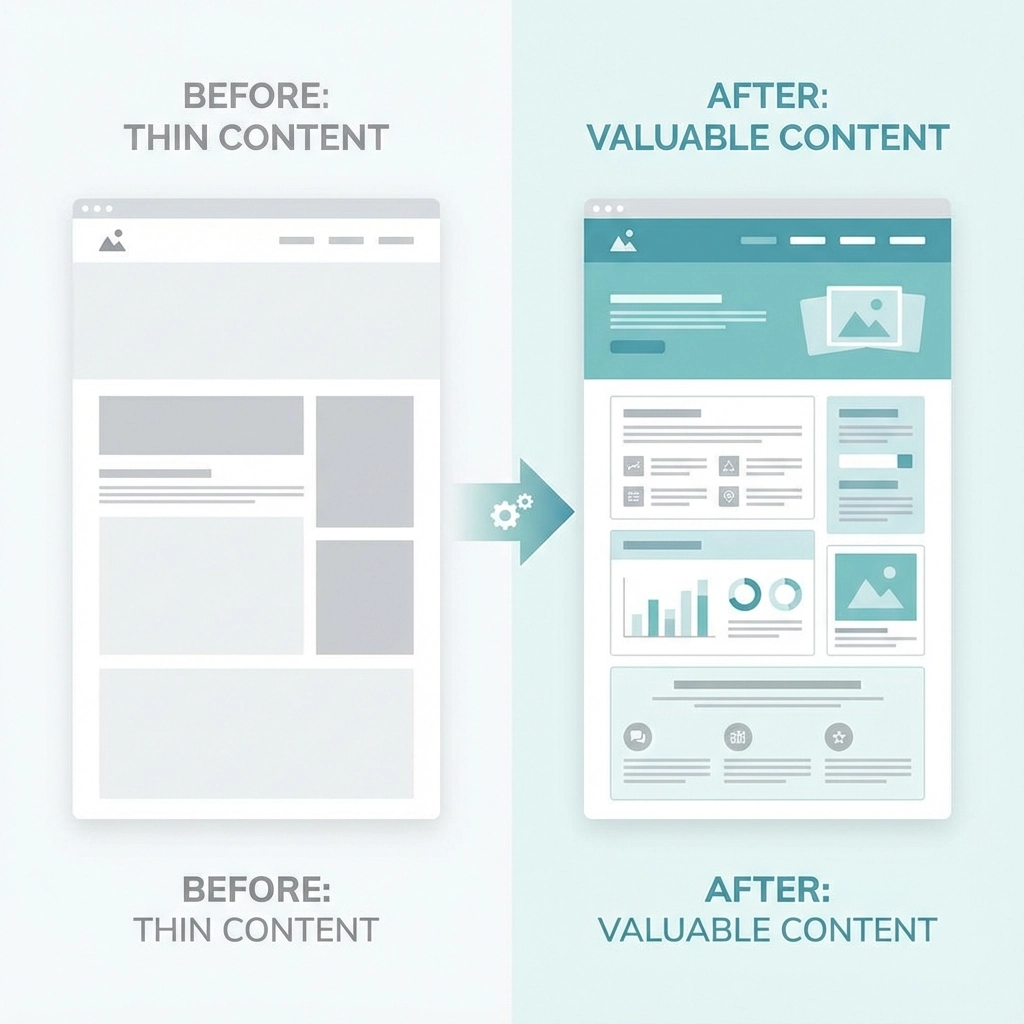
Category page architecture requires complete reimagining. Successful sites restructured their category pages to include filtering guides, comparison frameworks, genuine product photography, and detailed explanatory content that actually aided the shopping experience. This represents a fundamental shift from thin, structure-focused content toward substantive, user-centric information architecture.
Practical Steps for Recovery and Prevention
If you suspect thin content impacted your rankings, immediate action is essential. Recovery follows a predictable timeline, but only when approached systematically.
Quick Wins (1-3 Weeks)
Start with your highest-traffic pages that experienced ranking declines. Audit these pages for obvious thin content signals:
- Word count under 300 words with no substantial value
- Missing or generic product descriptions
- Absent or boilerplate author information
- No clear value proposition or user benefit
Implement technical fixes immediately. Ensure HTTPS is properly configured, add comprehensive contact information, and implement appropriate schema markup. These foundational elements now carry more weight in Google's evaluation process.
Medium-Term Recovery (4-8 Weeks)
Focus on comprehensive content overhauls for your top 20 performing pages. This isn't about adding more words: it's about adding genuine value. For e-commerce sites, transform category pages into buying guides that help customers make informed decisions. Include comparison charts, filtering recommendations, and detailed product differentiation.
Develop authentic review acquisition strategies. Focus on encouraging satisfied customers to leave detailed, specific reviews rather than pursuing volume. Google's algorithm now effectively identifies and devalues review manipulation tactics.
Long-Term Authority Building (3-6 Months)
Establish genuine expertise signals throughout your content. This means demonstrating first-hand experience through specific examples, acknowledging limitations in your recommendations, and providing unique insights unavailable elsewhere.
Build topical authority systematically. Rather than creating isolated pages targeting individual keywords, develop comprehensive content clusters that thoroughly cover related topics. This approach aligns with Google's emphasis on demonstrable expertise over keyword optimization.
The Path Forward
The December 2025 core update isn't just another algorithm change: it's a fundamental recalibration of what Google considers valuable content. Sites that treated content creation as a volume game focused on keyword targeting must now prioritize genuine user value and demonstrated expertise.
Recovery is possible, but it requires abandoning quick-fix mentalities in favor of sustainable quality improvements. The sites recovering fastest prioritize actual content enhancement and user experience over gaming tactics. Starting with your most important pages and systematically improving their genuine utility produces more durable results than attempting dramatic overnight recovery.
For businesses serious about long-term search success, this update represents an opportunity. While competitors scramble to recover from thin content penalties, sites that embrace Google's quality standards will capture increased market share and establish stronger competitive positions.
The message is clear: thin content is no longer viable in Google's ecosystem. The question isn't whether you'll need to improve your content quality: it's whether you'll do it proactively or reactively. Those who act decisively now will emerge stronger, while those who delay will find themselves increasingly irrelevant in search results.
If you're struggling to identify thin content issues or develop a comprehensive recovery strategy, Expert SEO Consulting specializes in helping businesses navigate algorithm updates and build sustainable search performance. Our team can audit your content, identify improvement opportunities, and develop implementation strategies that align with Google's evolving quality standards.
Don't let thin content tank your search visibility. The December 2025 core update has raised the bar permanently( make sure your content clears it.)