You’ve spent the last decade mastering the art of "the click." You optimized your meta titles, you fussed over your H1s, and you fought for that coveted #1 spot on the SERP. But here is the reality: the game has fundamentally changed. In 2026, we aren't just optimizing for clicks anymore; we are optimizing for recommendations.
When a user asks SearchGPT, "What’s the best enterprise CRM for a mid-sized law firm?" the AI doesn't give them a list of ten blue links to sort through. It gives them an answer. It picks a winner.
If your brand isn’t the one being mentioned in that chat bubble, you’re invisible. Period.
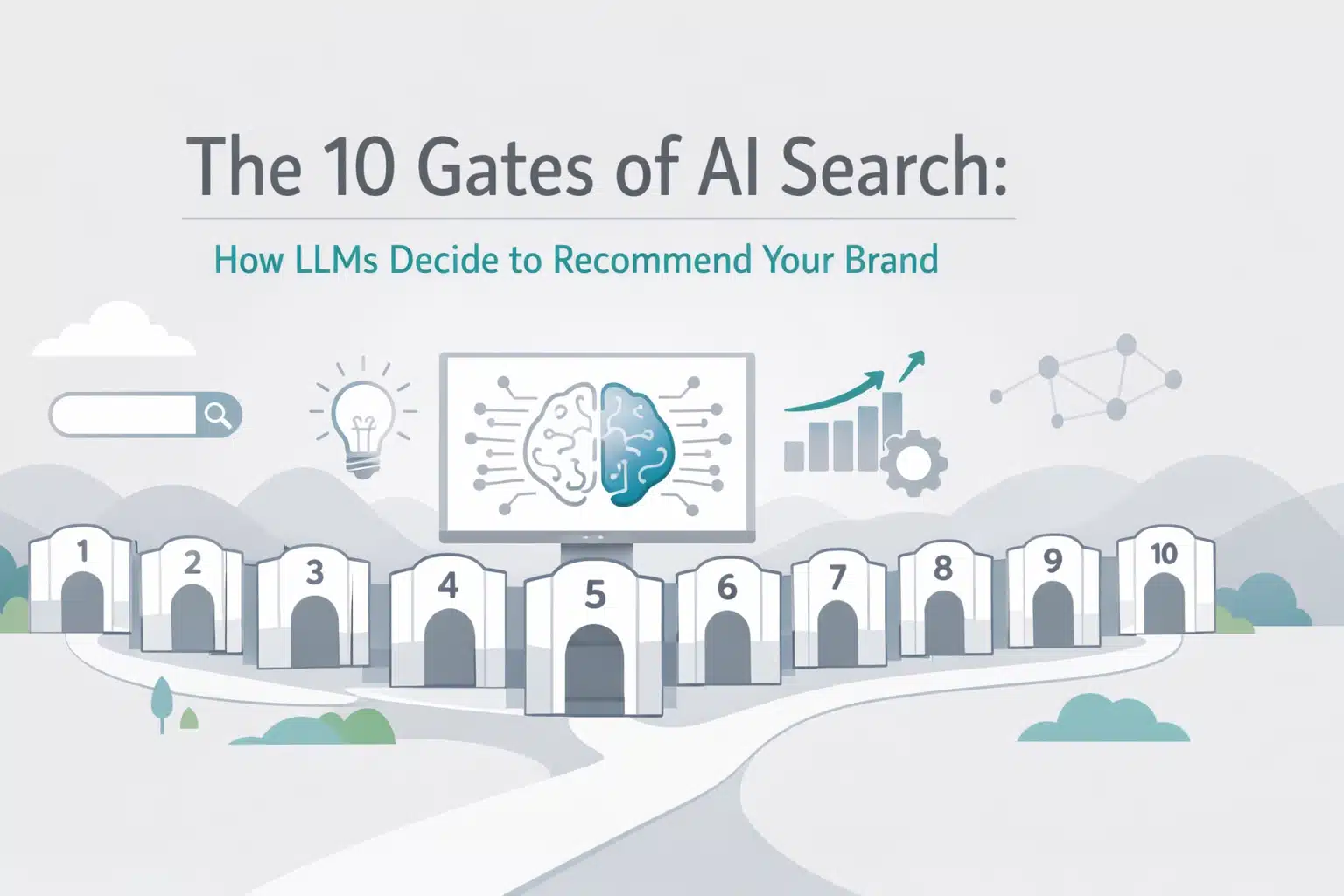
Most business owners think AI search is a "black box," a mysterious process where an LLM (Large Language Model) just magically knows things. It’s not. It’s a highly structured pipeline: a series of 10 sequential decision gates. Your content either clears the gate or it gets discarded.
Let’s walk through the "10 Gates of AI Search" and look at exactly what you need to do to clear them.
Phase I: The Discovery Gates (The Bot’s First Impression)
Before an AI can recommend you, it has to find you. This sounds like traditional SEO 101, but the "intent" behind AI crawling is much more aggressive.
1. Discovered
The journey begins when an AI bot (like GPTBot or Google-Other) identifies that your URL exists. This is the bare minimum. If your site isn't being discovered, you're out before you even start.
2. Selected
This is where the first "cull" happens. AI engines don't have infinite resources. They prioritize what to fetch based on Entity Authority, freshness, and perceived value. If your site looks like a content farm or lacks clear authority markers, the bot will simply decide your content isn't worth the energy to fetch.
3. Crawled
The bot actually retrieves your content. If your server is slow or your robots.txt is blocking the wrong things, you fail here.
4. Rendered
AI bots don't just "read" text; they render the page to see what the user sees. If your content is buried behind complex JavaScript or non-standard layouts, the AI might see a blank page.
How to clear these gates: You need a technical foundation that makes it effortless for bots to see your value. This is why we prioritize AI SEO Audits: it’s the only way to ensure your technical debt isn't acting as a "closed gate" to the very bots that could be driving your revenue.

Phase II: The Storage Gates (Classification & Authority)
Once the AI has your data, it has to figure out what to do with it. This is where the "intelligence" of the LLM really starts to kick in.
5. Indexed
The algorithm stores your content in its memory. But unlike Google’s old index, this isn't just a filing cabinet. It’s a multidimensional map of concepts.
6. Annotated
This is the most critical gate in Phase II. The algorithm classifies your content across dozens of dimensions. It looks at your "core identity" (who are you?) and your "confidence multipliers" (why should we trust you?).
If your Content Strategy is scattered: writing about AI one day and vegan recipes the next: the AI will struggle to annotate you correctly. You become an "orphan" entity. You want to be a "known" entity with clear topical authority.
7. Recruited
This is where things get competitive. The algorithm decides whether to include your content against competing alternatives. In 2026, you are competing simultaneously for placement in traditional search engines, Knowledge Graphs, and LLMs.
If three other brands have more "citations" from reputable sources, they get recruited. You get left in the archives. To win here, you need to know who is getting mentioned more than you. Tools like CiteMetrix are essential for tracking this visibility; if you don't know your "share of model," you're flying blind.
Phase III: The Execution Gates (The Recommendation)
This is the "final stretch." This is where the LLM actually generates a response for a real human being.
8. Grounded
"Grounding" is the secret sauce of modern AI. When an LLM doesn't have 100% confidence in its training data, it dispatches a bot to scrape the web in real-time. It checks your current content against its internal knowledge to ensure it’s not hallucinating.
If your content is clear, factual, and machine-readable, the AI will use it to "ground" its answer. If your content is vague or contradictory, the AI will discard you to avoid giving the user a "wrong" answer.
9. Displayed
The engine finally presents your brand to the user. This is the moment your name appears in the chat window. "According to [Your Brand], the best way to handle X is Y."
10. Won
The final gate. The "Won" gate is cleared when the user takes action: the "perfect click." This happens when the AI provides a citation or a link that the user actually follows because the recommendation was so compelling.
The "VIP Pass" to Clearing the Gates: Entity Authority
If there is one thing you take away from this, let it be this: Entity Authority is your foundational advantage.
The AI system constantly asks itself: Does this URL belong to an entity I already trust?
If you are a recognized authority in your niche, the AI will practically "fast-track" you through the Discovery and Storage phases. Content without clear entity association arrives as an orphan and waits at the back of the queue.
Think of it like this: would you rather take medical advice from a random person on the street or a Mayo Clinic doctor? The AI thinks the same way. It looks for "Confidence Multipliers":
- Consistent citations across high-authority sites.
- Clear authorship by recognized experts.
- Structured data (Schema) that explicitly tells the bot "who" you are.
If your brand isn't being cited, it's because you haven't cleared the "Recruited" gate. You need a way to track this. We use CiteMetrix because it’s the only way to see exactly how often AI engines are actually mentioning your brand compared to your competitors. Without that data, you’re just guessing.
Why Most Businesses Fail at the "Grounding" Gate
We see this every day. A business has great content, but it’s written only for humans. While that sounds like a good thing, it’s actually a recipe for failure in the AI age.
When an LLM goes to "ground" its answer, it’s looking for specific, extractable facts. If your content is buried in "fluff" or conversational filler that doesn't provide direct answers, the AI bot can't use it.
To clear the Grounding gate, your content must be:
- Machine-Readable: Use clear headers, bullet points, and concise definitions.
- Contextually Aligned: Directly answer the questions your customers are asking.
- Fact-Dense: Move away from "vague marketing speak" and toward "authoritative data."
This is a fundamental shift in Content Strategy. It’s no longer about hitting a word count; it’s about providing the "truth" that the AI can use to build its response.

The Checklist: How to Clear the 10 Gates Today
If you want to win in the era of AI search, you can't just "set it and forget it." You need an active strategy for each phase of the pipeline.
- For the Discovery Phase: Get an AI SEO Audit. Fix your crawl errors, optimize your site speed, and make sure your server is ready for the aggressive crawling of LLM bots.
- For the Storage Phase: Build your Entity Authority. Use Schema markup religiously. Ensure your brand is mentioned on high-authority, third-party sites.
- For the Execution Phase: Track your results. If you aren't using CiteMetrix to see your AI citation rate, you're missing the most important KPI of 2026.
- Refine your content: Move toward a strategy that prioritizes factual density and direct answers.
The Bottom Line: AI Search is Not Optional
The shift from "search engines" to "answer engines" is fundamental and irreversible. The businesses that understand the 10 gates: and how to clear them: will capture the lion's share of brand recommendations. The businesses that keep playing by the 2020 playbook will find themselves shouting into an empty void.
You don't have to navigate this transition alone. This is what we do. We help brands clear these gates, build entity authority, and win the "perfect click."
Ready to see where your brand stands in the AI pipeline?
Book a consultation with Expert SEO Consulting today and let’s make sure your brand is the one being recommended.