
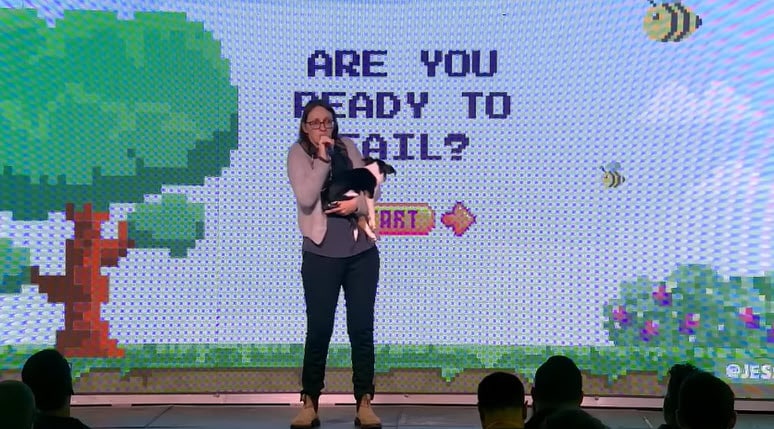
Jess Joyce from Inbound Scope took a different approach at Tech SEO Connect. Instead of technical implementation, she talked about the human side of frameworks—and why they fail. “We spent the last two days talking about tech and nerdiness and implementations,” she said, “but at the end of the day, this room is filled with people. Real people who feel things and go through things.”
Her premise: frameworks keep you from staring at a blank page (just like AI does now for writing), but they don’t turn your life into a straight line. Nobody follows the prescribed path—school, university, marriage, career. So why do we expect our SEO processes to work that way?
The talk was inspired by a Toronto meetup called “F*** Up Nights” where founders share radical failures. “On the internet, we’re not at a lack of anybody flexing anything,” Joyce said. “But how many of us talk about our failures?”
Four Real Situations Where Frameworks Failed
1. “We Work in Sprints” (They Don’t)
Joyce worked with a giant company that claimed to work in sprints. Eight months later, she discovered they didn’t. “When they say they work in sprints, it just means they file Jira tickets and they maybe get done at some point in the future.” Her entire framework was built around bi-weekly communication and systematic progress. When “sprints” turned out to be fiction, the framework collapsed.
2. The Developer Got Laid Off
Mid-project, the dev resource disappeared. Joyce offered to step in—she has dev experience. Six months later, she was still trying to get access. Enterprise security requirements meant emails, Jira access, Microsoft authentication. “I’m avoiding talking about getting access to the site because it’s going to take me 3 days just to get access.” The framework assumed she’d have a developer. She didn’t.
3. Internal Linking Sprint Without Access
Without site access, an internal linking sprint became “spreadsheets on spreadsheets on spreadsheets” passed to a dev who had endless questions. Meeting after meeting. “I still feel horrible for that dev. I can see his face and how much he hated his life when I was like, here’s my anchor text.” The framework sounded great. The execution was painful.
4. Life Happened
Joyce’s mother has epilepsy and was hospitalized for a month. “That threw out every single framework that I had in one shot.” She disappeared for a month, driving two hours each way to the hospital. They lost four clients. A year later, she’s still recovering from the compounding effects. “I had to throw out every single framework and start again.”
People Problems Are Framework Problems
Joyce catalogued the human failures that break frameworks:
“Frameworks don’t work” — Usually means they don’t understand what a framework is.
The dev/design/marketer all left — She worked on a project with six people. All gone. What happens to the frameworks you spent time implementing?
Knowledge is never distributed — Teams get shuffled in big organizations. Institutional knowledge walks out the door.
“We follow the framework but nothing ships” — The framework protects process, not outcomes. Busy work.
One person knows how this works — The “keymaster” problem. That laid-off dev held everything. In a recent meeting, the client needed DNS access. Where’s the keymaster? Gone.
The CMO changed — “Do you get that little gurgle in your stomach when the new CMO comes in? You have to do all your work over again and make sure they like you.” Framework becomes irrelevant without buy-in from new leadership.
A Framework for Frameworks
Joyce offered seven principles that frameworks should embody:
Modular — Components can be swapped without breaking the whole system.
Documented — Written down so it survives personnel changes.
Reviewed — Regularly examined and updated.
Contextualized — Her favorite word. “Do we have the context we need to move forward?” Without context, you’re guessing.
Permissive — Allows deviation when humans have better ideas.
Measured — Outcomes tracked, not just adherence.
Trusted — The foundation everything else rests on.
She distinguished between frameworks that should be rigid (security—you need processes for access control, especially when people leave) and frameworks that should be flexible (strategy, workflows, timelines, tactics).
Prompts Are Frameworks 2.0
Joyce connected framework thinking to AI prompts. “These days, you could take any framework and just throw it into a prompt. But please don’t.”
Copy-pasting prompts without context reminded her of the old days of copying code from Experts Exchange (“I have to say it slowly”) without understanding what it does. “We repackage and resurface the same problems.” Prompts need the same contextualization and principles as any other framework.
Three Diagnostic Questions
To evaluate whether your framework is healthy:
- Can my team modify this if the context changes?
- Does my framework have built-in flexibility?
- Am I measuring outcomes and not attachment to the framework?
“If you say no to any of these, you either have a human problem or a framework problem.” Or, as Ross Hudgens suggested, maybe you need to leave that company.
The Trust Foundation
Joyce’s closing point: “Your framework should drive your team’s permission to deviate.” If people are afraid to question the rules, they don’t trust leadership to adapt. In a time of rapid change—AI, search evolution, everything discussed at the conference—teams need open minds and the freedom to bring better ideas.
“The best teams understand that frameworks work well enough to keep improving them. And that only happens when you’ve trusted them first.”
My Takeaways
Joyce’s talk was the most human of the conference. After two days of technical optimization, she reminded us that every framework depends on people—and people are messy, unpredictable, and sometimes unavailable.
What I’m taking away:
1. Verify assumptions early. “We work in sprints” might mean something very different than you think. Don’t wait eight months to find out.
2. Distribute knowledge. The keymaster problem is real. If one person holds all the access and context, you’re one resignation away from chaos.
3. Context is everything. Joyce’s favorite word for a reason. Frameworks without context are just checklists.
4. Build in flexibility. Life happens. Devs get laid off. CMOs change. Frameworks that can’t adapt will break.
5. Measure outcomes, not adherence. Following a framework perfectly while shipping nothing is just busy work.
6. Treat prompts like frameworks. Copy-pasting without understanding context resurfaces the same problems we had with copy-pasted code.
The underlying message was about trust and permission. Teams that trust each other can deviate from frameworks when context demands it. Teams that don’t trust each other follow processes blindly and ship nothing. In a rapidly changing landscape, the ability to adapt matters more than the elegance of your original plan.