
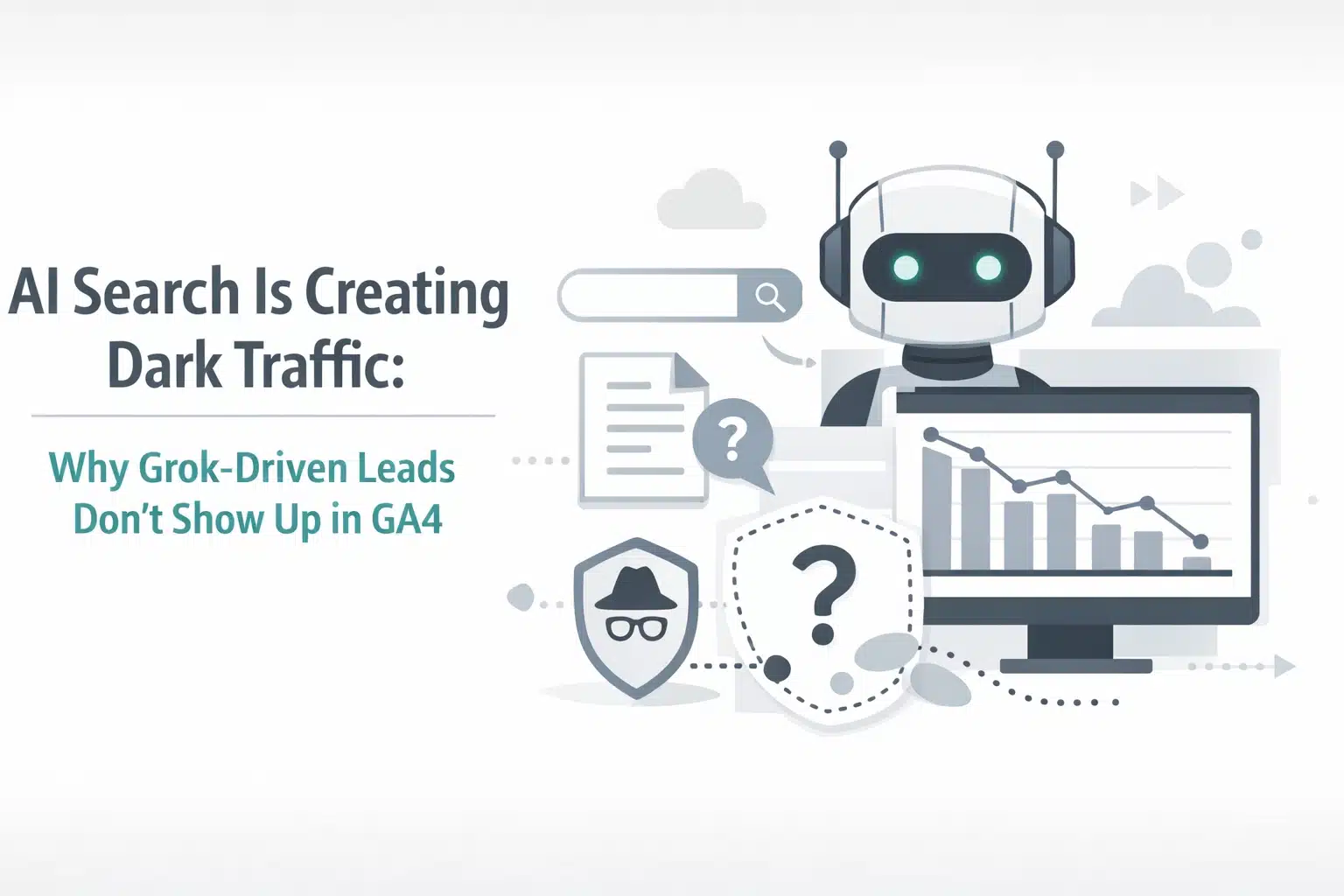
The Attribution Gap No One Is Talking About
A sales prospect fills out your contact form. When your team asks “How did you hear about us?” the answer stops you cold: “I found you through Grok.”
You immediately pull up Google Analytics 4. The lead came in five minutes ago. You check the source. It says Direct / (none). You filter by social, paid, and organic. Nothing. The lead appears to have materialized out of thin air, yet they explicitly told you they discovered your company through an AI search platform.
This isn’t a tracking error. This is the new reality of AI-driven search, and it’s creating a massive blind spot in how we measure marketing performance.
What Lawrence Hitches Discovered About AI Search Attribution
Digital marketing expert Lawrence Hitches recently conducted a series of experiments testing how AI search platforms influence buying decisions, and whether that influence shows up in traditional analytics. The findings were striking: AI search tools are driving real business leads and revenue, but they’re virtually invisible in standard attribution reports.
In one documented case, a qualified lead explicitly stated they found the company via Grok (X’s AI search assistant). Yet when the team reviewed their analytics, there was no trace of Grok as a traffic source. The visit appeared as direct traffic—classified alongside people who typed the URL directly or clicked a bookmark.
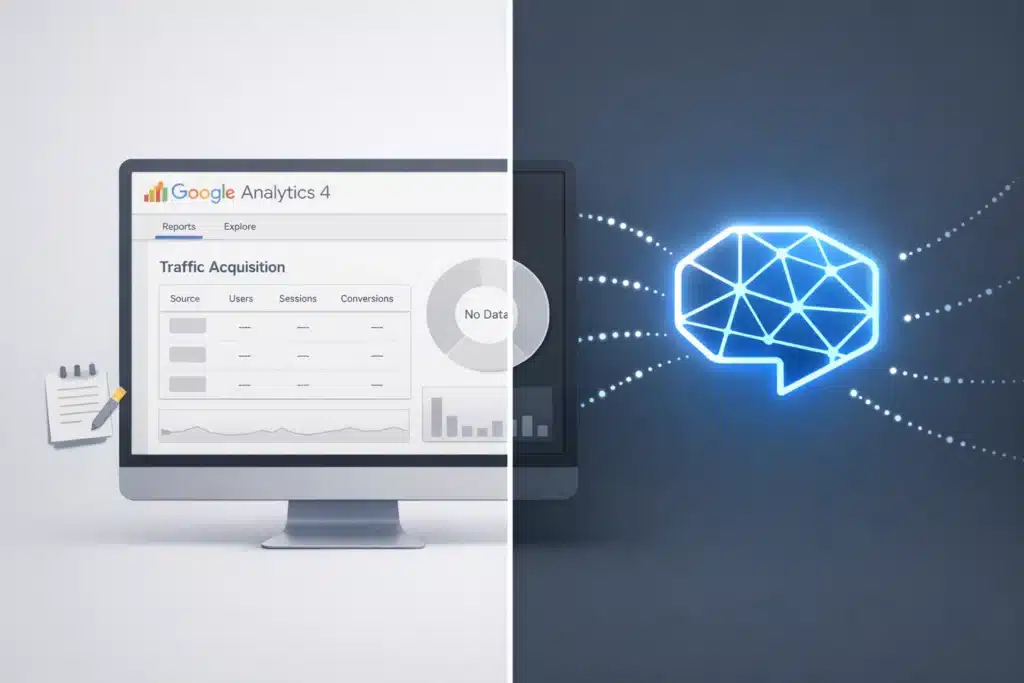
Here’s the problem: Grok doesn’t pass referrer information when users click through to websites. Without that referrer string—the data packet that tells analytics tools where traffic originated—platforms like GA4 have no way to attribute the visit to its actual source. The result is systematic misattribution that makes AI search influence completely invisible.
Why AI Platforms Create Dark Traffic
The technical reason is straightforward but consequential. When someone searches using a traditional search engine like Google and clicks a result, the browser passes a referrer header to the destination website. This header contains information about where the user came from, allowing analytics platforms to categorize the traffic source accurately.
Many AI search platforms don’t transmit this referrer data. According to testing by Ahrefs’ Patrick Stox, Grok shows no referrer information at all, meaning traffic appears as Direct in analytics systems. Google’s AI Overviews initially had similar issues (which Google acknowledged as a bug), and other AI assistants pass referral data inconsistently depending on how users interact with the platform.
This creates what’s known as “dark traffic”—visits that arrive at your website but can’t be traced back to their actual source. While some dark traffic has always existed (emails, messaging apps, certain social platforms), AI search is now adding a significant new layer to this measurement challenge.
The implications extend beyond simple attribution. When AI-driven traffic gets misclassified as direct, it inflates your direct traffic metrics while making other channels—including the AI platforms actually driving results—appear less effective than they are. This can lead to bad decisions about where to invest marketing resources.
AI Influence Happens Before the Click
Here’s what makes AI search attribution especially tricky: the influence often happens during the consideration phase, not at the point of click.
Traditional search behavior involves a clear sequence: search, click, evaluate, return for more searches, click again, eventually convert. Each interaction creates a trackable touchpoint. AI search compresses this process dramatically.
When someone asks an AI assistant for vendor recommendations, the AI might provide a curated shortlist with key differentiators, pricing context, and trust signals—all without the user clicking anything yet. By the time they decide to visit a website, they’ve already completed much of their research and trust-building through the AI interface.
These prospects often arrive “pre-sold.” They ask fewer basic questions. They move faster through sales conversations. And they may convert through a completely different channel days or weeks later—perhaps typing your URL directly after remembering the AI’s recommendation, or searching for your brand name specifically.
The AI platform influenced the decision, but it won’t show up in last-click attribution. It won’t show up in multi-touch attribution. It won’t show up anywhere.
What This Means for Marketing Measurement
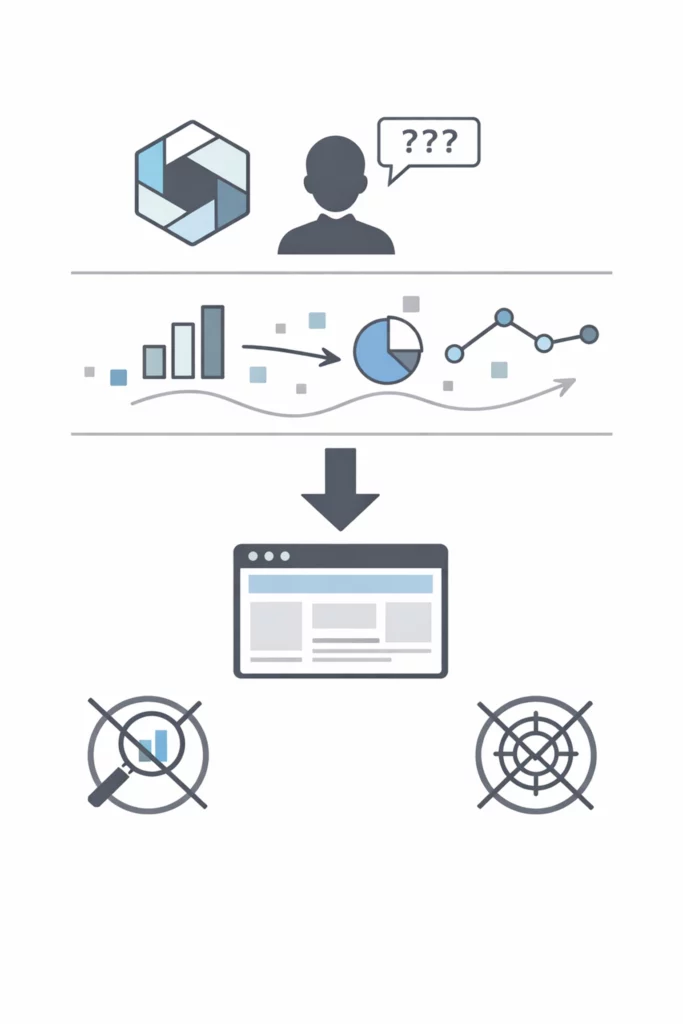
If you’re evaluating channel performance purely based on GA4 reports, you’re likely making decisions with incomplete information. AI search may be driving significant influence without generating a single trackable click. This creates several measurement challenges:
- Your “Direct” traffic is probably inflated. That spike in direct visits might not be people typing your URL—it could be AI-influenced traffic that analytics can’t categorize.
- Channel ROI calculations are skewed. If AI search is driving awareness and consideration but another channel gets credit for the conversion, you’re undervaluing the AI influence and potentially overvaluing the last-touch channel.
- You can’t optimize what you can’t measure. Without visibility into which AI platforms drive results, you can’t make informed decisions about optimizing your presence in AI search results.
The old metrics framework—impressions, clicks, conversions—was built for a world where each interaction left a traceable footprint. AI search breaks that model.
If You Can’t Track the Click, Track the Citation
This is the core insight: when attribution is broken, you need to shift from measuring clicks to measuring presence.
You will never get GA4 to properly attribute a lead that came from Grok. The referrer data doesn’t exist. No UTM parameter will fix this. No tag manager configuration will capture it. The click-level data simply isn’t there, and it may never be.
But you can measure whether your brand is appearing in AI-generated responses in the first place. That’s the upstream signal that GA4 is missing—and it’s the one that actually matters for strategic decision-making.
This is what CiteMetrix was built for. It monitors how six major AI platforms—ChatGPT, Gemini, Perplexity, Claude, Meta AI, and Google AI Overviews—mention your brand across the queries that matter to your business. When a lead tells you they found you through Grok, CiteMetrix shows you the broader pattern: how often AI platforms are recommending you, for which queries, how your visibility compares to competitors, and how that’s trending over time.
Think of it this way: GA4 tells you what happened after someone arrived at your site. CiteMetrix tells you what’s happening in the AI ecosystem before they arrive—the discovery layer that’s now invisible to traditional analytics. That discovery layer is where more and more buying decisions are being shaped.
With CiteMetrix, you can answer questions that GA4 never will: Are we being cited for our core service queries? Which competitors are getting cited instead of us? Are we being recommended or just mentioned? Which AI platforms surface us most frequently? Is our visibility improving or declining month over month?
These aren’t vanity metrics. They’re the leading indicators that predict whether your pipeline will have more Grok-driven leads (and ChatGPT-driven leads, and Perplexity-driven leads) next quarter—even if GA4 will never attribute them properly.
Building a Complete AI Measurement Framework
AI visibility monitoring through CiteMetrix is the foundation, but a complete measurement framework combines it with several complementary signals:
Update Your Lead Intake Process
Add AI search platforms to your “How did you hear about us?” forms and survey questions. Include specific options for ChatGPT, Perplexity, Grok, Google AI Overviews, and other emerging platforms. Direct self-reporting, while imperfect, gives you qualitative data that analytics can’t capture. When this self-reported data correlates with what CiteMetrix shows about your AI visibility, you have a strong signal.

Track Sales Velocity and Close Rates
AI-influenced leads often progress through sales cycles faster because they arrive with more context. Monitor whether your direct traffic converts at higher rates or closes faster than other sources—this may indicate hidden AI influence. Cross-reference these patterns with CiteMetrix visibility data: if your AI citation rates are climbing and your direct traffic quality is improving simultaneously, the connection is hard to ignore.
Watch for Correlated Proxy Metrics
Monitor signals that often move in tandem with AI visibility: increases in branded search volume, spikes in direct traffic following visibility improvements that CiteMetrix detects, and changes in the types of questions prospects ask during sales conversations. These proxy metrics won’t give you perfect attribution, but they help build a directional picture.
Monitor Brand Equity Signals
Are you seeing increases in branded queries, social mentions, or industry recognition? AI search often amplifies brands that already have strong signals of authority and relevance. Growth in these areas may correlate with the AI visibility that CiteMetrix tracks, even when direct attribution is impossible.
AI Visibility as Strategic Positioning
This measurement gap forces a perspective shift: treat AI search visibility less like a direct-response channel and more like brand positioning.
You don’t abandon brand marketing because you can’t attribute every conversion to a specific billboard or podcast sponsorship. Similarly, AI search visibility is becoming essential shelf space in the consideration phase—valuable even when you can’t draw a straight line from AI mention to conversion.
The difference is that unlike billboards, AI visibility is measurable—just not through GA4. CiteMetrix gives you the measurement layer that traditional analytics can’t provide: concrete data on where you appear, how often, in what context, and how that changes over time. The attribution gap exists at the click level, but it doesn’t exist at the visibility level.
The companies that succeed in this new landscape are those who recognize AI search as a layer in the customer journey that influences decisions without necessarily creating trackable touchpoints—and who invest in measuring that influence at the right level.
Making Your Business AI-Search Ready
As AI search influence grows, the question isn’t whether to invest in AI visibility—it’s how to ensure your business is positioned to benefit when prospects use these tools.
At Expert SEO Consulting, we’ve developed frameworks specifically for this challenge. Our approach goes beyond traditional SEO to address how AI systems discover, evaluate, and cite businesses:
- AI SEO Audits assess whether your site architecture, content structure, and entity relationships make you eligible to appear in AI-generated answers—regardless of whether you can track every resulting visit.
- Content Strategy focused on extractability and authority signals that AI platforms prioritize when building responses to user queries.
- AI Visibility Monitoring via CiteMetrix tracks your presence in AI search results across six platforms over time, giving you the directional data that GA4 will never provide. CiteMetrix is currently in beta—request access at citemetrix.com/beta.
The shift to AI-powered search doesn’t mean abandoning measurement—it means adapting how you measure success and making strategic decisions with the right data from the right sources.
The Bottom Line
Grok-driven leads that don’t show up in GA4 aren’t a technical bug to be fixed—they’re a fundamental characteristic of how AI search platforms operate. As these platforms become more prominent in how people discover and evaluate businesses, the attribution gap will only widen.
The companies that thrive won’t be those who wait for perfect attribution models. They’ll be the ones who recognize that the measurement problem has a solution—it just isn’t in GA4. It’s in tracking AI visibility directly, where the influence actually happens, using tools like CiteMetrix that measure presence across the platforms shaping buyer decisions.
Your next high-value lead might come from Grok, Perplexity, or an AI platform that doesn’t exist yet. GA4 won’t tell you where they came from. But CiteMetrix can tell you whether the AI ecosystem is sending them your way—and that’s the metric that matters.
Ready to see where your brand stands in AI search? Request beta access to CiteMetrix at citemetrix.com/beta, or book a consultation with Expert SEO Consulting to build a measurement framework that captures influence beyond clicks.
Sources:
Lawrence Hitches via Search Engine Land (“What 4 AI Search Experiments Reveal About Attribution and Buying Decisions”)
Patrick Stox via Ahrefs (“Generative Engines Are Breaking Web Analytics”)


4 Comments