The era of chasing high-volume keywords and hoping for the best is officially over. If your current SEO strategy relies on broad demographics and surface-level "buyer personas" like "Marketing Manager Mary" or "Small Business Steve," you are optimizing for a search landscape that no longer exists.
In the wake of the AI search revolution: driven by platforms like Perplexity, ChatGPT, and Google’s AI Overviews: the mechanics of visibility have shifted fundamentally. Search engines are no longer just matching strings of text; they are mapping specific user problems to contextually relevant solutions.
Recent data reveals the high stakes of this transition: visitors coming from AI search interfaces convert 4.4 times better than traditional organic search visitors. Why? Because these users aren’t just browsing; they are arriving equipped with synthesized information and decision-making context. To capture this high-intent traffic, your brand must move beyond generic SEO and embrace the era of deep personas.
The Collapse of Traditional Keyword-Based SEO
For two decades, SEO was a game of volume. You found a keyword with high traffic and low competition, built a page around it, and waited for the "blue links" to drive clicks. This worked because search engines were essentially sophisticated filing cabinets.
Today, AI search engines function as digital consultants. They don't just point users to a page; they ingest, synthesize, and present information as a definitive answer. When a user asks an AI, "What is the best enterprise SEO strategy for a SaaS company facing a 20% churn rate due to market saturation?" the engine isn't looking for a page optimized for "enterprise SEO strategy." It is looking for content that understands the specific pain points of churn, market saturation, and SaaS-specific scaling.
If your content is generic, it is invisible. AI systems evaluate authority at the entity level, analyzing your domain’s consistency, expertise, and how well your answers map to the nuanced needs of the user. Generic content: the kind produced by surface-level personas: fails to provide the "information gain" that AI algorithms now prioritize.

Why Generic Personas Failed
The traditional static persona was a fictional archetype built on broad strokes: age, job title, and a couple of generic goals. These personas were designed for a transactional search world. They collapse under the weight of AI search because they lack the data-rich environmental factors that define modern user intent.
AI search queries are longer, more conversational, and multi-turn. They reflect a user’s actual situation: their regulatory environment, their local economic conditions, and their specific technical hurdles.
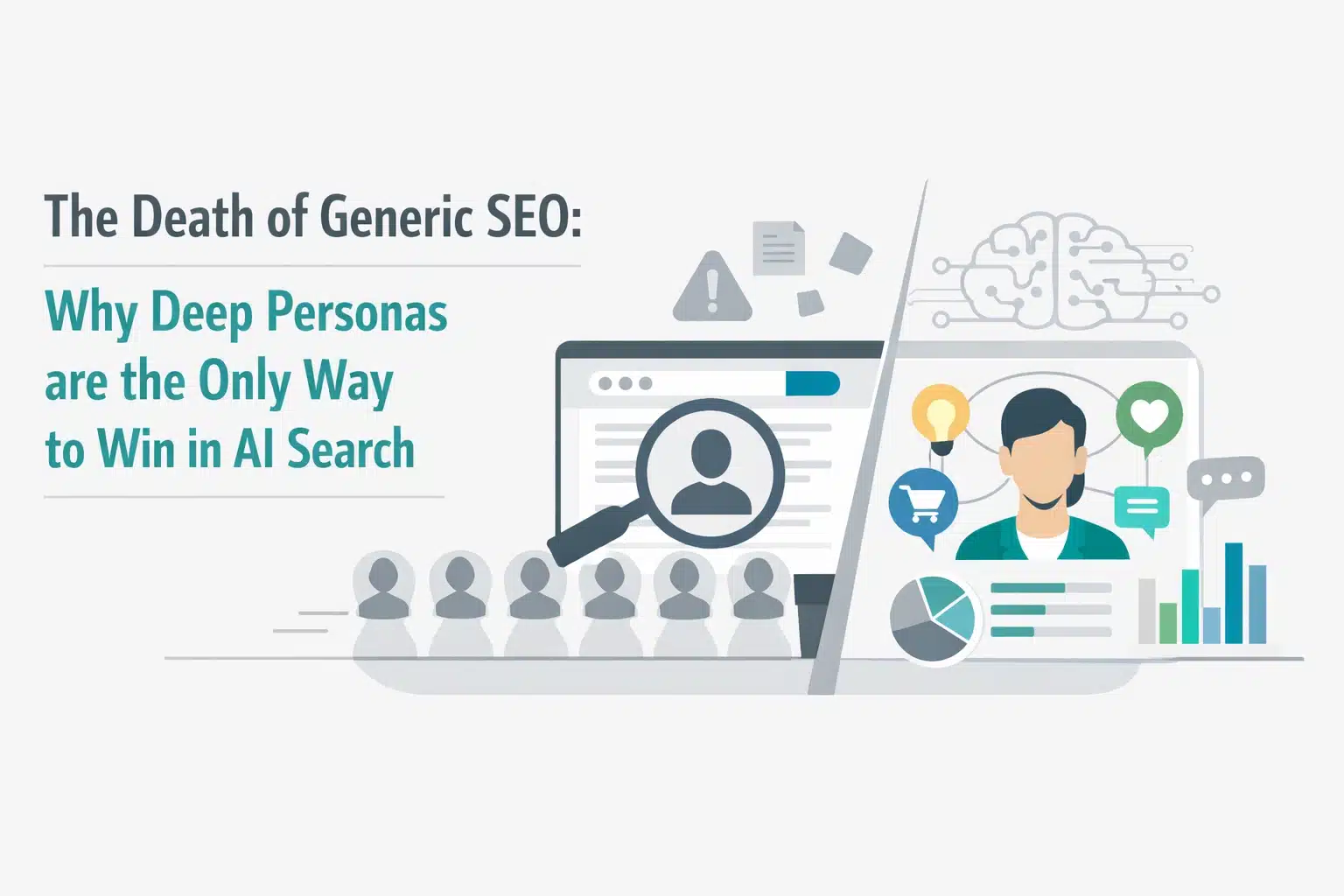
When you build a content strategy based on "Manager Mike," you produce content that is a mile wide and an inch deep. AI engines see this content as "noise." To be cited as a trusted authority by an AI, your content must demonstrate an understanding of the user’s context that feels almost telepathic. This requires deep personas that layer real-world environmental factors onto traditional profiles.
The Anatomy of a Deep Persona
A deep persona doesn't just ask "who" the customer is; it asks "where" they are in their decision-making journey and "what" environmental pressures are forcing their hand. At Expert SEO Consulting, we focus on five critical layers that traditional personas miss:
- Environmental Context: What industry trends or regulatory shifts are currently impacting this persona?
- Decision-Making Constraints: Is the persona working with a shrinking budget, or are they under pressure to scale at all costs?
- Specific Pain Point Mapping: Instead of "needs more leads," a deep persona identifies "needs to reduce CPL by 15% to maintain venture capital funding."
- Information Gap Analysis: What does this persona already know, and what specific technical details are they missing to make a final decision?
- Behavioral Signal Patterns: How does this persona interact with AI? Do they prefer summarized data, or are they looking for deep-dive white papers to verify AI claims?
By building content around these layers, you move from "best page" thinking to "best answer" thinking. This is how you win in a world where AI retrieval systems process discrete chunks of information rather than just entire URLs.
Mapping Pain Points to AI Engines
AI engines are essentially "problem-solution" machines. To win, your content must be the most direct bridge between a user’s pain point and a solution.
If you understand the deep persona’s specific struggle: for example, a CTO struggling to integrate legacy databases with new AI tools: your content shouldn't just talk about "database integration." It should address the latency issues, the security protocols, and the specific API limitations that the persona is likely to encounter.
When your content is this specific, AI engines recognize you as a high-authority entity. You are no longer just another blog post; you are a primary source of truth. This shift is essential because why Google’s AI search still rewards SEO basics is often misunderstood. The "basics" now include the technical foundation that allows AI to crawl and understand your deep persona-led content effectively.

The Strategic Pivot: Content Strategy and SEO Training
Winning in the age of AI requires more than just a change in how you write; it requires a change in how your team thinks. This is why SEO Training and a revitalized Content Strategy are no longer optional: they are essential for survival.
Your team needs to move away from keyword research tools as their primary source of truth. Instead, they must become experts in customer empathy and data analysis. They need to learn how to:
- Identify the "hidden" questions your customers are asking AI engines.
- Structure content using schema and semantic markers so AI can easily "chunk" your expertise.
- Produce content that provides "information gain": new, unique insights that the AI hasn't already summarized from a dozen other sites.
A modern content strategy must prioritize quality over quantity. One deep-dive article that perfectly addresses a complex persona pain point is worth more than fifty generic posts optimized for high-volume, low-intent keywords.
Authenticity is the New Optimization
AI systems reward expertise, accuracy, clarity, and, above most else, authenticity. Generic personas cannot deliver this because they lack the specificity to guide authentic content creation. Deep personas make authenticity inevitable. When you write for a specific person facing a specific problem in a specific context, your expertise shines through.
This authenticity is what builds the "entity authority" that search engines like Google use to rank your site in the AI age. They are looking for signals that you are a real expert solving real problems for real people.

What You Need to Do Now
The transition from keyword-centric SEO to persona-centric AI optimization is fundamental and irreversible. If you continue to optimize for the search engines of 2020, you will be left behind by the competitors who are optimizing for the AI of 2026.
To protect your organic traffic and capitalize on the 4.4x conversion rate of AI search visitors, you must:
- Audit your existing personas: Discard the generic archetypes and rebuild them using real-world behavioral and environmental data.
- Refine your content strategy: Shift your focus from keyword volume to pain-point depth.
- Invest in SEO Training: Ensure your team understands how to communicate with both humans and AI models effectively.
- Focus on Entity Authority: Build a brand presence that AI engines recognize as a definitive source of truth in your niche.
The death of generic SEO is an opportunity for those willing to do the deep work. By understanding your audience better than anyone else: and reflecting that understanding in every piece of content you produce: you won't just survive the AI search revolution; you will lead it.
Ready to evolve your strategy and win in the age of AI search? Book a consultation with Expert SEO Consulting today and let’s build a deep-persona framework that drives real results.