

Local SEO drives 46% of all Google searches, yet 70% of small businesses are making critical mistakes that cost them thousands in lost revenue every month. While your competitors fumble with outdated tactics, smart businesses are capitalizing on local search opportunities that most companies completely ignore.
Here's the reality: local SEO isn't optional anymore. It's the difference between being found by customers actively searching for your services and watching them walk into your competitor's door instead. The good news? Most local SEO mistakes are surprisingly easy to fix once you know what to look for.

Mistake #1: Treating Google Business Profile Like a Forgotten Stepchild
Your Google Business Profile isn't just another directory listing: it's your digital storefront. Yet 60% of businesses either don't claim their listing or leave it woefully incomplete, essentially telling Google they don't exist.
The damage: Incomplete profiles rank 70% lower than fully optimized ones. You're literally invisible to customers searching for your exact services in your area.
The fix: Complete every single field in your Google Business Profile. This means:
- Adding all relevant business categories (up to 10)
- Uploading high-quality photos of your business, team, and work
- Listing all service areas you cover (up to 20)
- Adding specific services with detailed descriptions
- Including business hours for holidays and special events
Pro tip: Add posts regularly to your Google Business Profile. Businesses that post weekly see 70% more clicks than those that don't. This signals to Google that your business is active and engaged.
Mistake #2: Playing NAP Information Roulette
NAP inconsistency (Name, Address, Phone number) across online directories is like giving Google mixed signals about whether your business is legitimate. Even small variations: like "Street" vs. "St." or including suite numbers inconsistently: can tank your rankings.
The damage: Inconsistent NAP information reduces local search visibility by up to 30%. Google simply doesn't trust businesses that can't keep their basic information straight.
The fix: Conduct a complete NAP audit across all major directories:
- Google My Business
- Yelp
- Better Business Bureau
- Industry-specific directories
- Apple Maps
- Bing Places
Create a master document with your exact business information format and use it consistently everywhere. Consider investing in local SEO management services to monitor and maintain consistency across hundreds of potential listings.
Mistake #3: Ignoring the Local SEO Hotspots That Actually Matter
Most businesses optimize their homepage and forget about the specific page elements that drive local rankings. Your title tags, meta descriptions, H1 headings, and URL structure are ranking goldmines that most companies leave completely untapped.
The damage: Pages without optimized local elements rank 45% lower than properly optimized competitors.
The fix: Apply this proven formula to every service page:
Title Tag Formula: [Primary Service] + [Location] (55-60 characters)
Example: "Emergency Plumbing Repair in Phoenix, AZ | 24/7 Service"
Meta Description Formula: Benefit + Proof + Call-to-Action (140-150 characters)
Example: "Phoenix's fastest plumbing repair. 30-minute response time, licensed & insured. Call now for free estimate: (555) 123-4567"
H1 Heading: Natural, readable version with service + location
Example: "Phoenix Emergency Plumbing Repair Services"
URL Structure: Keep it clean and location-specific
Example: "/emergency-plumbing-phoenix-az/"
Map one primary keyword to one page. Duplicate content targeting the same keyword + location combination will cannibalize your rankings.
Mistake #4: Treating Online Reviews Like They'll Happen Automatically
Reviews aren't just social proof: they're a direct ranking factor. Businesses with 15+ reviews rank 12% higher than those with fewer reviews. Yet most companies either ignore review generation entirely or make sporadic, desperate attempts when things get slow.
The damage: Zero review strategy means you're letting competitors with organized review systems dominate local search results.
The fix: Implement a systematic review generation process:
- Send review requests within 24-48 hours of completed service
- Use multiple channels (email, text, direct ask)
- Make it incredibly easy with direct links to your Google Business Profile
- Respond to ALL reviews (positive and negative) within 48 hours
- Create a review response template that addresses concerns professionally
The key is consistency. Getting one review per week beats getting 10 reviews once per year. Google values recent, ongoing review activity over old review bursts.
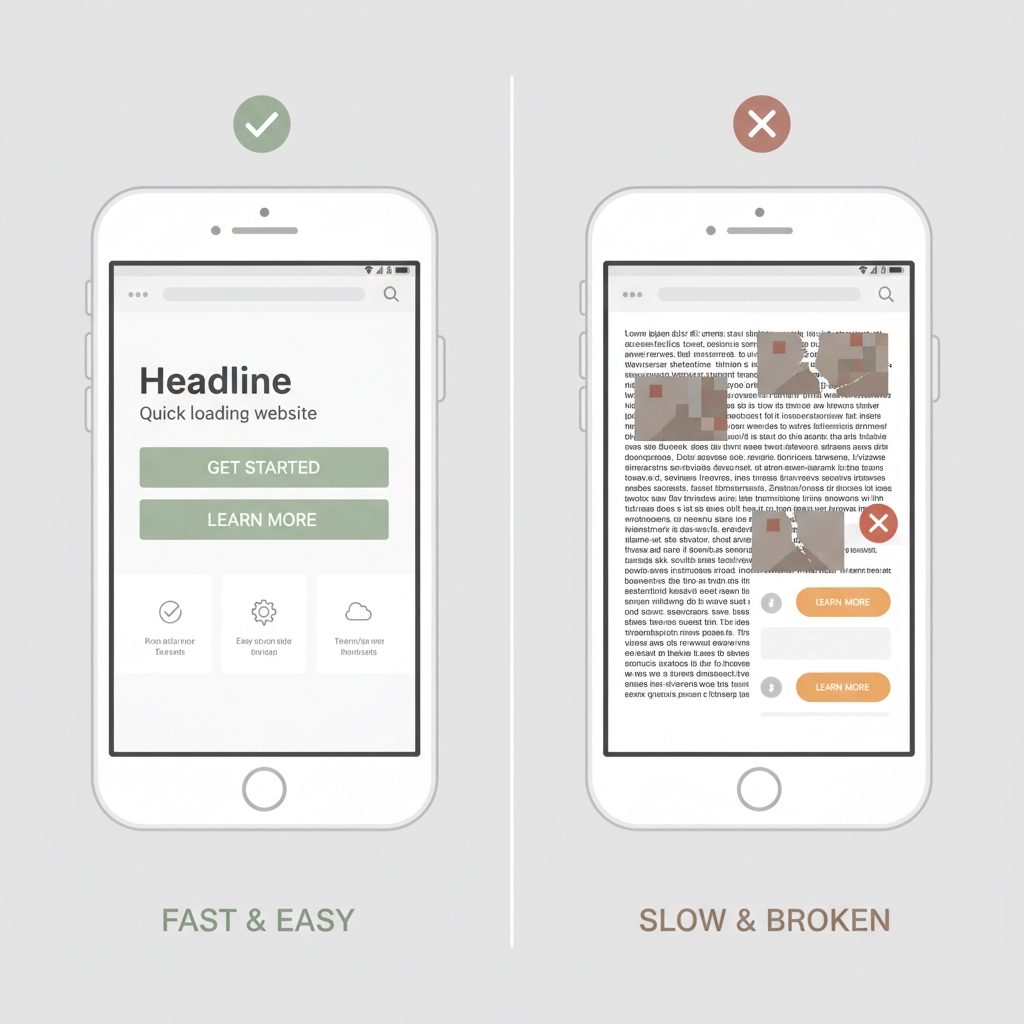
Mistake #5: Serving Mobile Users a Desktop Experience
Mobile searches for "near me" have increased 200% in the past two years, yet many local businesses still treat mobile optimization as an afterthought. If your site takes longer than 3 seconds to load on mobile, 53% of visitors will leave before seeing your content.
The damage: Google's mobile-first indexing means slow mobile sites get penalized in all search results, not just mobile ones.
The fix: Prioritize mobile user experience:
- Ensure your site loads in under 3 seconds on mobile
- Use large, thumb-friendly buttons for phone calls and directions
- Optimize images for fast loading without quality loss
- Implement click-to-call functionality prominently
- Test your site across different mobile devices and screen sizes
Additionally, optimize for voice search by incorporating conversational, long-tail keywords. Instead of just "plumber Phoenix," include phrases like "emergency plumber near me open now" or "best plumbing company in Phoenix Arizona."
Mistake #6: Skipping Schema Markup and Directory Listings
Schema markup is like giving Google a cheat sheet about your business, yet 70% of local businesses don't use it. Meanwhile, comprehensive directory listings signal legitimacy and authority to search engines.
The damage: Without schema markup, Google has to guess what your business does and where it's located. Directory gaps make your business appear less established than competitors.
The fix: Implement these essential schema types:
- LocalBusiness schema on your homepage
- Service schema for each service page
- Review schema to display star ratings in search results
- FAQ schema for common customer questions
- Event schema for workshops, sales, or special hours
For directory listings, focus on:
- Industry-specific directories (legal directories for lawyers, medical directories for doctors)
- Local chamber of commerce listings
- Better Business Bureau
- Major review platforms (Yelp, Angie's List, HomeAdvisor)
- Location-specific directories for your city or region
Quality matters more than quantity. Focus on authoritative, relevant directories rather than submitting to hundreds of low-quality sites.
Mistake #7: Flying Blind Without Performance Tracking
Most businesses set up local SEO and never look at the results. You can't optimize what you don't measure, and local SEO requires ongoing refinement based on actual performance data.
The damage: Without tracking, you're wasting money on tactics that don't work while missing opportunities that could drive significant growth.
The fix: Establish monthly tracking for these key metrics:
- Local search ranking positions for target keywords
- Google My Business insights (views, clicks, calls, direction requests)
- Organic traffic to location/service pages
- Conversion rates from local search traffic
- Review acquisition rate and overall rating trends
- Click-through rates from search results
Use Google Search Console to identify which local keywords are driving traffic and which pages need optimization. Set up Google Analytics goals to track phone calls, form submissions, and other local conversion events.
Many businesses benefit from professional SEO training to build internal capabilities for ongoing optimization and monitoring.
The Local SEO Reality Check
Local SEO isn't a "set it and forget it" strategy. It requires consistent attention, regular optimization, and systematic execution across multiple channels. The businesses winning local search aren't necessarily the biggest or most established: they're the ones executing fundamentally sound local SEO strategies consistently.
The seven mistakes above represent the difference between being found by customers actively searching for your services and being invisible in your own market. While your competitors continue making these errors, implementing these fixes positions you to capture the local search traffic they're leaving on the table.
Ready to stop losing customers to easily preventable local SEO mistakes? Expert SEO Consulting's comprehensive SEO strategies help businesses dominate local search results through systematic optimization and ongoing performance monitoring.