Search didn’t disappear—it changed layers. What used to be a straightforward contest for clicks is now a competition to become the source an AI system trusts enough to use, summarize, and act on.
That’s the strategic shift most marketers are still underestimating. We aren’t just dealing with “Answer Engines” anymore. We have moved into the “Agentic Shift.” Users aren’t just asking ChatGPT or Gemini for a recipe; they are telling their AI agents to “find the best organic meal kit, compare the pricing, and start a subscription for me.”
In this new reality, the “user” isn’t a human scrolling through a page. The user is an agent, a sophisticated piece of software acting on a human’s behalf. If that agent doesn’t “see” your brand, you don’t exist. This is where CiteMetrix data becomes the most important asset in your marketing stack. At Expert SEO Consulting, we’ve pivoted our entire strategy to account for this shift, and you need to do the same if you want to survive the next twelve months.
What is the Agentic Shift?
For the last two decades, SEO was about visibility to humans. You created content, Google indexed it, and a human clicked it. The Agentic Shift represents the transition from AI as a chatbot to AI as an autonomous operator.
An “agent” doesn’t just provide information; it executes tasks. It reasons, it plans, and it acts. When an AI agent is tasked with “booking a high-end hotel in Austin with a gym and a rooftop bar,” it doesn’t look at ten websites. It crawls the web, parses structured data, evaluates sentiment, and makes a recommendation, or even completes the booking itself.

This fundamental change means your Answer Engine Optimization (AEO) strategy must evolve. It’s no longer enough to be the “answer” to a question; you must be the “solution” that the agent trusts enough to select. This trust is built on citations, and that is exactly what CiteMetrix allows us to track.
Why CiteMetrix is the New Google Search Console
In the old days, we used Google Search Console to see which queries drove traffic. In the agentic age, traffic is a secondary metric. The primary metric is Citation Share.
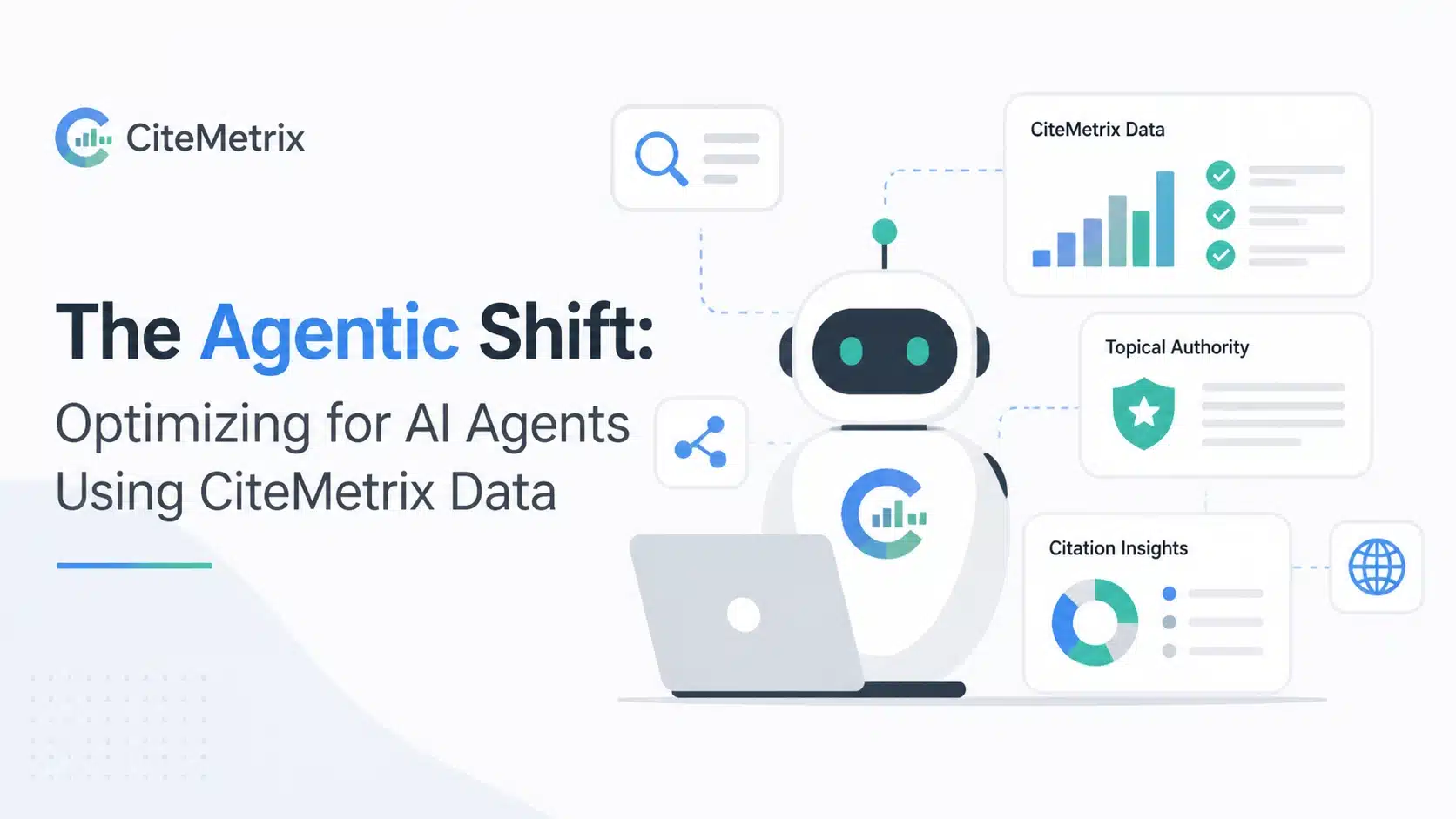
CiteMetrix is the tool we use to track how often, and in what context, your brand is being cited across large language models (LLMs) and agentic workflows. If a travel agent AI is recommending hotels, CiteMetrix tells us if your hotel was in the consideration set and why it was or wasn’t chosen.
Without CiteMetrix data, you are flying blind. You might have great organic traffic from legacy searchers, but you could be invisible to the 58% of users using AI-powered interfaces. This data informs our AEO strategy by identifying “Citation Gaps”, areas where your competitors are being referenced as authorities by AI agents while your brand is left out of the conversation.
Building an Agent-First Content Strategy
To optimize for agentic search, you have to stop writing for “keywords” and start writing for “entities.” AI agents don’t care about your 2% keyword density. They care about your relationship to other trusted entities on the web.
1. Feed the Knowledge Graph
Agents rely on structured data to understand the world. If your schema markup is outdated or non-existent, an AI agent has to “guess” what you do. They don’t like guessing. We ensure every client at Expert SEO Consulting has a robust, interconnected schema graph that defines their products, their people, and their expertise in a language agents speak fluently.
2. Prioritize “Cite-Worthy” Originality
CiteMetrix data shows that agents prioritize unique, data-backed insights over recycled content. In 2026, “how-to” guides are being replaced by AI-generated answers. What the AI can’t replace is your proprietary data, your case studies, and your unique brand voice. To be cited, you must provide the primary source of truth that the AI needs to complete its task.
3. Verification and Trust
Agentic AI is programmed to avoid hallucinations. It looks for corroboration. If your website says you are the “best,” but third-party citations, reviews, and industry papers don’t back that up, the agent will skip you. CiteMetrix helps us monitor these third-party signals so we can strengthen your brand’s authority across the entire ecosystem.

Local SEO in the Age of Agents
Local businesses are perhaps the most impacted by the Agentic Shift. Think about how people find services now. “Hey Siri, find a plumber who can come over right now and has good reviews.”
The AI agent isn’t just looking at your website; it’s looking at your Local SEO footprint across the web. It checks your Google Business Profile, your Yelp ratings, local directories, and even mentions in local news.
CiteMetrix data allows us to see how local agents perceive your business. Are you being cited as “affordable” or “premium”? Are you being cited as “reliable” or “fast”? We use this data to tune your local presence, ensuring that when an agent is making a decision for a user, your business is the logical, low-risk choice.
From Information to Execution: The Future of Conversion
The ultimate goal of optimizing for agents is to be the “Chosen Action.” When an agent moves from the research phase to the execution phase, your site needs to be technically ready. This means:
- API-First Thinking: Can an agent easily pull pricing or availability from your site?
- Clear Value Propositions: Is your offer so clear that a machine can’t misunderstand it?
- Zero Friction: If an agent tries to “execute” a task (like adding an item to a cart), does your site architecture allow it, or does it block it with complex scripts?
We’ve seen businesses lose millions in potential revenue because they were “invisible” to agents, even while ranking #1 for traditional search terms. Don’t let that be you.

Using CiteMetrix to Outperform the Competition
One of the coolest things about CiteMetrix is the ability to perform “Agentic Competitive Analysis.” We can see exactly which sources ChatGPT or Claude is using to form its opinions about your industry.
If your competitor is being cited because of a specific white paper they published three years ago, we know exactly what kind of “knowledge debt” we need to fill. We don’t just guess what content to create; we use the data to see where the AI’s knowledge is lacking and we fill that void with your brand’s expertise.
As Evan Herman and many of our other clients have noted, the shift to data-driven AI visibility has been the single biggest growth lever in recent years. It’s about being proactive, not reactive.
The Time to Act is Now
The shift to agentic search isn’t a “maybe” for 2027: it is the reality of 2026. With over half of Google searches already filtered through an AI lens, the window for traditional SEO dominance is closing.
You need a partner who understands how to bridge the gap between human-centric search and agentic execution. You need a strategy that doesn’t just aim for “rankings,” but aims for “citations.” At Expert SEO Consulting, we live and breathe this data. We don’t just follow trends; we use tools like CiteMetrix to stay ahead of them.
If you’re feeling like your current SEO strategy is stuck in 2024, it’s time for an upgrade. Let’s look at your CiteMetrix data together and build a roadmap for the agentic future.
Ready to dominate the AI-powered search landscape?
Book a consultation with our team today and let’s get your brand the citations it deserves.