Search doesn’t work the way it used to. Ranking still matters, but rankings alone no longer decide who wins attention, trust, or business. If your SEO strategy is still built around getting a blue link in front of a searcher, you’re optimizing for a version of Google that’s already gone.
In 2026, being visible is only the starting point. The real question is whether your brand gets selected as the source worth trusting. Search engines now interpret, summarize, and narrow options before users ever make a click. That means your content isn’t just competing to appear on the page—it’s competing to shape the answer.
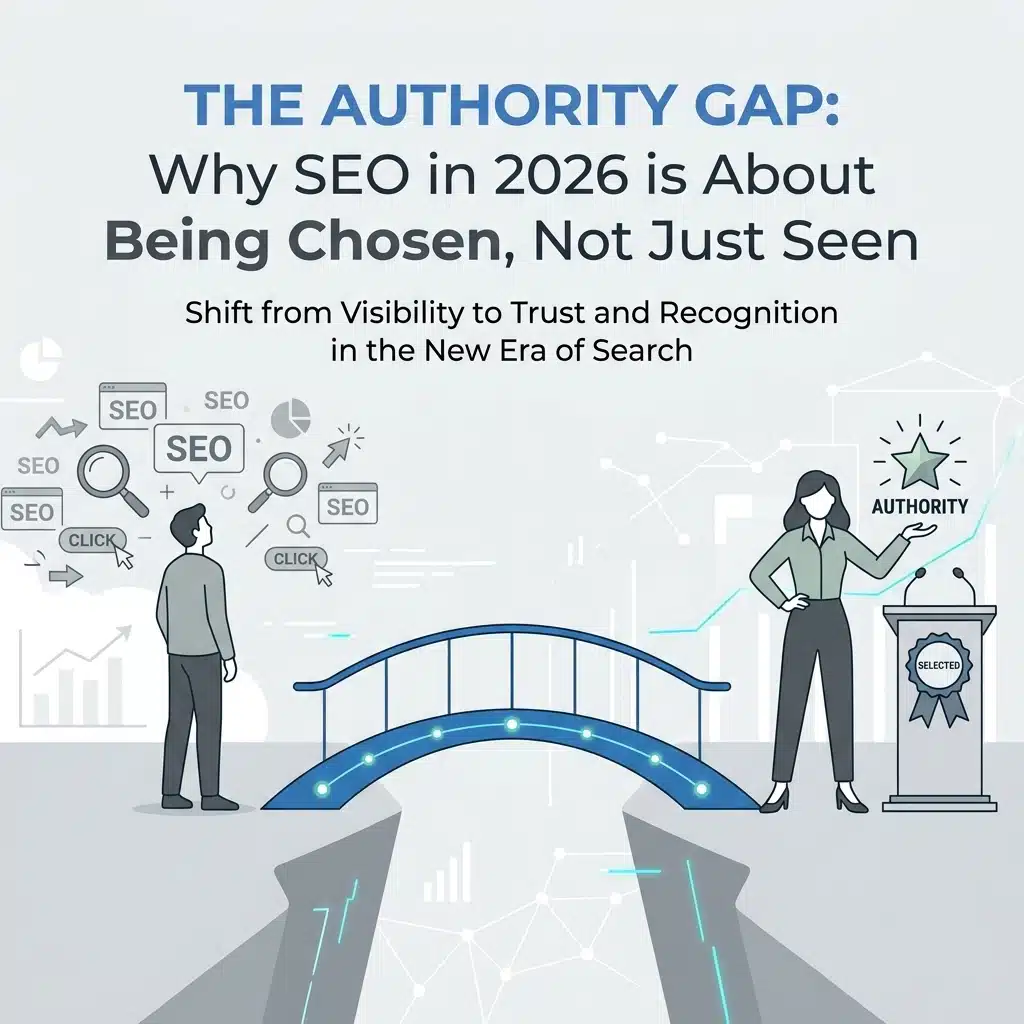
This is what we call the Authority Gap. It’s the distance between being indexed and being trusted. If an AI Overview synthesizes an answer for a user but doesn't cite your brand as the definitive source, your ranking is functionally worthless. You might be "seen" by the crawler, but you weren’t "chosen" as the authority.
At Expert SEO Consulting, we’ve watched this shift happen in real time. To stay competitive now, your strategy has to move beyond visibility and prove—clearly, consistently, and at every level—that you’re the authority search engines should choose.
From Retrieval to Reasoning: The New Search Reality
For decades, SEO was about retrieval. A user typed a query, and Google retrieved the most relevant links. But in 2026, search engines have moved into the "Reasoning" phase. They decompose complex questions, verify facts across multiple sources, and write a synthesized response directly on the Search Engine Results Page (SERP).
This is why traditional traffic is under threat. Recent data suggests that brands relying on legacy SEO tactics are facing a projected 25% decline in organic traffic this year. Why? Because users are consuming the answer without ever needing to click. This "Zero-Click" reality means that if you aren’t the entity providing the data for that AI-synthesized answer, you are effectively invisible to the consumer.

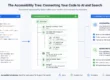
Alt text: A minimal flat design illustration showing an AI interface synthesizing data from multiple sources into a single, authoritative answer, professional vibe, .jpg format.
Why AI Citations are the New Rankings
When over half of all searches are filtered through an AI lens, the goal of your Content Strategy must change. You aren't just writing for humans; you are writing to be the "Primary Source" for an AI model.
AI models, whether it’s Google’s Gemini, OpenAI’s SearchGPT, or Perplexity, are designed to minimize risk. They want to provide the most accurate, least controversial, and most authoritative answer possible. They "choose" sources based on a specific set of signals:
- Fact Density: Does your content provide verifiable data points or just fluff?
- Entity Recognition: Does the search engine recognize your brand as a topical leader in its Knowledge Graph?
- Semantic Depth: Do you cover a topic so thoroughly that the AI views you as the definitive "cluster" owner?
If you aren’t checking these boxes, you’re falling into the Authority Gap. You might rank #3 for a high-volume keyword, but if the AI Overview at the top of the page ignores your content in favor of a competitor’s more authoritative data, you’ve already lost the lead.
The Architecture of Authority: A Three-Layered Framework
To bridge this gap, we implement a framework we call the Architecture of Authority. This isn’t about "tricking" an algorithm; it’s about becoming the most logical choice for the AI to pick.
1. The Information Layer (Optimization for RAG)
Retrieval-Augmented Generation (RAG) is how modern search engines pull specific data to answer a query. To be chosen, your content needs to be structured for extraction. This means clear headers, modular data, and a heavy emphasis on original research. AI bots prefer content that provides unique "knowledge nuggets" they can’t find elsewhere.
2. The Reputation Layer (Building the Entity)
This is where modern Link Building comes into play. It’s no longer about the quantity of links, but the authority of the entities talking about you. If high-authority, niche-specific sites cite your work, it signals to the Knowledge Graph that your brand is a trusted entity. (By the way, if you need a quick boost in your credit-based SEO tasks, you can always check out our 50-credit pack to get the ball rolling).
3. The Transaction Layer (Agent Optimization)
In 2026, we’re seeing the rise of AI Agents, autonomous programs that make decisions for users. When someone tells their AI assistant to "find the best SEO consultant for a mid-sized tech firm," the agent doesn't look at blue links. It looks for the brand with the highest trust score and the most consistent "Truth Signals" across the web.

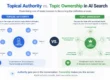
Alt text: A minimal professional graphic representing the three layers of authority: Information, Reputation, and Transaction, using a flat design aesthetic, .jpg format.
Topical Authority: The 30-Article Threshold
One of the most significant shifts we’ve seen recently is the move away from "one-off" viral posts toward deep topical clusters. In 2026, the data is clear: sites that establish "Topical Authority" see a 40–70% increase in keyword rankings within just a few months.
What does that look like in practice? It means you can’t just write one great article about a subject. You need to build a cluster of 25 to 30 semantically connected pieces of content. This signals to Google that you aren’t just "mentioning" a topic, you own it.
Search engines now assess the "co-occurrence of relevant n-grams and entities." If you’re writing about digital marketing but don't have deep-dive content on AI-powered analytics, schema integration, and entity mapping, the search engine decides your expertise is shallow. It will "see" you, but it won't "choose" you as the definitive answer for complex queries.
E-E-A-T is No Longer Optional, It’s the Barrier to Entry
We used to talk about E-E-A-T (Experience, Expertise, Authoritativeness, and Trustworthiness) as a "nice to have" or a "best practice." In the AI-driven landscape of 2026, it is the fundamental filter.
AI-generated fluff has flooded the internet. To combat this, Google has dialed up the "Experience" and "Trust" signals to eleven. They are looking for:
- First-person perspectives: "We tested this…" or "In our experience with [Client Name]…"
- Author Transparency: Real humans with real credentials (which is why our owner, Eric Richmond, stays so involved in our strategic direction).
- Consistency: Does your site say the same thing as your LinkedIn, your industry interviews, and your white papers? AI systems detect "Truth Gaps" instantly. If your messaging is inconsistent, your authority score plummets.

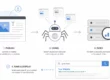
Alt text: A clean, minimal flat design icon set representing Experience, Expertise, Authoritativeness, and Trust, professional and modern, .jpg format.
How to Audit Your Own Authority Gap
Are you being seen, or are you being chosen? Ask yourself these three questions:
- Do we appear in AI Overviews for our primary keywords? If you’re ranking #1-5 but aren't cited in the AI summary, you have a structural information problem.
- Does our brand appear in the Knowledge Graph? Search for your brand name. If a Knowledge Panel doesn't appear, or if it lacks detail, the "Reputation Layer" of your SEO is broken.
- Is our content citable? If an AI bot read your latest blog post, would it find a unique statistic, a proprietary framework, or a specific case study it could use to answer a question? If the answer is "no," you’re just contributing to the noise.
The Bottom Line: Be the Source, Not the Echo
The Authority Gap is widening every day. As search engines become more sophisticated, they will continue to favor brands that provide the "definitive" version of the truth. Being "seen" is a vanity metric; being "chosen" is a business strategy.
You can't close this gap with yesterday’s tactics. You need a forward-looking approach that treats SEO as an exercise in brand authority and technical excellence. Whether you are a solo founder or an enterprise marketing director, the requirement is the same: you must prove to the machines: and the humans they serve: that you are the only logical answer.
If you’re ready to stop hoping for clicks and start owning your niche, let's talk about building your authority.
Ready to bridge the gap?
Book a consultation with our team today and let’s turn your visibility into authority.