If you’re still optimizing for single keywords and checking off meta tags like it’s 2018, you’re not just behind the curve: you’re practically invisible to the modern web.
The search landscape has shifted from traditional SEO to Answer Engine Optimization (AEO). In this new world, success doesn’t come from chasing isolated terms. It comes from understanding how real people search, how their questions connect, and how to organize content around those relationships. Search engines want to know if you own the "topic," not just the "term."
At Expert SEO Consulting, we realized years ago that manual keyword research couldn't keep up with this evolution. The real challenge wasn’t finding more keywords. It was building a smarter strategy around them. To help our clients win, we developed our own proprietary keyword clustering tool. It’s the engine that powers our topical authority strategies, and today, I’m going to pull back the curtain on how we use it to help brands dominate their niches at scale.
The Death of the "Single Keyword" Strategy
Let’s be honest: the days of "one page, one keyword" are dead. If you try to rank for "best espresso machine" without having a comprehensive ecosystem of content around "espresso extraction," "burr grinder calibration," and "milk frothing techniques," the AI crawlers will skip right over you. They perceive your site as a shallow resource rather than an authoritative destination.
The problem? Mapping out those thousands of related terms manually is a nightmare. It takes weeks of spreadsheet gymnastics to identify which terms belong together and which require separate pages. This is the bottleneck that kills growth.

Enter Keyword Clustering: The Architecture of Authority
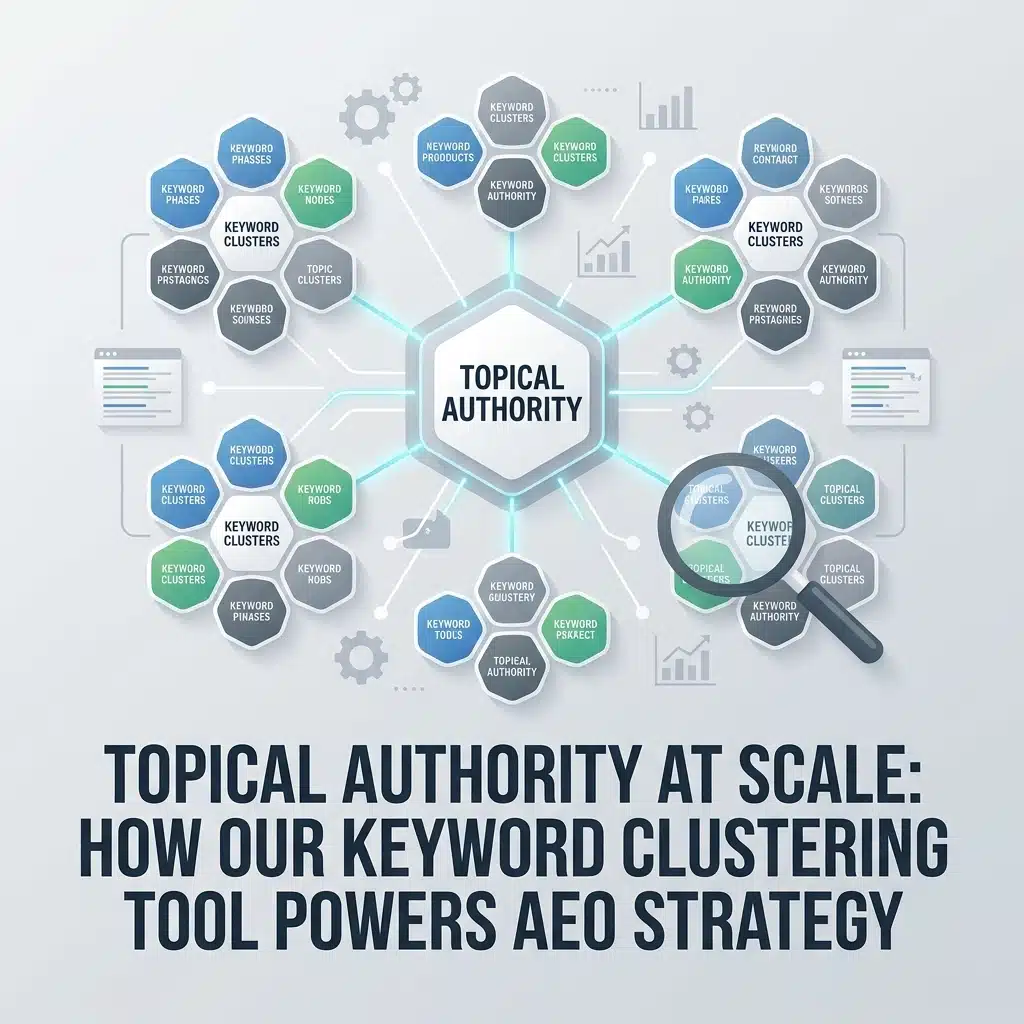
Keyword clustering is the process of grouping keywords into "buckets" based on search intent and semantic similarity. Instead of a flat list of 5,000 keywords, you end up with 50 strategic content pillars.
Our proprietary tool at Expert SEO Consulting doesn't just group words that look similar; it uses SERP-based logic. By analyzing the overlap in top-ranking URLs for different queries, the tool identifies exactly which keywords Google considers to be part of the same "intent." If 80% of the results for "Term A" and "Term B" are the same, our tool tells us they belong on the same page.
But the tool is only part of the story. The real value comes from the strategy behind the clustering. Someone still has to decide what deserves a pillar page, what belongs as supporting content, where intent shifts enough to justify a separate asset, and how those pieces should connect across the site. That human layer is what turns raw keyword groupings into a content strategy that actually moves the needle. It prevents keyword cannibalization: where your own pages compete against each other: and ensures that every piece of content you publish serves a specific, non-overlapping purpose in your topical map.
Why AI Crawlers Crave Clusters
Why does this matter for AEO? When an AI like Google’s SGE (Search Generative Experience) or a LLM (Large Language Model) summarizes an answer for a user, it draws from sources that demonstrate the most comprehensive understanding of the subject.
By using semantic clustering, you are essentially "feeding" the AI a structured map of your expertise. You aren't just providing an answer; you’re providing the context. Our tool helps us identify the "semantic gaps" in your current content: the missing pieces of the puzzle that, once filled, signal to the crawlers that you are the ultimate authority.
When your site covers every nuance of a topic, your "topical authority" score skyrockets. This doesn’t just help you rank for one competitive term; it creates a "halo effect" where all pages in that cluster start rising in the rankings simultaneously.

Scaling Topical Authority Without the Headaches
The "at scale" part is where most agencies trip up. It’s easy to build topical authority for a tiny niche with five articles. It’s a different beast entirely when you’re dealing with an enterprise site or a highly competitive national market.
Our process follows a rigorous path to ensure nothing is left to chance:
- Massive Keyword Extraction: We pull every possible query related to your business, often reaching 10,000+ data points.
- Proprietary Clustering: Our tool processes these keywords, identifying the "Pillar" topics and the "Supporting" sub-topics.
- Intent Mapping: We categorize each cluster by where the user is in the funnel (Informational, Transactional, Navigational).
- Gap Analysis: We compare this map against your existing site. Where are you strong? Where are the "content deserts"?
This is where our SEO audits become a strategic weapon. We don’t just look for broken links; we look for structural weaknesses in your topical authority. We find the places where you have 50 keywords ranking on page 4 because you haven't grouped them into a coherent cluster.
Turning Data into AEO Dominance
Once the tool has generated the clusters, the execution becomes a game of precision. We use the clusters to build "Content Hubs."
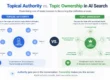
Imagine a central Pillar Page that provides a high-level overview of a major topic. Surrounding it are 10–15 "Cluster Pages" that dive deep into specific sub-topics. These pages are all internally linked in a way that passes maximum "authority" back and forth.
Being the "source of truth" for a cluster is the only way to improve your chances of being cited when search engines generate answers and summaries. If you only have one disconnected page on a topic, the AI is unlikely to trust you as a primary source. But if you have an interconnected web of 20 high-quality pages? You become the go-to reference.

The Result: Faster Growth and "Moated" Rankings
We’ve seen it time and again: sites that move to a cluster-based model gain traffic significantly faster than those using traditional methods. Why? Because you’re working with the algorithm’s desire for context rather than trying to trick it with keyword density.
When you own a cluster, you create a "moat" around your rankings. A competitor might write a better single article than you, but they can’t easily replicate an entire ecosystem of 50 interlinked, authoritative pages. That is how you protect your traffic in the age of AI.
Stop Guessing, Start Clustering
The shift in search behavior isn't a "maybe" anymore: it’s the current reality. If your content strategy is still based on gut feelings or a list of random keywords from a basic tool, you are leaving your traffic to chance.
At Expert SEO Consulting, we believe in data-driven authority guided by human strategy. Our keyword clustering tool takes the guesswork out of the equation, but the real advantage comes from knowing how to turn those clusters into a clear, scalable roadmap to becoming the leader in your niche. We help you build the structures that search engines respect and that users find genuinely helpful.
Are you ready to see what your topical map actually looks like? Are you tired of seeing your competitors show up in the AI snippets while you’re stuck on page two?
Don't wait for the next algorithm update to realize your strategy is outdated. Let’s build your topical authority together.
Book a consultation with our team today and let's put our proprietary tools to work for your brand.