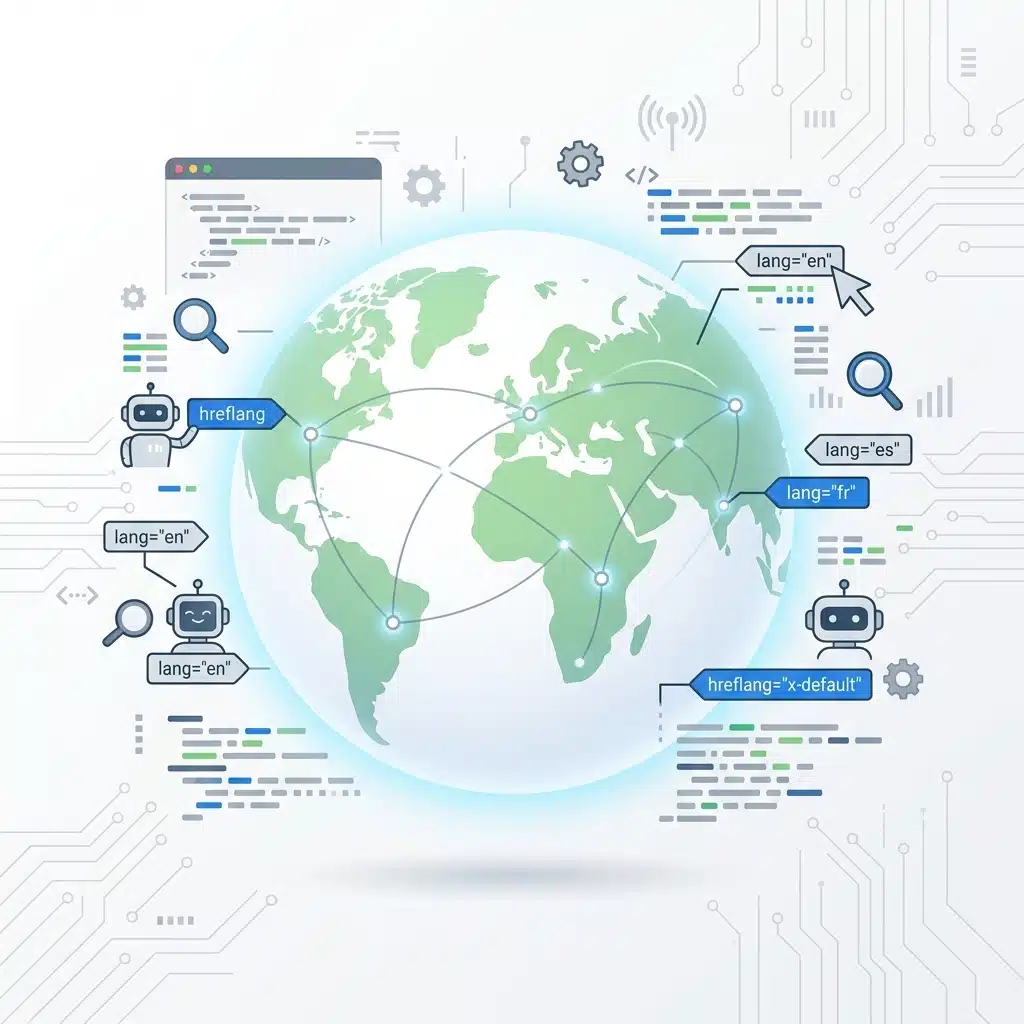
58% of Google searches are now AI-powered. If that statistic doesn't make you pause, it should. We aren't just optimizing for a list of blue links anymore; we are optimizing for a world where AI agents synthesize, translate, and serve content directly to users. In this new landscape, the margin for error has vanished.
If you’re operating a global brand, your technical SEO setup: specifically your hreflang tags: is no longer just a "best practice." It is the difference between being cited as an authority in Madrid or being completely hallucinated out of existence because an AI crawler couldn't figure out which version of your site to trust. Welcome to the era of Agentic Engine Optimization (AEO).
The Death of Traditional International SEO
For years, international SEO was relatively straightforward. You set up your subdirectories or CCtlds, threw some hreflang tags into the <head>, and hoped Googlebot would correctly map your English site to US users and your Spanish site to Mexican users. If you messed it up, the worst-case scenario was usually a bit of duplicate content confusion or the wrong currency appearing in search results.
That era is over.
Today’s AI crawlers: the engines behind Search Generative Experience (SGE), Gemini, and OpenAI’s search capabilities: are far more sophisticated and, paradoxically, more sensitive to technical signals. They don’t just "index" your pages; they "understand" them to provide direct answers. When an AI agent encounters a global site without a validated hreflang structure, it creates a massive friction point.

Visual: A minimal flat design illustration showing an AI robot head connected to various global map icons via digital threads.
What is Global AEO?
Agentic Engine Optimization (AEO) is the evolution of SEO. While SEO focuses on visibility in search engine results pages (SERPs), AEO focuses on being the preferred source of truth for AI agents.
When a user in Paris asks an AI, "What is the best enterprise SEO strategy for 2026?" the AI doesn't just look for a French page. It scans the global web. If your site has high-authority content in English but a poorly mapped French version, the AI might attempt to translate your English page on the fly or, worse, cite a competitor who has a technically perfect localized setup.
Global AEO requires you to provide explicit, machine-readable signals that tell these AI crawlers exactly which content belongs to which locale. This is where your hreflang validator becomes your most important tool. Without it, you are leaving your global reputation up to an algorithm’s best guess.
Why Hreflang is the Language of AI Agents
You might think that because LLMs (Large Language Models) are great at translation, they don't need hreflang tags. That is a dangerous assumption.
AI crawlers use hreflang tags as a primary trust signal. Here is why they matter more now than ever:
- Cross-Lingual Synthesis: AI systems synthesize information from multiple sources. If your hreflang tags are broken, the AI may treat your localized pages as separate, competing entities rather than a unified global brand. This dilutes your authority.
- Contextual Accuracy: An AI agent needs to know if your "Spring Sale" is happening in March (Northern Hemisphere) or September (Southern Hemisphere). Hreflang tags provide the regional context that prevents AI from giving users inaccurate, localized information.
- Citation Quality: When 58% of searches are AI-powered, getting cited is the new "ranking #1." AI agents are programmed to cite the most relevant, localized source. If your technical SEO isn't airtight, you won't get the citation.
To ensure your site is ready for this shift, you must start with a comprehensive SEO Audit. You cannot fix what you haven't diagnosed, and in the world of AEO, a single syntax error in your language code can tank your global visibility.
The Role of the Hreflang Validator
In the past, you might have checked your hreflang tags once a year or during a site migration. In the age of AEO, that is a recipe for disaster. Sites are more dynamic than ever, and AI crawlers are visiting your pages more frequently.
A Hreflang Validator is no longer a luxury; it is an essential part of your technical stack. It ensures that:
- Return Tags Exist: Every page pointing to a localized version must be pointed back by that version. If the link is broken, AI crawlers view the relationship as untrustworthy.
- Language Codes are Valid: Using
en-UKinstead ofen-GBmight seem like a small typo, but it confuses the logic of an AI agent trying to map regional relevance. - Self-Referencing Tags are Present: AI crawlers use self-referencing tags to confirm they have reached the correct "canonical" version for that specific language/region.

Visual: A minimal flat design graphic showing a checklist with green checkmarks next to "Valid Language Codes," "Return Tags," and "Regional Targeting."
Technical SEO: The Foundation of AEO
Let’s be clear: AEO is not a replacement for technical SEO; it is a higher standard of it.
If your site architecture is a mess, an AI crawler isn't going to spend extra compute power trying to solve your puzzle. It will simply move on to a site that is easier to parse. This is why we emphasize that technical SEO references: like schema markup, site speed, and specifically, international targeting: are the bedrock of any digital marketing strategy in 2026.
Declarative statements are necessary here: If your technical SEO is broken, your AI visibility will be non-existent.
When we perform SEO Audits, we frequently find that international sites have "ghost" pages: translated versions that aren't properly linked via hreflang. To an AI, these pages look like duplicate content or, worse, low-quality spam. A validator catches these errors before the crawlers do.
The High Cost of "Good Enough"
"We'll just let the browser auto-translate it."
I hear this from business owners all the time. It is a fundamental misunderstanding of how the web works in 2026. Auto-translation is for the user's convenience, but it does nothing for the crawler's understanding.
When you neglect proper hreflang implementation, you are essentially telling Google’s AI: "I don't care enough about this market to give you a clear map."
The AI will respond in kind by ignoring you.
With 58% of searches being AI-powered, the volume of traditional "click-through" traffic is changing. Users are getting their answers in the AI overview. If you aren't the source of that answer because your regional tags were confusing, you’ve lost that customer before they even knew you existed.
Strategy: How to Optimize for Global AEO Today
So, what do you need to do right now to ensure your brand survives the agentic shift?
- Audit Your International Footprint: Use professional tools to crawl your site exactly like an AI agent would. Look for inconsistencies in your regional targeting.
- Implement a Hreflang Validator Protocol: Don't just set it and forget it. Integrate validation into your CI/CD pipeline or your monthly SEO maintenance.
- Prioritize Entity Clarity: Ensure your localized pages use Schema.org markup that mirrors your hreflang strategy. This double-layer of communication makes it impossible for an AI to misunderstand your intent.
- Monitor AI Citations by Region: Watch how AI engines are citing your site in different languages. If you see your English site being cited in a German AI response, your hreflang tags are likely broken.

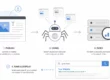
Visual: A flat design flowchart showing a 4-step process: Audit -> Validate -> Implement Schema -> Monitor Citations.
The Future is Agentic
We are moving toward a web where "searching" is replaced by "asking." In this world, AI agents act as intermediaries between your business and your customers. These agents are strictly logical; they follow the paths of least resistance and the signals of highest authority.
Hreflang tags are the coordinates those agents use to navigate the global web. If your coordinates are off, you're invisible.
Expert SEO Consulting has seen the landscape shift fundamentally over the last year. The companies that are winning are the ones that treated technical SEO as a foundational requirement rather than a one-time project. They are the ones who invested in high-quality audits and rigorous validation.
You cannot afford to wait for your international traffic to drop before you take this seriously. The AI transition is happening in real-time.
Don't Leave Your Global Strategy to Chance
If you haven't looked at your international technical setup in the last six months, it's already outdated. The crawlers have changed, the search engines have changed, and the stakes have never been higher.
Is your site ready for the 58% of users using AI-powered search? Are your hreflang tags acting as a bridge or a barrier to your global audience?
Stop guessing and start optimizing. Our team at Expert SEO Consulting specializes in the complex technical architecture required for modern Global AEO. We help you ensure that when an AI agent looks for an answer, it finds your brand: no matter the language or location.
Ready to future-proof your global presence?
Book a consultation with our experts today and let’s make sure your site is ready for the agentic revolution.