Traffic analytics are telling half-truths right now, and marketing teams are paying the price. When 48% of all tracked Google queries now trigger an AI Overview: serving an estimated 2 billion monthly users globally: traditional metrics like organic position and click-through rates no longer explain where your brand actually stands in the digital ecosystem.
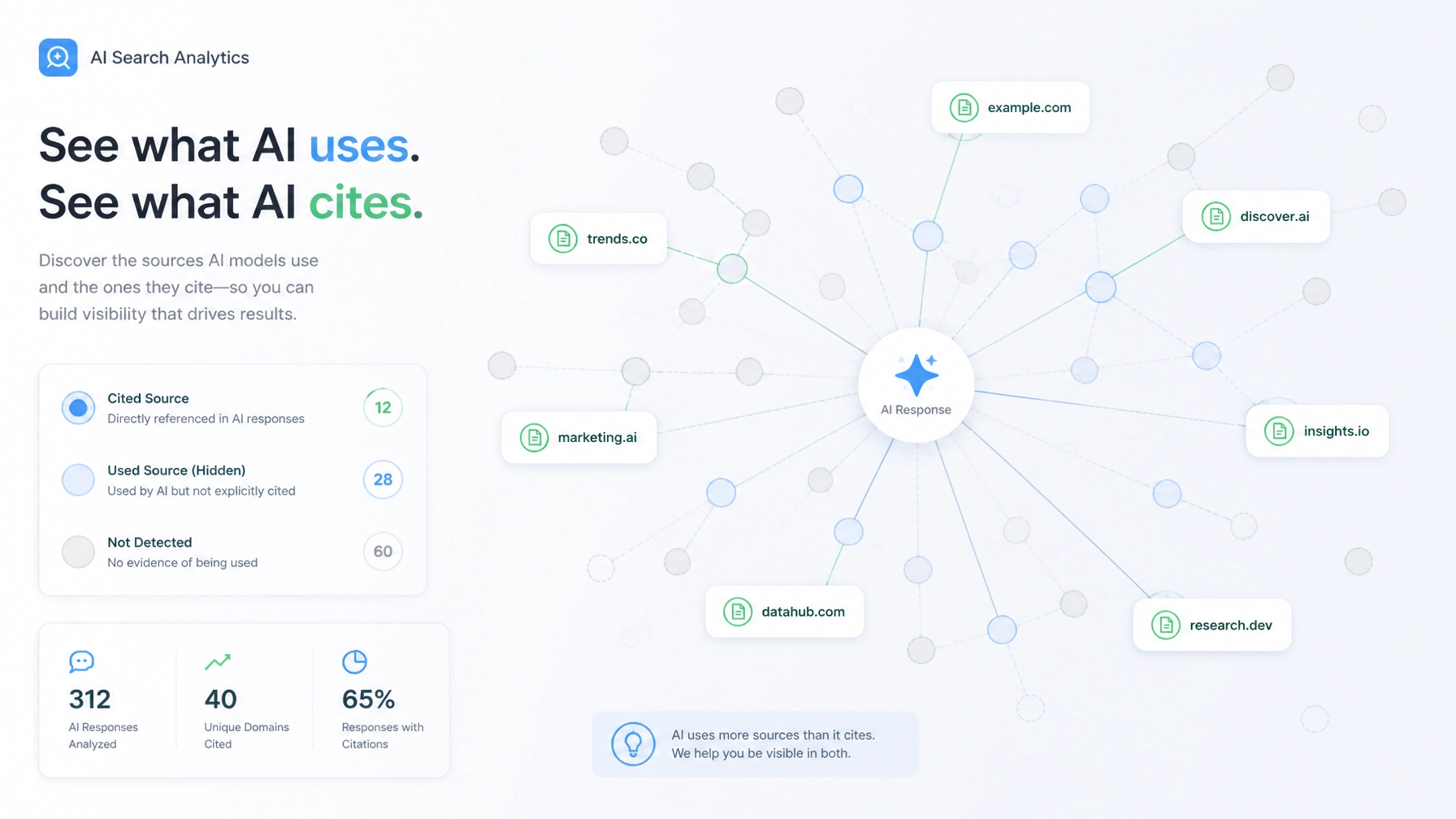
You already know that AI search has altered how users find answers, but here is what most digital strategists miss: being present in an AI-driven search result is no longer a binary win or loss. Today, search engines evaluate and utilize brands through two distinct operational lenses: Used and Cited.
If your reporting dashboard only tracks visible link clicks from AI Overviews, you are flying blind. Let's dissect the 2026 frameworks for measuring AI search volume, examine how platforms like CiteMetrix and Peec AI operate, and map out the exact strategy required to move your domain from silent retrieval to visible authority.
The Core Schism: What "Used vs. Cited" Means for AI Overviews
Modern generative engines do not work like traditional index-and-rank algorithms. When a user executes a complex query, Large Language Models (LLMs) and retrieval-augmented generation (RAG) systems fetch dozens of source documents to reason through the answer.
However, only a tiny fraction of those fetched documents ever appear as clickable cards in the user interface. This creates a profound operational divide:
- Used Sources: Documents and URLs that the model retrieves, parses, and uses to formulate its reasoning and factual grounding, but which never appear as visible UI citations [14].
- Cited Sources: URLs that the engine both uses and exposes as visible links (such as the carousel cards beneath an AI Overview or the inline citations in a Perplexity response) [14].

This distinction shatters traditional attribution models. A brand can heavily influence an AI-generated answer: shaping the narrative, products, or definitions presented to the user: without capturing a single direct referral click. Conversely, a site might occasionally snag a peripheral citation while having zero foundational impact on the model's underlying knowledge synthesis.
Understanding this reality requires specialized visibility analytics. While platforms like CiteMetrix track cross-engine citation shares and domain-level visibility across platforms like ChatGPT and Perplexity, emerging URL-level diagnostic tools separate latent use from visible interface exposure [1, 5, 14]. For organizations looking to modernize their measurement, conducting regular SEO audits is essential to diagnose whether your content is being parsed or ignored.
The 2026 AI Search Landscape: Volume, Coverage, and Traffic Realities
To understand why this framework matters, you have to look at the sheer scale of AI-mediated discovery in 2026. Recent industry benchmarks from BrightEdge and Advanced Web Ranking reveal that AI Overviews appear on approximately 48% of all tracked Google queries, representing a massive consolidation of screen real estate [8, 10, 15].
At the same time, platform diversification is accelerating:
- ChatGPT processes billions of daily queries and commands over 75% of AI referral traffic, heavily favoring established news aggregators, Wikipedia, and structured knowledge bases [3, 12, 18].
- Perplexity has seen triple-digit year-over-year growth, operating on a citation-first model that averages 16 to 22 citations per response and indexes niche expert domains at remarkably high rates [3, 12, 18].
Despite this massive query volume, traffic dynamics have shifted. Referral clicks from AI Overviews often yield lower raw volume than traditional #1 organic rankings, but the inbound traffic is significantly higher in commercial intent and conversion quality. Users who click an AI citation have already digested the synthesized overview and are seeking deeper validation or transactional capability.
To capture this high-intent traffic, brands must understand how an AI citation tracker strengthens your search visibility. Without granular tracking, you cannot distinguish between a drop in traditional rankings and an expansion of silent, non-cited AI usage.
Inside the Source Mix: Who Wins the Citation War?
Large-scale citation studies across 2026 highlight a clear hierarchy in how search engines populate their visible citation layers. The distribution is heavily skewed toward platforms with high structural authority and user-generated engagement:
- YouTube: Dominates as the #1 single-domain citation source for Google AI Overviews, capturing roughly 20% to 23% of total citation share due to multimodal parsing [2, 15].
- Wikipedia: Maintains its position as a top-2 foundational source across major AI engines, appearing in nearly 18% of analyzed overview sets [2, 15].
- Reddit & Community Forums: Have experienced an unprecedented surge in 2026 as search engines officially integrate community perspectives and firsthand experiences into answer boxes [2, 8, 13].
- Proprietary Knowledge Graphs & Brand Assets: Enterprise domains with robust brand search volume consistently outperform smaller niche sites in both the "used" and "cited" tiers.

Recent research published by ConvertMate across 80 million AI citations highlights a critical leading indicator: brand search volume boasts a correlation coefficient of 0.334 with AI citation frequency: outperforming traditional backlink counts in several regression models [17]. When users actively search for your brand name across the web, AI retrieval models register your entity as an authoritative anchor, elevating you from an unreferenced background source to a prominently cited entity.
Strategic Playbook: Moving from "Used" to "Cited" Status
Acknowledging the gap between being used by an algorithm and being cited by an interface is the first step. Closing that gap requires a deliberate pivot in how you structure, publish, and optimize your digital assets.
Here is your actionable framework for 2026:
- Audit Your Content Architecture for RAG Suitability: AI engines do not read web pages the way humans do; they parse semantic chunks. Ensure your content utilizes clear heading hierarchies, explicit entity definitions, and concise summary tables that make information easy for retrieval models to ingest and attribute.
- Perform Comprehensive Content Gap Analyses: Identify where competitors are capturing visible citations for queries where your brand is currently absent or only silently "used." A rigorous content gap analysis uncovers the exact topical angles missing from your library.
- Amplify Off-Page Entity Signals: Because brand search volume is the strongest predictor of AI retrieval, invest in digital PR, podcast appearances, and community engagement on platforms like Reddit and industry forums. Make your brand impossible for an LLM to ignore.
- Deploy Modern AI Visibility Tooling: Move beyond legacy rank-tracking software. Utilize multi-engine analytics stacks to monitor your domain's footprint across AI Overviews, Perplexity, and ChatGPT.
The rules of search visibility have been rewritten. Organizations that cling to legacy keyword-ranking metrics will continue to watch traffic evaporate, while forward-thinking brands master the nuances of retrieval and citation.
Ready to secure your position in the new AI search ecosystem? Book a consultation with Expert SEO Consulting today to audit your AI visibility and future-proof your digital marketing strategy.