For years, digital marketers treated topical authority as the ultimate finish line. If you published enough interconnected content, structured your internal links correctly, and demonstrated robust E-E-A-T (Experience, Expertise, Authoritativeness, and Trustworthiness), search engines would reward you with top-tier visibility. But the rise of generative search and large language models (LLMs) has fundamentally rewritten the rules of engagement. Studies on AI citation behavior reveal a striking reality: traditional domain authority accounts for less than 4% of citation variance in AI search results, while structural depth and contextual relevance dictate the rest.
Being recognized as an expert across a broad subject area is no longer a golden ticket to the top of an AI-generated answer. Today, survival in the search landscape requires moving past mere topical authority and achieving topic ownership: the rare, highly defensible state where AI systems consistently select and cite your brand as the definitive source.
Defining the Divide: Topical Authority vs. Topic Ownership
To understand why traditional SEO playbooks are falling short, we must examine the fundamental mechanics separating authority from ownership.
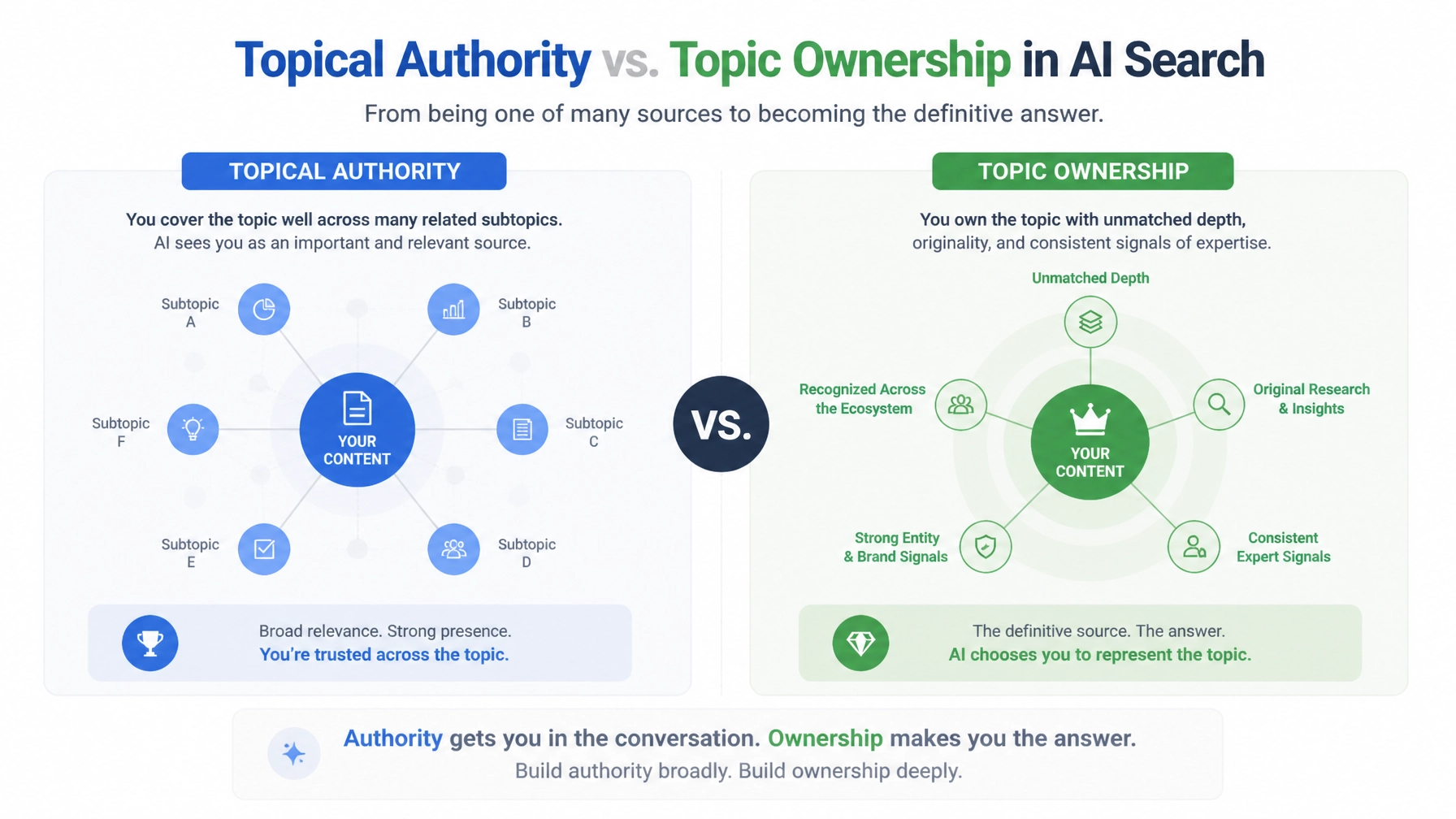
- Topical Authority (What you've built): This is a site-level attribute. It signals that your domain covers a subject comprehensively through a structured cluster of articles, entities, and supporting pages. It proves to crawlers that you understand the breadth and depth of an industry.
- Topic Ownership (Whether the system picks you): This is a competitive selection state. It represents the exact moment AI systems prefer, trust, and repeatedly cite your entity as the primary answer across dozens of related prompts: leaving competitors behind in the zero-sum game of generative summaries.

As digital strategists frequently note when evaluating organic SEO services, authority gets you into the candidate pool. Ownership determines who gets picked. When an AI engine constructs a synthesized answer, it doesn't display ten blue links where everyone gets a trophy; it curates a concise, authoritative narrative backed by a handful of trusted citations. If your content merely matches the industry baseline, you remain an option among many rather than the definitive authority.
Why Topic Ownership is Rare (and Why Expertise Falls Short)
In conventional search engines, a searcher receives a page of diverse results containing multiple viewpoints and competing domains. In AI-driven search environments, however, the paradigm shifts to a winner-take-most model.
Achieving topic ownership is difficult because LLMs evaluate information through strict retrieval-augmented generation (RAG) filters. They look for:
- Absolute Extractability: Can the machine parse your data points, definitions, and frameworks instantly without wading through conversational fluff?
- Semantic Uniqueness: Do you offer proprietary insights, empirical studies, or structural frameworks that competitors cannot replicate?
- Entity Consensus: Are you recognized across external knowledge graphs and industry citations as the primary entity associated with the query?
When businesses rely solely on publishing standard blog posts that paraphrase existing industry consensus, they build generic topical authority without establishing ownership. AI models recognize that the content is relevant, but they have no compelling reason to single it out as the singular source of truth. Conducting a rigorous content gap analysis is essential to identify where your content meets industry standards: and where it fails to stand out as the definitive market leader.
How AI Models Determine Ownership vs. General Authority
Large language models determine ownership by evaluating three critical dimensions: Coverage, Architecture, and Position.
[Coverage: Depth & Breadth] + [Architecture: Machine-Readable Flow] + [Position: Off-Page Consensus] = Topic Ownership
- Coverage: How thoroughly have you addressed every conceivable subtopic, edge case, and user intent within your niche? Ownership requires answering questions your competitors haven't even thought to ask.
- Architecture: How is your content organized? AI models thrive on pristine semantic hierarchies, clear definitions, schema markup, and logical internal linking structures. When your site's architecture mirrors how humans naturally explore complex subjects, machine crawlers can easily map and trust your entity relationships.
- Position: Off-page signals and external validation. Being cited by industry peers, referenced in academic literature, and acknowledged across entity graphs solidifies your position at the top of the retrieval hierarchy.
Understanding these dynamics requires a shift in how marketing teams audit their digital footprint. As explored when analyzing how an AI citation tracker strengthens your search visibility, monitoring how AI systems reference your brand across different prompt variations is just as important as tracking traditional keyword rankings.
Tracking Entity-Level Authority with CiteMetrix & Advanced Measurement
Traditional analytics tools measure keyword positions, click-through rates, and estimated traffic. They fail, however, to capture whether an AI model considers your brand the owner of a specific category.
This is where specialized tracking platforms: often categorized around entity metrics and citation tracking (such as CiteMetrix-style methodologies): change the game. These modern measurement frameworks evaluate:

- Prompt-Level Share of Mentions: Tracking your brand's presence across curated prompt sets related to your core topics. An "owner" typically appears in at least 80% of related prompts and maintains a commanding lead over runners-up.
- Citation vs. Mention Dynamics: Differentiating between when an AI names your brand in text versus when it directly hyperlinks to or cites your URL as an authoritative source.
- Ownership Durability: Measuring month-over-month retention of top citation placement. True topic ownership exhibits high durability, remaining stable even as underlying algorithms update.
Without tracking these entity-level metrics, organizations remain blind to how generative search engines perceive their brand value.
A Practical Framework for Building Toward Topic Ownership
Transitioning from broad topical authority to true topic ownership demands a deliberate, systematic approach. Here is a four-step framework your organization can implement immediately:
- Audit Your Semantic Architecture: Map out your core topic clusters. Ensure your pillar pages and supporting articles are connected through clean, logical internal links that guide both human readers and AI crawlers effortlessly.
- Uncover Invisible Gaps: Use a specialized website content gap analysis tool to pinpoint missed subtopics, unanswered user queries, and superficial explanations in your existing library.
- Optimize for Machine Extractability: Restructure dense paragraphs into clear definitions, bulleted summaries, comparative tables, and precise schema markup. Make it effortless for an LLM to quote your expertise verbatim.
- Build Unshakable Entity Consensus: Shift your link-building and PR efforts toward securing high-authority citations and third-party validation that reinforce your brand as the primary entity in your domain.
+-------------------------------------------------------+
|                Topic Ownership Roadmap                |
+-------------------------------------------------------+
|  1. Audit semantic architecture & internal linking    |
|  2. Uncover and close deep content gaps               |
|  3. Format content for instant machine extractability |
|  4. Track AI citation share & entity-level consensus  |
+-------------------------------------------------------+
Conclusion: Claim Your Market Before Algorithms Choose For You
The digital search landscape is unforgiving to brands that settle for being "good enough." While topical authority opens the door to the conversation, topic ownership locks it from the inside, ensuring that when potential customers turn to AI for answers, your business is the only name mentioned.
Navigating this transition requires more than standard SEO tactics: it demands a forensic understanding of how modern algorithms evaluate expertise, structure, and entity authority.
Ready to transform your brand from a background player into the definitive owner of your industry's most valuable topics? Book a consultation with our expert team today to discover how we can elevate your search visibility for the AI era.