You built a superior product, optimized your website for modern search engines, and delivered exceptional value to your customers: yet when potential buyers ask ChatGPT, Claude, or Gemini for recommendations in your industry, your name remains conspicuously absent. Instead, legacy competitors with inferior offerings dominate every generative response.
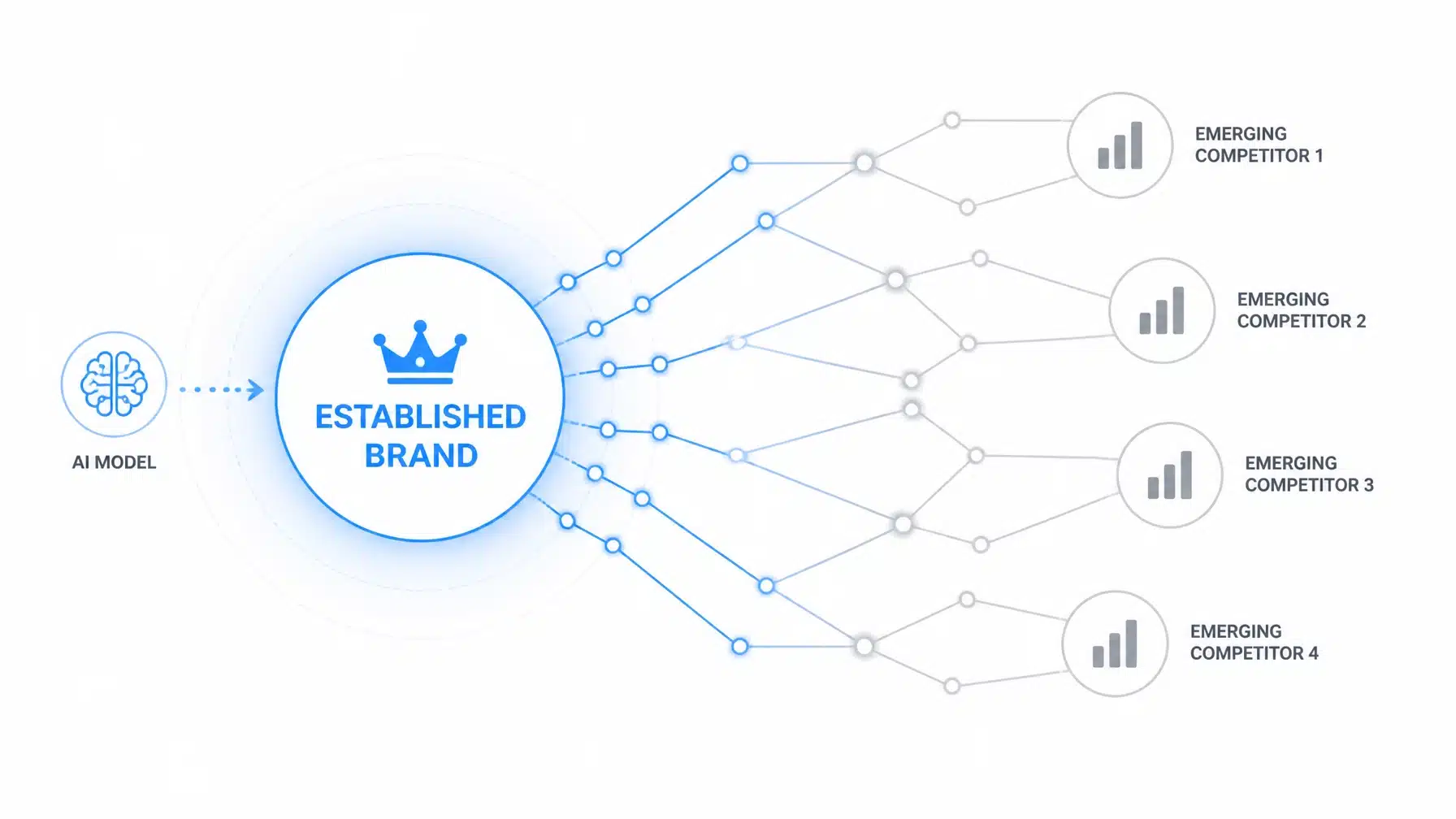
What you are experiencing is not an accident of code. It is brand familiarity bias, a structural phenomenon reshaping digital visibility.
Recent studies tracking generative search behavior reveal that large language models (LLMs) favor familiar, established brand names 3.2 times more often than lesser-known competitors, with dominant entities capturing over 55% of all model citations. Furthermore, research demonstrates that 63% of brand-specific searches in AI assistants focus exclusively on each model's five most familiar entities.
For emerging and mid-market brands, this creates an invisible glass ceiling. In an ecosystem where traditional search engine result pages (SERPs) are rapidly being replaced by synthesized conversational answers, traditional SEO tactics alone are no longer sufficient. Understanding how AI models process brand familiarity: and learning how to inject robust brand signals into training data and vector embeddings: is now essential for survival.
The Anatomy of Brand Familiarity Bias in LLMs
To understand why AI models exhibit such stark favoritism toward established names, we must examine how LLMs are trained and queried.
Unlike traditional search engines that crawl web indexes in real-time to retrieve documents based on keyword matching, LLMs generate responses derived from probabilistic associations learned during pre-training and fine-tuning. Global brands like Nike, Apple, or Salesforce appear in training corpora: books, news articles, academic papers, and forum discussions: orders of magnitude more frequently than regional or newer competitors.
+-----------------------------------------------------------------+
|               Training Data Frequency Disparity                 |
+-----------------------------------------------------------------+
| Established Incumbent Brand [████████████████████] High Density |
| Emerging Competitor Brand   [████] Low Density                  |
+-----------------------------------------------------------------+
This massive imbalance in training data creates severe associative weighting. When an AI model encounters a vague prompt or a category-level query (e.g., "What is the best enterprise HR software?"), its parametric memory immediately surfaces high-frequency entities. The model’s internal weights equate frequency of mention with authority and reliability, automatically defaulting to safe, recognizable names.

The consequence is a self-fulfilling prophecy: because the model mentions established brands more often, users engage with them more frequently, generating new web text that further reinforces the brand's footprint in subsequent model updates.
Why AI Equates Frequency with Authority
Human beings often fall victim to the familiarity heuristic: the psychological tendency to prefer things we already know. However, AI models do not "prefer" brands out of psychological comfort; they do so through mathematical probability.
When LLMs construct multi-step reasoning chains or execute complex fan-out queries (where a single prompt triggers dozens of sub-searches across knowledge bases), they rely heavily on semantic proximity. Brands that are deeply embedded across diverse semantic clusters (news, reviews, Reddit discussions, Wikipedia, and whitepapers) possess a higher vector density.
[User Query]
     │
     ▼
[AI Model Fan-Out Engine] ──► [High-Density Entity Vector]  (Instant Citation)
                          ──► [Low-Density Entity Vector]   (Filtered Out)
As our analysis of the secret engine of AI search and fan-out queries outlines, modern AI assistants break broad user prompts into granular thematic checks. If your brand lacks dense co-occurrence across those sub-topics, the retrieval-augmented generation (RAG) pipeline fails to surface your domain as a relevant authority, regardless of your on-page keyword optimization.
Tracking the Familiarity Gap with Advanced Analytics
Overcoming brand familiarity bias begins with measurement. You cannot optimize for what you cannot quantify.
Traditional rank trackers only show where you sit on a static Google SERP. They cannot tell you:
- How often Gemini recommends your product compared to a legacy rival.
- Whether Claude associates your brand name with positive industry attributes or treats you as an unknown entity.
- How your brand's citation share fluctuates across different AI engine updates.
This is where specialized tooling comes into play. By leveraging sophisticated platforms designed for AI visibility: supported by expert SEO tools support: marketing teams can audit their presence across generative engines.

As explored in our deep-dive on how an AI citation tracker strengthens your search visibility, tracking citation frequency allows businesses to identify exact gaps in their generative footprint. When you measure your brand share of voice in AI responses month-over-month, you can pinpoint which third-party authoritative sources (review sites, industry publications, developer communities) feed data into the LLMs dominating your niche.
Strategic Playbook: How Newer Brands Can Overcome AI Bias
Breaking through the incumbent advantage requires a deliberate shift from traditional keyword-based optimization to Generative Engine Optimization (GEO) and entity-first branding. Here is your actionable checklist to build inescapable brand signal in AI training data:
- Diversify Third-Party Entity Mentions: AI models verify brand legitimacy by cross-referencing multiple authoritative domains. Ensure your brand is prominently featured on trusted aggregators, industry review platforms, and niche directories that LLMs frequently scrape.
- Optimize for Semantic Co-Occurrence: Instead of focusing on single-word keywords, build content clusters that associate your brand name directly with high-value industry concepts, problems, and solutions.
- Secure High-Authority Editorial Citations: Platforms like Gemini and Claude lean heavily on reputable editorial publications. PR campaigns targeted at top-tier industry publications inject critical weight into your brand's knowledge graph nodes.
- Foster Community and Forum Discussions: LLM training corpora heavily index conversational platforms like Reddit and specialized forums. Authentic user advocacy and detailed product discussions on these platforms create invaluable training signals.
- Audit and Refine Structured Data: Implement robust JSON-LD schema markup (Organization, Product, SameAs properties) to explicitly define your brand entity to web crawlers and AI search agents.

Future-Proofing Your Brand in the Era of Generative Search
The shift from blue links to conversational AI answers is irreversible. Brands that rely solely on legacy SEO will continue to watch their organic traffic erode as AI models provide direct, consolidated answers that favor familiar names.
Overcoming the brand familiarity bias is not about outspending market giants; it is about strategically positioning your digital footprint so that AI models cannot ignore your existence. By systematically building entity authority, tracking your generative citation share, and optimizing for semantic relevance, you can transform your brand from an unknown challenger into an inescapable AI-recommended leader.
Ready to uncover your brand's true visibility in ChatGPT, Claude, and Gemini? Schedule a consultation with our team today to conduct a comprehensive AI citation audit and build your custom generative search strategy.