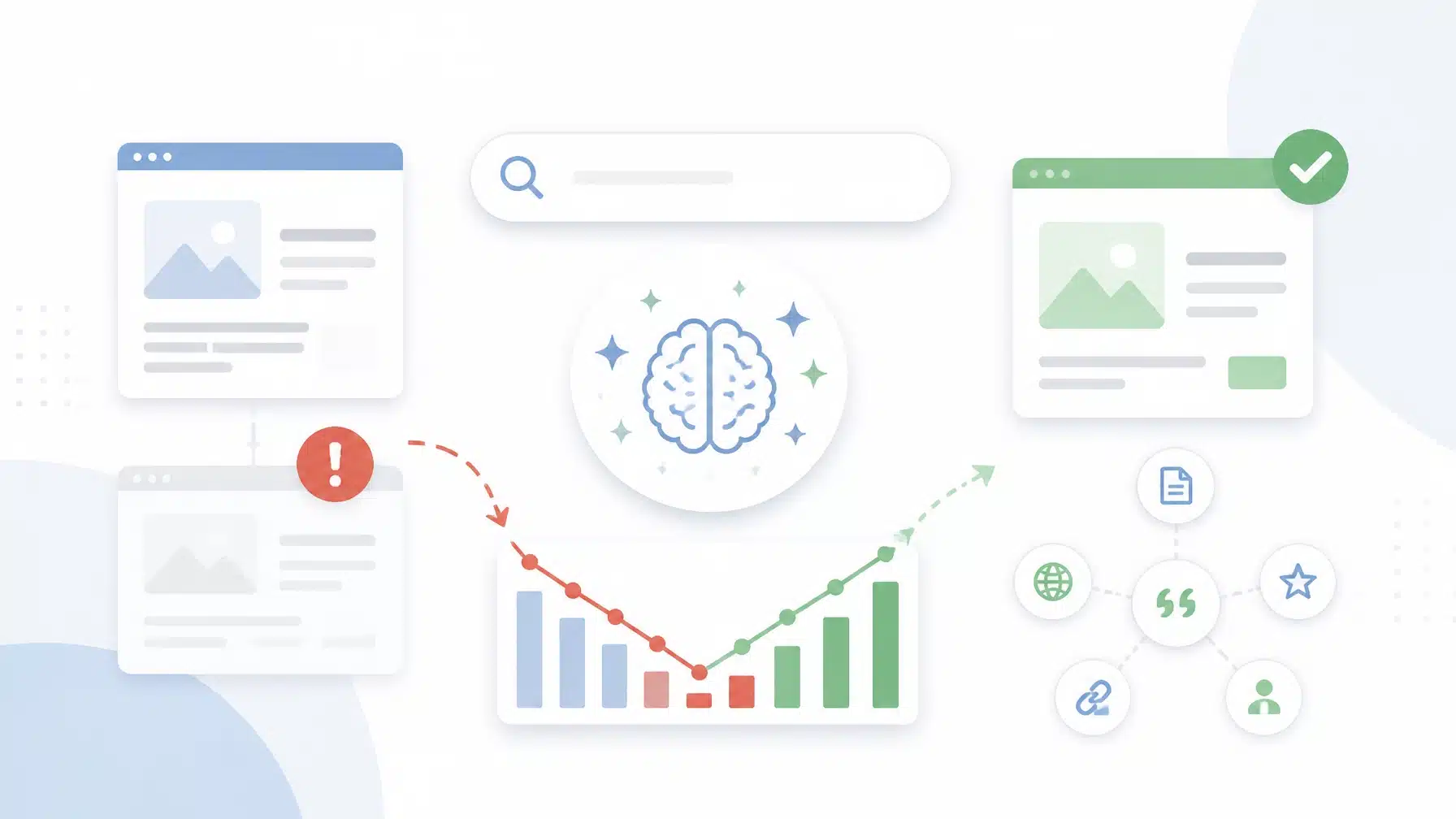
The search landscape didn't just shift; it shattered. If you feel like your organic traffic is slipping through your fingers, you aren't imagining it. As of June 2026, 58% of all Google searches are now AI-powered, meaning users are getting direct answers from AI Overviews (formerly SGE) without ever needing to click a link.
For businesses that haven't adapted, the impact has been brutal. Industry data shows that websites failing to optimize for AI visibility have seen traffic declines between 34% and 46% in the last twelve months. The era of ranking #1 and collecting clicks is over; today, you are either the source the AI cites or you are invisible.
Why is your site being left out of the AI conversation? It usually comes down to these 10 fundamental failures.
1. Your Content is a "Wall of Text"
AI models don't read like humans; they parse. If your pages consist of long, dense paragraphs without clear structural markers, the AI cannot identify "answer fragments" to pull into an overview. Large language models prefer content that is easily segmented.
The Fix: Transition to a "Chunked" content strategy. Use clear H2 and H3 headings that mirror common user questions. Break complex ideas into bulleted lists or numbered steps. This isn't just for readability: it’s about making your content machine-readable.
2. You’re Burying the Lead (and the Answer)
Marketing-heavy copy: the kind that starts with "At [Company], we are passionate about excellence": is the ultimate visibility killer in 2026. If a user asks a question and your answer is buried 800 words deep in a narrative, the AI will ignore you in favor of a competitor who provides an immediate, concise definition.
The Fix: Use the "Inverted Pyramid" style. Place a direct, one-to-two sentence answer to the primary query at the very top of your page. If you are explaining algorithm recovery services, define what they are and why they matter in the first paragraph.

3. The "Entity" Gap: You’re an Island
AI search engines use "Entity-Based SEO." They look at your brand as an object in a giant web of connections. If your website is the only place your brand is mentioned, the AI doesn't trust your authority.
The Fix: Build your digital footprint beyond your own domain. Consistent mentions in industry directories, third-party reviews, and guest features on high-authority sites are essential. The more "nodes" you have connecting to your brand across the web, the more likely the AI is to cite you as a trusted source.
4. Missing Schema: The Missing Translator
Think of Schema markup as the translator that speaks the AI's native language. Without structured data, you’re forcing the AI to guess the intent of your page. In a competitive environment, "guessing" leads to exclusion.
The Fix: Implement advanced Schema types including FAQPage, HowTo, Product, and Organization. This is no longer optional; it is the baseline for being understood by modern search agents. Our AI SEO audits specifically look for schema gaps that prevent AI discovery.
5. Weak E-E-A-T Signals
Google’s AI Overviews prioritize content that demonstrates Experience, Expertise, Authoritativeness, and Trustworthiness. If your blog posts are written by "Admin" or lack a clear author bio with verifiable credentials, the AI will default to more established "Goliath" publishers.
The Fix: Humanize your expertise. Every piece of content must be tied to a real person with a track record. Include author bios, link to LinkedIn profiles, and embed real-world case studies or testimonials that prove you’ve actually done the work.

6. Technical Blockades (The Robots.txt Disaster)
It sounds basic, but you’d be surprised how many sophisticated businesses accidentally block AI crawlers. If your robots.txt file is too restrictive or you have accidental noindex tags on your most valuable "answer" pages, you are effectively invisible to the LLMs.
The Fix: Conduct a forensic technical check. Ensure that your key resources are accessible to both standard crawlers and specialized AI bots. If you’ve seen a sudden drop, you may need a forensic SEO audit to identify hidden technical blockers.

7. Mobile Latency and Core Web Vitals
AI search agents value the user experience of the sources they cite. If a user clicks through an AI summary and hits a page that takes four seconds to load on a mobile device, the AI learns that your site is a poor recommendation.
The Fix: Optimize for the "Mobile-First" reality. Aim for a Largest Contentful Paint (LCP) of under 2.5 seconds. Speed is a proxy for reliability in the eyes of search algorithms.
8. Stale Content Decay
AI models have a strong preference for fresh, maintained information: especially in fast-moving industries like tech or finance. Simply changing the "Published Date" on a post from 2022 won't cut it. The AI can detect if the underlying data and context are outdated.
The Fix: Audit your top-performing content every six months. Update statistics, refresh your examples, and ensure your content strategy accounts for current industry trends. AI visibility is a privilege that must be maintained, not a one-time achievement.
9. Lack of "Quotability" (Too Much Fluff)
AI search results typically feature snippets of 1.74 media citations per overview. To be one of those citations, your content must be "quotable": meaning it contains punchy, data-rich sentences that can be lifted and placed into a summary without losing meaning.
The Fix: Edit for impact. Remove qualifying language like "it appears that" or "we believe that." Use definitive statements: "Conversion rates for AI-optimized pages are 22% higher than traditional landing pages."

10. Competing for "The Big 10" Instead of Your Niche
Analysis shows that 80% of media mentions in AI search are concentrated in a few massive outlets. If you are a mid-sized business trying to rank for "What is SEO?", you are competing against Wikipedia and the New York Times. You will lose every time.
The Fix: Dominate the "Long-Tail" and specific niches. Focus your local SEO and topical authority on specialized areas where the Goliaths don't have the depth you do. Be the absolute authority on a specific problem, and the AI will have no choice but to cite you.
The New Search Reality
The transition to AI-powered search is the most significant fundamental change since the invention of the backlink. You cannot wait for things to "settle down": the change is already here. Is your website an "answer engine" or just a collection of pages?
If you aren't seeing your brand in the AI Overviews, your strategy is likely anchored in a search world that no longer exists. The good news? These issues are fixable with the right forensic approach and a commitment to high-authority content.
Stop guessing and start recovering your traffic.
Book a consultation with Expert SEO Consulting today to see how we can turn your site into an AI visibility powerhouse.