It is Wednesday, May 6, 2026, and the digital landscape has fundamentally shifted. If you are still relying on a static XML sitemap and hoping a weekly crawl will keep your rankings afloat, you are already behind. The numbers don’t lie: 58% of Google searches are now AI-powered. We are no longer optimizing for a simple index; we are optimizing for an “Agentic Engine.”
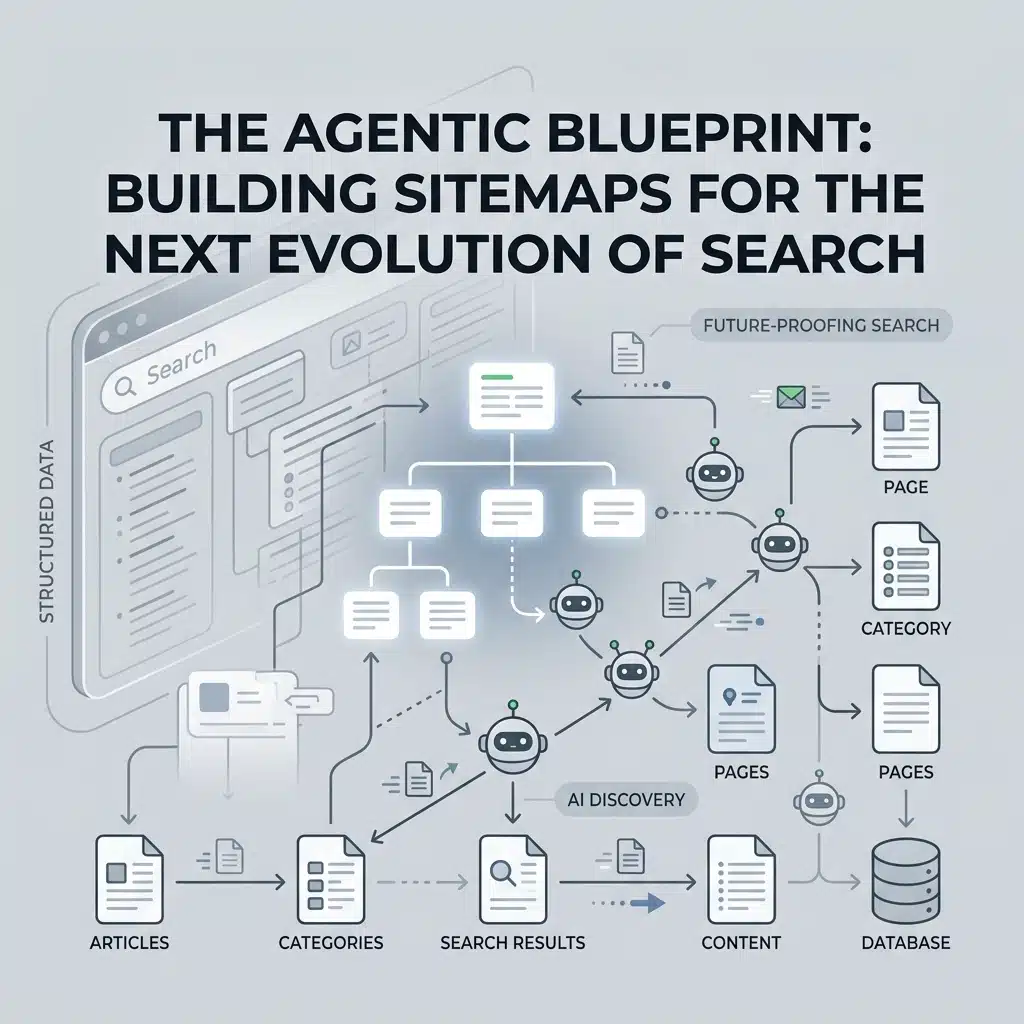
The rise of agentic AI: autonomous systems that don’t just find links but synthesize information, make decisions, and execute tasks: has turned traditional SEO on its head. In this new era, your site architecture isn’t just a map for a bot; it’s a blueprint for an intelligence. If that intelligence can’t parse your data in milliseconds, you don’t exist.
The Death of the Static XML Sitemap
For twenty years, the XML sitemap was the gold standard. You’d generate a file, submit it to Search Console, and wait. That era is over. Static sitemaps are a liability in a world where AI agents require real-time data to provide accurate answers.
When an AI agent: whether it’s a specialized medical assistant or a broad-scale travel planner: queries the web, it isn’t looking for a list of URLs to show a user. It is looking for a structured data source it can ingest immediately to provide a definitive answer. If your content was updated three hours ago but your sitemap won’t reflect it until tomorrow, you’ve lost the opportunity to be the source of truth.
Agentic search demands a shift toward API-first architectures and webhook-driven content delivery. We are moving from “pull” SEO (where we wait for Google to crawl) to “push” SEO, where our systems tell the agentic engines exactly what has changed the moment it happens.

58% and Counting: Why AEO is the New SEO
With 58% of searches being AI-powered, the focus has pivoted from Search Engine Optimization (SEO) to Answer Engine Optimization (AEO). The goal is no longer to “rank #1” for a keyword. The goal is to be the “Answer” that the agent provides to the user.
To win in AEO, your site architecture must be “agent-ready.” This means moving beyond a flat hierarchy and toward an entity-based structure. AI agents don’t just read words; they identify entities (people, places, things, concepts) and the relationships between them. If your sitemap doesn’t explicitly define these relationships, the agent will move on to a competitor who does.
At Expert SEO Consulting, we’ve seen that sites utilizing a Sitemap Analyzer specifically tuned for agentic engines see a 40% higher inclusion rate in AI-generated summaries compared to those using standard legacy sitemaps.
The Agentic Blueprint: 4 Pillars of Modern Site Architecture
Building an agent-ready site requires a fundamental rethink of how your data is exposed to the web. Here is the blueprint for the next evolution of search.
1. Real-Time Content Syndication
In 2026, latency is the enemy of visibility. Your sitemap should not be a file; it should be a live stream. By implementing real-time content syndication protocols, you ensure that as soon as a product price changes or a new blog post is published, the agentic crawlers are notified. This is essential for survival in fast-moving industries like e-commerce, finance, and news.
2. Entity-First Hierarchy
Traditional sitemaps categorize by URL structure (e.g., /blog/post-name). Agentic sitemaps categorize by entity. Your sitemap_index.xml should guide agents through a logical progression of topics and sub-topics that mirror a knowledge graph. This allows the AI to “understand” the topical authority of your site without having to process every single page.
3. Machine-Readable Schema as a First-Class Citizen
Schema markup is no longer an “extra” for rich snippets; it is the primary language of agentic search. Your sitemap should point agents directly to the most schema-rich versions of your pages. Every Product, Organization, and FAQ schema must be explicit, verified, and interconnected. If an agent has to guess what your data means, it will guess wrong: or worse, ignore you.
4. API-Enabled Content Management
The most sophisticated brands are moving away from traditional CMS outputs and toward API-enabled content delivery. This allows AI agents to query your site directly for specific data points rather than “scraping” the HTML. This level of access builds trust with the engine, positioning your site as a primary source of data for the agent’s knowledge base.

Why You Need a Sitemap Analyzer for the Agentic Era
You wouldn’t build a skyscraper without a structural engineer, so why are you building a digital presence without a technical audit? The complexity of 2026-era search means that manual checks are impossible.
A modern Sitemap Analyzer doesn’t just check for 404 errors. It evaluates:
- Entity Clarity: Does the sitemap accurately represent the core entities of your business?
- Crawl Efficiency for Agents: Are you wasting “agent budget” on low-value pages?
- Schema Synchronization: Does the data in your XML/API sitemap match the structured data on the page?
- LLM Accessibility: Is your content formatted in a way that Large Language Models (LLMs) can easily tokenize and ingest?
Without these insights, you are flying blind. We recommend regular SEO Audits that specifically target these agentic markers. It’s the only way to ensure your architecture is actually serving your business goals in an AI-dominated market.
The Shift from Links to Relationships
Think about how you use an AI assistant today. You don’t ask for “a link to a plumber.” You ask, “Find me a highly-rated plumber near me who is available at 2 PM on Tuesday and specializes in tankless water heaters.”
To answer that, the agent needs to know:
- You are a plumber (Entity).
- You are located in a specific city (Location).
- Your ratings (Reputation).
- Your availability (Real-time data).
- Your specialty (Specific service entity).
If your product-sitemap.xml or service pages aren’t structured to answer those specific data points through a machine-readable blueprint, you aren’t just losing rank: you are being excluded from the conversation entirely.
Building for Human Intent, Optimized for Machine Synthesis
While we talk a lot about “agents” and “engines,” the end goal is still the human user. The magic of the Agentic Blueprint is that it satisfies both. By creating a clean, logical, and technically superior site architecture, you improve the experience for human visitors while making it effortless for AI agents to recommend you.
The transition to agentic search is irreversible. The 58% of searches currently handled by AI will only grow as agents become more integrated into our operating systems, cars, and wearable tech. These agents don’t have time to “browse” your site. They need the blueprint, and they need it now.

Immediate Steps to Future-Proof Your Site
The landscape is moving fast, but there are concrete steps you can take today to ensure your site remains relevant:
- Audit Your Current Structure: Use advanced tools to see how an AI agent perceives your site. Are you an authority, or just a collection of keywords?
- Transition to Dynamic Sitemaps: If you’re on a legacy platform, look into API-driven sitemap solutions that update in real-time.
- Focus on Answer-Based Content: Ensure your site architecture highlights FAQ sections and clear, declarative data points that are easy for an engine to extract.
- Verify Your Entities: Use Organization and Person schema to tell the engines exactly who you are and what you do.
Is Your Site Ready for the Agentic Revolution?
The “Agentic Blueprint” is no longer optional. It is the fundamental requirement for visibility in 2026. If your site architecture is still built for the search engines of 2016, you are essentially invisible to more than half of your potential customers.
At Expert SEO Consulting, we specialize in bridging the gap between traditional SEO and the next generation of AEO. We don’t just fix your rankings; we re-architect your digital presence for the era of intelligence.
Stop guessing and start building for the future.
Book a consultation with our team today and let’s turn your website into an agent-ready powerhouse. Your competitors aren’t waiting( neither should you.)