58% of Google searches are now AI-powered. Take a second to let that number sink in. If you’re still operating under the assumption that SEO is just about keywords and backlink counts, you’re missing the seismic shift happening under your feet. We aren’t just optimizing for human users anymore; we are optimizing for highly sophisticated, resource-hungry AI agents.
In this new era of Answer Engine Optimization (AEO), the metric that matters most isn't just "quality content": it’s the technical efficiency of that content. AI bots from Google, OpenAI, and Perplexity are under massive pressure to crawl and process data with maximum efficiency. They don't have the "patience" that traditional indexers once had. If your site is slow, unstable, or unresponsive, these bots will simply move on.
Core Web Vitals have transitioned from being a "tie-breaker" ranking factor to becoming the actual foundation of AI crawlability. If you want to be the source that AI cites, speed is no longer a luxury: it is the price of entry.
The AI Bot’s Need for Speed: It’s All About Compute
When a traditional search engine bot crawls your site, it’s looking to index pages for a massive library. When an AI crawler arrives, it is looking for data to feed into a large language model or to provide a real-time answer to a user’s query. This process is computationally expensive.
AI bots prioritize crawl efficiency. Every millisecond an AI bot spends waiting for your Largest Contentful Paint (LCP) to trigger is a millisecond of wasted compute power. In a world where 58% of searches are AI-driven, Google and other providers are aggressively throttling sites that waste their resources.

If your site fails the basic Core Web Vitals (CWV) thresholds, you are effectively telling the AI: "My data isn't worth the energy it takes to extract it." This is why we’ve seen a massive correlation between high CWV scores and visibility in AI-generated overviews. Performance is a signal of quality. If you can’t manage a fast server, the AI assumes you aren't an authority worth citing. If you've noticed a sudden drop in visibility, it might not be your content: it might be your infrastructure. In many cases, we recommend an SEO Audit to identify these specific technical bottlenecks before they become permanent visibility killers.
The Trio of Trust: LCP, INP, and CLS in the AI Age
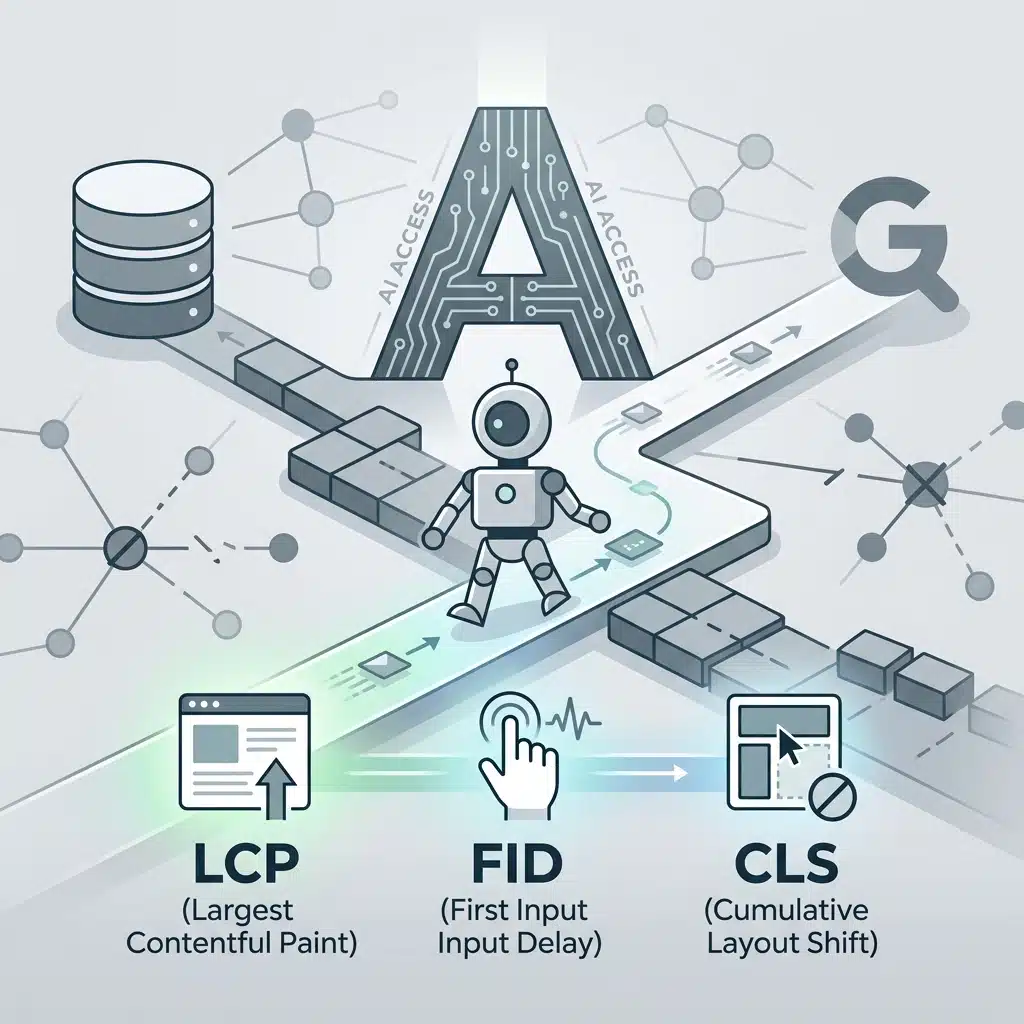
To win at AEO, you have to master the three pillars of Core Web Vitals. But you have to look at them through the lens of a machine, not just a human.
1. Largest Contentful Paint (LCP) – The "Time to Truth"
LCP measures how long it takes for the main content of a page to become visible. For an AI bot, this is the "Time to Truth." If the bot has to wait more than 2.5 seconds to see your primary value proposition, it’s going to flag your URL as low-priority.
To an AI, slow LCP suggests a bloated, poorly managed site. We’ve found that sites with an LCP under 1.5 seconds have a significantly higher rate of indexation for AI-driven "Search Generative Experience" (SGE) results.
2. Interaction to Next Paint (INP) – The Conversational Metric
INP replaced FID (First Input Delay) as a core metric because it measures the responsiveness of the entire page lifecycle. AI bots are increasingly "interacting" with pages to find hidden data or to understand how a user would navigate a site.
If your JavaScript is so heavy that it hangs the browser for 300ms every time a button is clicked, the AI bot views your site as fundamentally broken. A low INP score (ideally under 200ms) signals to the AI that your site is technically sound and capable of handling complex queries.
3. Cumulative Layout Shift (CLS) – Visual Stability is Technical Integrity
CLS measures how much the content jumps around as the page loads. While this is primarily a user experience metric, for an AI bot, layout shifts can interfere with DOM parsing. If elements are shifting while a bot is attempting to map the structure of your data, it creates "noise." AI models hate noise. They want clean, structured, and stable data. A CLS score below 0.1 is the industry standard for maintaining technical integrity.

Why AEO Requires a "Performance First" Mindset
Answer Engine Optimization is the next evolution of search. In this landscape, the "Answer Engine" acts as a gatekeeper. It doesn't just show a list of links; it summarizes your content and provides it to the user directly.
Here’s the catch: AI bots are trained to prioritize the most "reliable" sources. In the digital world, reliability is synonymous with performance. Think of it like this: would you trust a medical professional who takes twenty minutes to find their notes, or the one who has them ready the moment you ask?
Speed builds trust. When your site meets or exceeds performance targets, you are signaling to Google’s AI that you are a top-tier authority. This isn't just about ranking #1 anymore; it’s about being the only answer the AI gives.
Performance Targets for AI Dominance:
- LCP: Within 2.5 seconds (Aim for 1.2s for high-competition niches).
- INP: Under 200 milliseconds.
- CLS: Below 0.1.
- Time to First Byte (TTFB): Under 0.8 seconds.
If you aren't hitting these numbers, you aren't just losing visitors; you are losing the AI’s "respect."
The Impact of Core Web Vitals on Indexation
We’ve observed a trend where sites with poor Core Web Vitals are seeing their "Crawled – Currently Not Indexed" numbers skyrocket in Search Console. This isn't a coincidence. Google is using CWV as a filter for the crawl queue.
Because crawling the web for AI training and retrieval is so expensive, Google has to be selective. They are moving toward a "just-in-time" crawling model for AI responses. If your site doesn't load fast enough to be included in that real-time response window, you're out.
If you suspect your site has been "throttled" due to performance issues or past updates, looking into Algorithm Recovery is the first step to reclaiming your spot in the crawl queue. You can’t recover from a traffic drop if the bots have decided your site is too "expensive" to visit.

Actionable Steps: Optimizing for the AI Crawl
You can't just "wish" your way to a faster site. You need a declarative, aggressive approach to technical SEO. Here is what you need to do right now:
- Eliminate Render-Blocking Resources: If your CSS and JS are stopping the bot from seeing your content immediately, you’ve already lost. Use asynchronous loading and inline critical CSS.
- Optimize Image Payloads: Use Next-Gen formats (WebP/AVIF). An AI bot doesn't need to see a 5MB 4K image to understand your content. Keep it lean.
- Leverage Global CDNs: AI bots crawl from various locations. If your server is in New York and the bot is crawling from a node in California or Europe, that latency adds up.
- Simplify the DOM: Excessive DOM size (too many nested HTML elements) slows down both the browser and the crawler. Keep your site architecture clean and flat.
The Future is Fast or Invisible
The era of "slow and steady wins the race" is dead in the world of digital marketing. The AI revolution has fundamentally changed the rules of engagement. With 58% of searches being AI-powered, the "Speed of Trust" is the only metric that guarantees long-term survival.
AI bots are the new decision-makers. They decide which businesses get the spotlight and which ones fade into the "page 10" abyss. If your foundation: your Core Web Vitals: is shaky, no amount of AI-generated content or backlink building will save you.
You have to decide if you want to be the source that the AI relies on or the site the AI skips over to save on compute costs. The choice is yours, but the clock is ticking.
Ready to ensure your site is fast enough for the AI era?
Don't let technical debt kill your visibility. Book a consultation today and let’s get your Core Web Vitals where they need to be.