You already know that your website has errors in Google Search Console, but here is what most digital marketers miss: not every technical warning deserves your engineering team's attention.
Industry benchmarks indicate that over 62% of mid-market websites carry critical technical SEO debt that drains crawl budgets and degrades organic visibility. Yet, when developers open a site audit tool, they are greeted by hundreds: sometimes thousands: of red and yellow flags. Treating every minor warning as a five-alarm fire paralyzes development roadmaps and burns out engineering resources on fixes that yield zero measurable return.
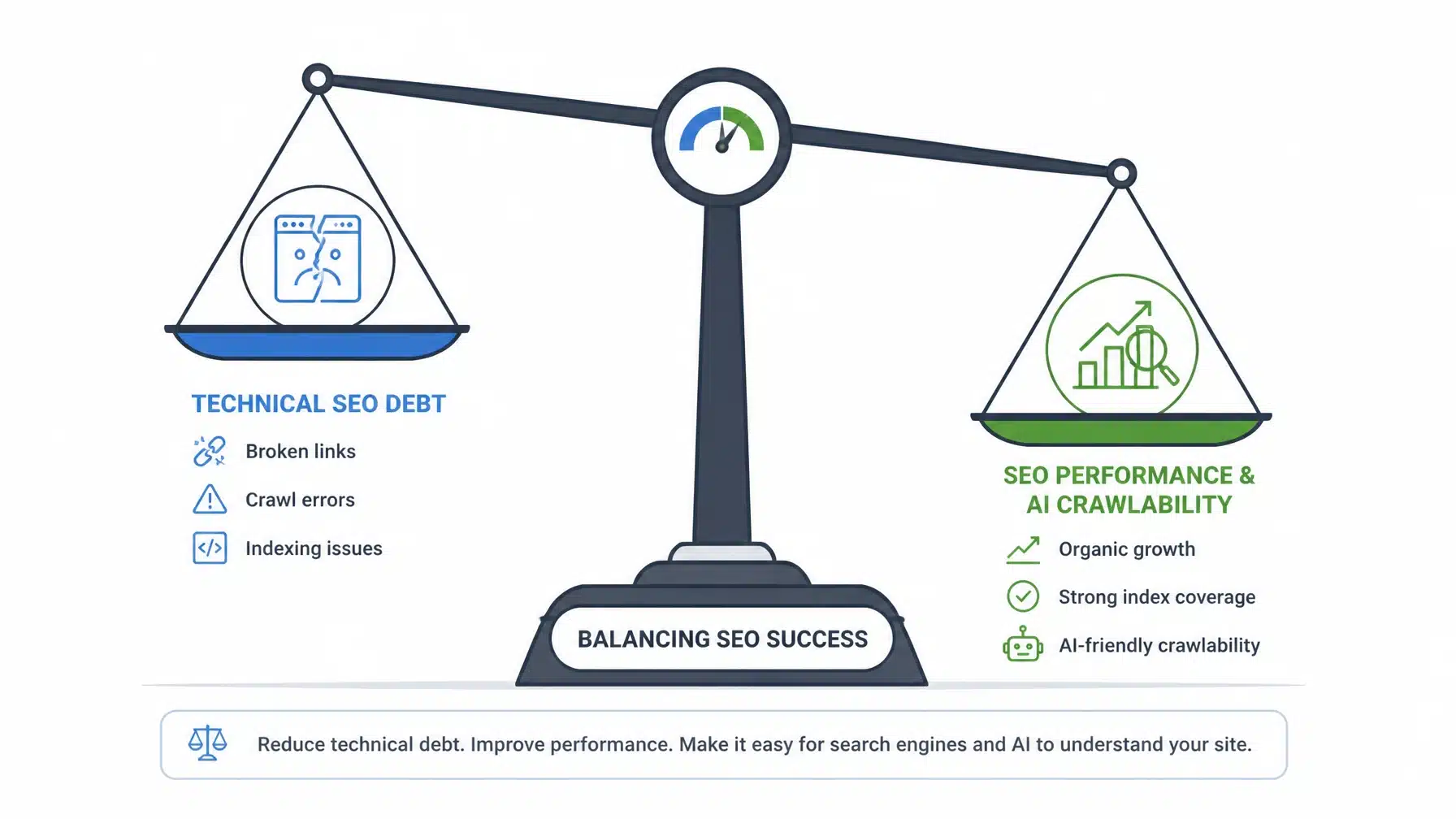
Technical SEO debt is no longer optional to manage, especially as modern search engines rely heavily on automated algorithms and generative AI to retrieve and synthesize information. But survival in this landscape requires ruthless prioritization. You need a structured framework to determine what demands immediate remediation and what can safely be ignored.
The Anatomy of Technical SEO Debt
Technical SEO debt accumulates quietly over years of site redesigns, content migrations, third-party plugin installations, and shifting development teams. Like financial debt, it incurs interest over time: expressed in sluggish page rendering, wasted crawl budgets, and plummeting keyword rankings.
Let's examine the four most common culprits rotting beneath the surface of modern websites:
- Legacy Code and Bloated Templates: Years of custom patches, unused JavaScript libraries, and outdated framework elements create bloated codebases that slow down server response times and confuse automated parsers.
- Bloated Plugins and CMS Extensions: Especially prevalent in WordPress and custom monolithic CMS environments, stacking dozens of plugins often injects duplicate scripts, redundant CSS, and conflicting metadata tags.
- Redirect Chains and Loops: Multiple sequential redirects (A to B to C) waste precious crawl budget, delay browser rendering, and dilute link equity.
- Orphaned Pages: High-value content buried without internal links becomes invisible to crawlers, effectively wasting valuable content assets.
Addressing these issues requires more than running a monthly crawl. It demands a rigorous evaluation of how code quality intersects with actual search engine retrieval. For a deeper dive into modern retrieval mechanics, explore our analysis on how an ai citation tracker strengthens your search visibility.
The ROI of Fixing vs. Deferring
When engineering leadership pushes back against technical SEO tickets, they are usually reacting to vague problem statements. To secure development resources, you must quantify the return on investment (ROI) of remediation versus the compounding cost of deferral.

When you defer technical fixes, the interest compounds rapidly:
- Crawl Budget Exhaustion: Search bots spend hours crawling broken internal links and redirect loops instead of indexing newly published, high-converting product or service pages.
- Indexation Drop-offs: Important pages slip out of the index entirely because canonical tags conflict or rendering fails.
- Stagnant Organic Revenue: Despite publishing exceptional content, overall organic traffic flattens or declines because the underlying technical foundation cannot support competitive scaling.
Conversely, targeted remediation unlocks immediate efficiency. Fixing systemic template errors across five page templates can instantly revive thousands of suppressed URLs without writing a single new word of content. To evaluate your current baseline, a comprehensive SEO audit is essential to diagnose where technical friction is bleeding organic revenue.
A Practical Framework: What to Fix vs. What to Ignore
How do you stop guessing and start prioritizing? You must evaluate every identified issue against a strict four-pillar decision matrix: Business Impact, SEO Impact, Scale, and Implementation Effort.
+-------------------------------------------------------+
| P0 (Critical Fixes)  | High SEO/Business Impact       |
+----------------------+--------------------------------+
| P1 (Strategic Fixes) | High Impact, Moderate Effort   |
+----------------------+--------------------------------+
| P2 (Backlog Items)   | Low Impact, High Scale         |
+----------------------+--------------------------------+
| P3 (Safe to Ignore)  | Low Impact, Low Business Value |
+-------------------------------------------------------+
1. What to Fix Immediately (P0 & P1)
- Indexation and Crawl Blocks: Server errors (5xx), accidental
noindextags on revenue-generating templates, androbots.txtmisconfigurations that block vital directories. - Rendering Discrepancies: Critical content rendered entirely via client-side JavaScript that search crawlers fail to parse reliably.
- Systemic Canonical Mismatches: Template-level canonical errors that point to non-existent URLs or misdirect authority away from primary landing pages.
2. What to Safely Ignore (P3 & P4)
- Low-Traffic "Low-Priority" Soft 404s: Isolated minor warnings on archived blog posts from 2018 that receive zero organic impressions and hold no inbound links.
- Minor Markup Inefficiencies: Obsessing over missing optional schema properties on pages that have zero commercial intent.
- Harmless Redirects to External Assets: Single 301 redirects on legacy external links that still pass authority smoothly without creating multi-hop chains.
By separating vanity metrics from revenue-driving mechanics, your teams can focus exclusively on fixes that move the needle.
Prioritizing for AI Crawlability and Indexation
The search landscape has fundamentally changed. Traditional search engines relied purely on keyword matching and basic link graphs; modern AI-driven discovery engines parse page structure, semantic relationships, and entity graphs in real time.

When technical debt interferes with AI crawlability, your brand disappears from automated summaries and generative engine answers. To optimize your site for this new era, prioritize these technical pillars first:
- Rendering and Retrieval Clarity: If AI retrieval systems cannot parse your DOM tree cleanly during the initial fetch, your content is effectively invisible to generative summaries. Ensure critical text and structured data are present in the server-rendered HTML.
- Structured Data and Schema Integrity: Clean JSON-LD schema acts as the universal translation layer for AI engines. Fix broken, outdated, or conflicting schema markup immediately to give machines unambiguous entity context.
- Logical Content Hierarchy: Disorganized heading tags and ambiguous internal link paths confuse AI models trying to understand topical depth and subject authority.
Understanding how generative engines query and synthesize data is vital. Read our insights on the secret engine of ai search: what are fan-out queries to align your technical infrastructure with modern search mechanics.
Establishing Durable Process Fixes
One-off technical audits fail because technical debt regenerates the moment developers push new code. True optimization requires building permanent guardrails into your engineering workflow.

Here is what you need to do to permanently stem the tide of technical debt:
- Embed SEO Requirements in Product Briefs: Ensure that any redesign or feature release includes pre-approved SEO specifications for redirects, metadata handling, and URL structures.
- Automate Pre-Launch SEO QA: Integrate automated crawlers into your staging environments to catch broken canonicals, missing alt text, and slow rendering before code hits production.
- Allocate Dedicated Sprint Capacity: Dedicate 15% of every engineering sprint specifically to technical debt reduction, treating SEO maintenance as core infrastructure work rather than an afterthought.
- Utilize Specialized Support: For businesses looking to scale internal capabilities, investing in structured SEO tools support ensures your teams have the expertise required to maintain pristine site architecture.
Conclusion
Technical debt is an inevitable byproduct of digital growth, but letting it dictate your organic performance is entirely optional. By replacing frantic, reactive firefighting with a disciplined, impact-driven prioritization framework, you protect your engineering resources and secure your visibility in both traditional and AI-powered search engines.
Stop letting minor audit warnings drain your momentum. Take control of your site's technical foundation today and ensure your digital assets are built for sustainable growth.
Ready to eliminate costly technical debt and future-proof your search presence? Book a consultation with our expert team today to diagnose your site's hidden bottlenecks and build a high-ROI remediation roadmap.