For years, digital marketing measurement was straightforward. You tracked keyword rankings, organic traffic spikes, and form fills, neatly wrapping them into monthly executive reports. Today, that playbook is obsolete. In 2026, buyers increasingly rely on generative artificial intelligence, multi-turn conversational search, and AI Overviews to evaluate vendors before they ever visit a traditional landing page or fill out a contact form.
When your executive team asks, "What is our return on investment for all the effort going into AI visibility and LLM positioning?", showing a screenshot of ChatGPT recommending your product is no longer enough. CFOs and revenue leaders do not fund vanity mentions; they fund predictable pipeline growth.
Connecting LLM citations and AI Overviews directly to pipeline revenue requires moving beyond traditional metrics and adopting a disciplined, multi-layered attribution framework. At Expert SEO Consulting, we have designed a specialized approach to solve this exact challenge: bridging the gap between opaque AI algorithms and hard financial outcomes.
The Visibility-to-Revenue Disconnect
The fundamental challenge in modern search marketing is attribution drift. When a prospective enterprise buyer asks Claude or Perplexity for the top three software solutions in your category, those models synthesize information, evaluate brand authority, and cite authoritative sources without passing traditional UTM parameters.
If your brand is cited as the recommended standard in an LLM response, the buyer often bypasses the search engine results page entirely. They navigate directly to your domain, type your brand name into a search bar, or book a demo citing "direct traffic" or "word of mouth."
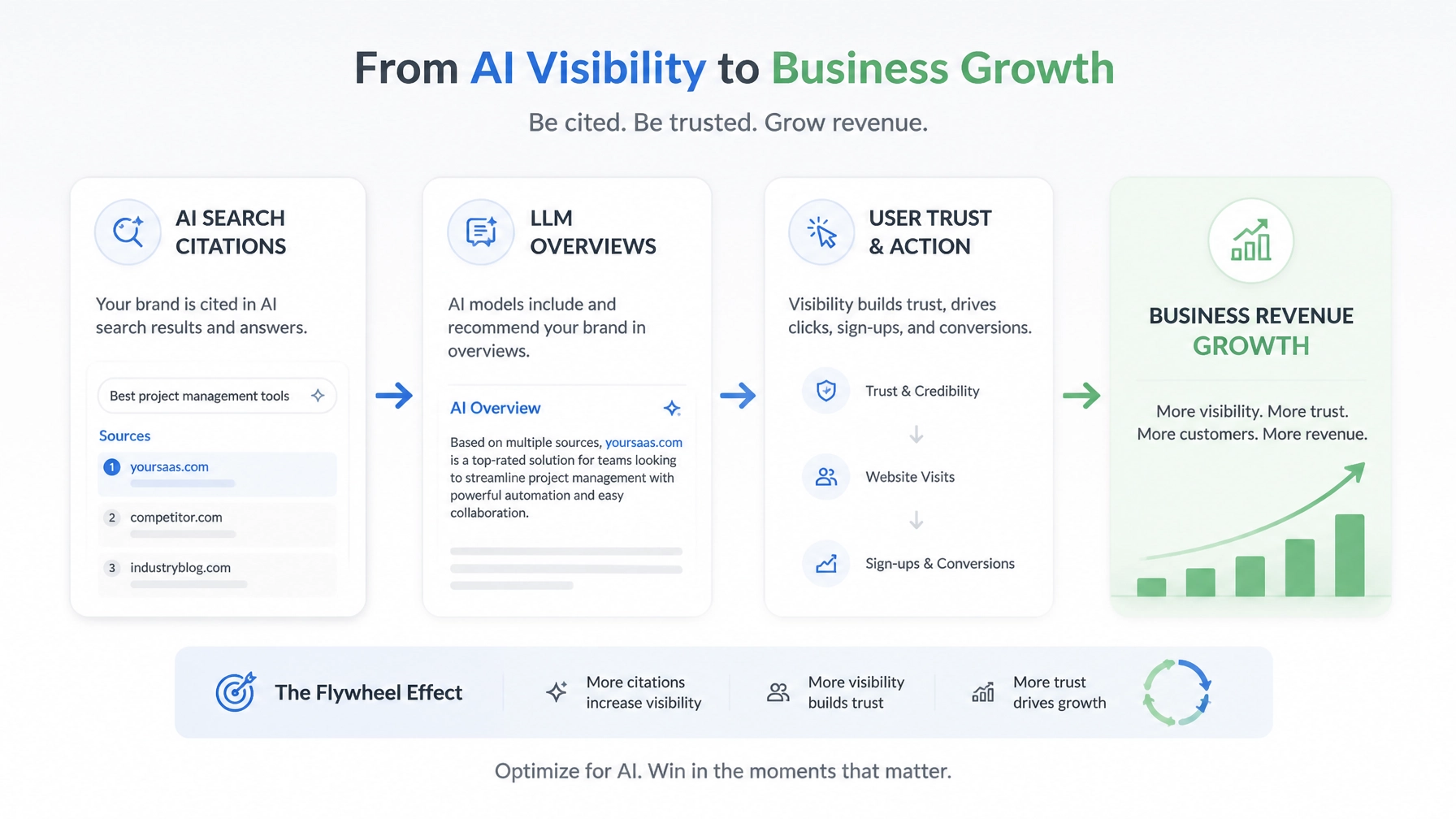
Without the right instrumentation, your analytics platform misattributes this high-intent demand, leaving your AI visibility efforts looking like a cost center rather than a revenue engine. Closing this visibility-to-revenue gap requires a systematic, four-layer measurement structure that maps top-of-funnel AI citations all the way through to closed-won deals.
ESC’s Four-Layer AI Visibility Measurement Framework
To accurately calculate ROI on AI search positioning, Expert SEO Consulting utilizes a proprietary four-layer measurement framework. This structure allows marketing and revenue teams to trace the exact trajectory from an LLM citation to a signed contract.

Layer 1: Visibility & Share of Voice (SOV)
Before revenue can enter the pipeline, you must establish whether AI models actually know, trust, and recommend your brand. This layer measures:
- AI Share of Voice (SOV): The percentage of category-defining prompts across ChatGPT, Claude, Gemini, and Perplexity where your brand is actively recommended.
- Citation Frequency: How often your domain or owned assets are cited as authoritative sources in AI-generated answers.
- Prompt Coverage Rate: The breadth of strategic query variations in which your brand maintains a top-three positioning.
Tracking these leading indicators at scale requires specialized infrastructure. Leveraging advanced platforms like CiteMetrix allows organizations to monitor LLM citation velocity and brand positioning across hundreds of high-intent industry queries in real time. For a deeper dive into setting up this infrastructure, explore our guide on how an ai citation tracker strengthens your search visibility.
Bridging Traffic and Demand: Tracking LLM Referrals
Once your visibility is established, the next phase is tracking how AI-driven demand manifests in your analytics ecosystem. While direct referrals from chat interfaces represent only a fraction of true AI-driven traffic, they provide vital behavioral telemetry.

Isolating AI Referral Traffic in GA4
In your analytics suite, set up custom channel groupings or regex filters to isolate traffic originating from known AI domains (chatgpt.com, perplexity.ai, claude.ai, and search engines rendering AI Overviews). Monitor metrics such as:
- AI-Referred Session Volume: Growth week-over-week in visitors arriving via conversational search agents.
- Engagement Rate & Page Depth: Do visitors coming from LLM citations exhibit higher intent and spend more time on commercial solution pages compared to traditional organic search traffic?
- Branded Search Lift: Correlate spikes in your AI Share of Voice with subsequent lifts in direct brand searches and navigational queries.
Understanding how search engines expand user queries through mechanisms like fan-out queries helps marketing teams structure content that satisfies both traditional algorithms and multi-turn LLM reasoning.
Connecting Citations to Pipeline and CRM Attribution
Traffic and citations remain theoretical until they enter your CRM. To prove financial impact, you must instrument your sales pipeline to capture AI touchpoints directly from prospective buyers.

Implementing the "AI-Influenced" CRM Flag
Update your lead intake forms and CRM deal properties to include an AI-Influenced field or multi-touch attribution tag. Train your sales development and account executive teams to ask a simple qualitative question during initial discovery calls:
"Before reaching out to us today, did you encounter our brand recommended or cited in any AI assistants, LLM research tools, or search engine AI summaries?"
When prospects confirm an AI touchpoint shaped their vendor shortlist, tag the opportunity accordingly. This unlocks powerful pipeline metrics:
- Pipeline Influence Rate: The percentage of qualified opportunities carrying an AI-influenced touchpoint.
- Sales Cycle Velocity: Do AI-informed prospects convert faster or close at higher average contract values (ACVs) than traditional leads? Because LLMs pre-educate buyers and establish trust before the first sales call, AI-influenced pipeline frequently exhibits shorter sales cycles and superior win rates.
Calculating True AI Visibility ROI
With your visibility data, traffic telemetry, and CRM pipeline flags in place, calculating your return on investment becomes a rigorous financial exercise rather than a guessing game.
The standard formula utilized within our framework is straightforward:
$$\text{AI Visibility ROI} = \frac{\text{AI-Attributed Revenue} – \text{AI Investment Costs}}{\text{AI Investment Costs}} \times 100$$
Where AI-Attributed Revenue aggregates:
- Direct AI-Sourced Revenue: Closed-won deals originating from tracked LLM referral sessions.
- Fractional Influenced Revenue: A calculated portion of opportunities where AI citations played a foundational role in the buyer's research journey, validated via CRM attribution and onboarding surveys.
By quantifying these returns against your total investment in specialized content strategy, technical optimization, and monitoring tools: such as those deployed through our seo tools support engagements: you present your leadership team with an undeniable business case.
What You Need To Do Right Now
Adapting your measurement model to the era of AI-driven search is essential for sustainable growth. To transition from vanity metrics to pipeline revenue, take these immediate actions:
- Audit Your Current Visibility: Deploy AI tracking tools to discover where your brand currently stands in LLM citations and AI Overviews versus key competitors.
- Instrument Your Analytics: Clean up your GA4 referral segments to capture chat-based traffic and monitor commercial page consumption.
- Update CRM Fields: Train sales reps to capture AI research touchpoints during discovery calls to map pipeline influence accurately.
- Align Content Strategy: Optimize technical architecture and deep-dive resources to feed LLM crawlers the exact expert data they require to cite you as the category leader.
The search landscape has fundamentally changed. Organizations that master AI visibility measurement will dominate their markets, while those relying on outdated metrics will watch their pipeline dry up.
Ready to connect your AI search presence to predictable revenue growth? Book a consultation with Expert SEO Consulting today to audit your AI visibility and implement our proprietary attribution framework.