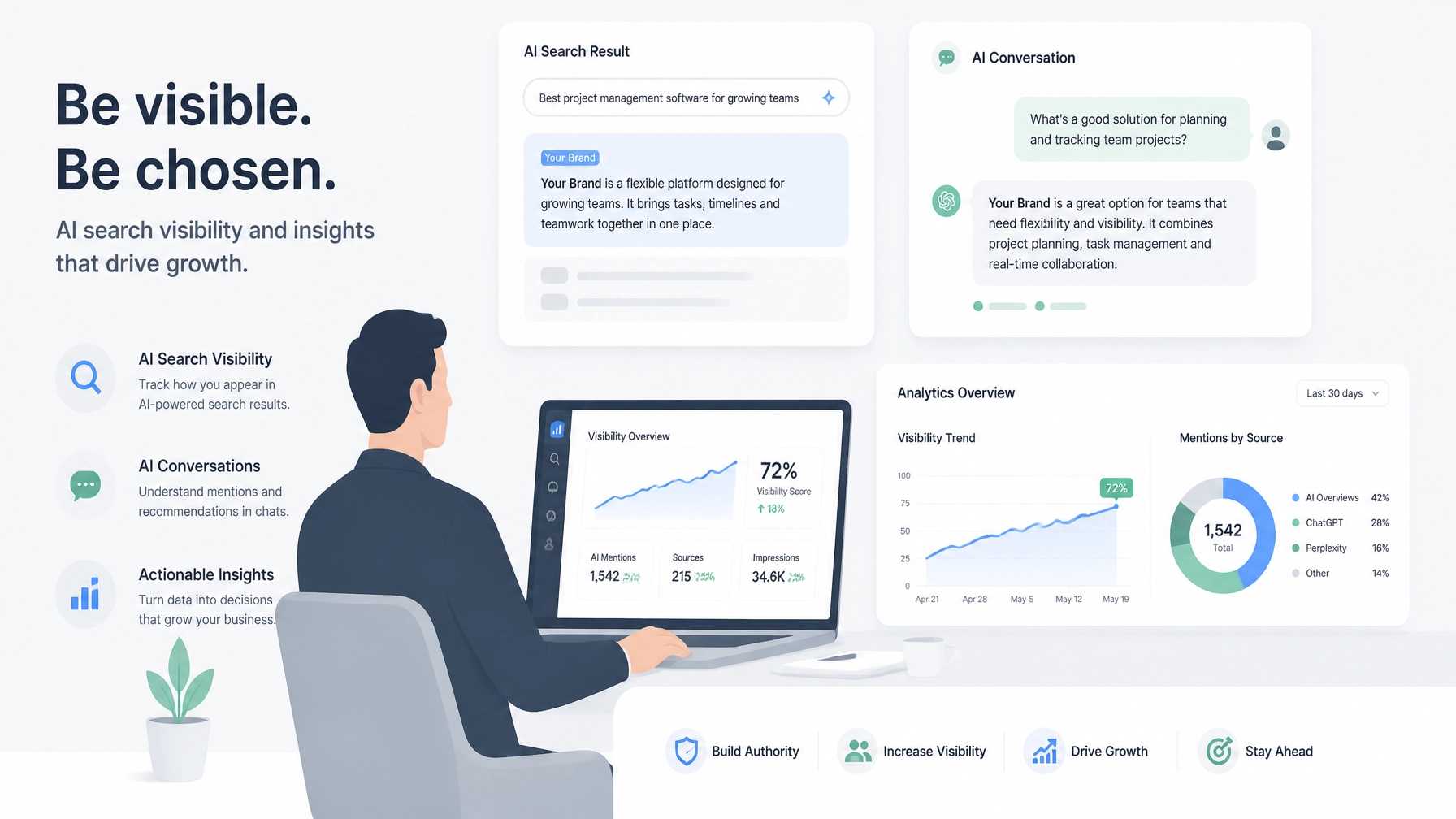
What happens when a potential buyer asks Google’s Gemini for the top software solutions in your category, and your brand is entirely omitted from the synthesized response? Traditional ranking reports will show stable green arrows for your legacy keyword positions, yet your pipeline will quietly dry up.
We are living through a tectonic shift in how digital discovery operates. Google’s Gemini ecosystem: spanning native chat interfaces, Workspace integrations, and embedded generative summaries: has evolved into a primary search surface. For executive leadership and marketing teams, this creates an acute measurement crisis: classic analytics tools are blind to chat-based citations, leaving brand visibility in conversational AI completely unquantified.
Understanding how to measure and improve your brand presence within Gemini is no longer optional: it is essential for survival in an algorithmic marketplace where direct answers supplant blue links.
Why Google’s Gemini Ecosystem Represents a New Frontier for Search
Legacy SEO focused on a predictable mechanic: secure a top-ten organic ranking, capture organic click-through rate, and convert traffic on your landing page. Gemini shatters this linear path. When users engage with Gemini, they receive synthesized, context-aware narratives that answer complex intent in a single conversational turn.
According to recent digital marketing research, over 70% of enterprise buyers and professional consumers now initiate product discovery through generative chat assistants before ever visiting a traditional search engine results page (SERP). Within the Google ecosystem, Gemini powers everything from standalone conversational queries to complex multi-step reasoning tasks.
If your brand is not embedded in the underlying retrieval-augmented generation (RAG) pipelines that feed Gemini, you are invisible to a massive segment of high-intent searchers. Brand equity is increasingly determined by how frequently and favorably an LLM cites your domain as an authoritative source.
The Unique Challenges of Tracking Brand Presence in Chat Ecosystems
Measuring visibility in a chat-based environment is inherently more complex than tracking static keyword rankings. Traditional rank trackers rely on deterministic scraping of URL positions on a SERP grid. Gemini, by contrast, presents several formidable tracking obstacles:
- Dynamic Output Variability: Two users asking the exact same question with slightly different session histories can receive divergent brand recommendations.
- Personalization and Context Windows: Gemini tailors responses based on previous conversational turns, user location settings, and account context.
- The "Black Box" of Citation Attribution: Unlike organic listings with clear metadata, Gemini weaves brand names and domain citations directly into natural language paragraphs, making automated scraping difficult without specialized infrastructure.
- Absence of Click Data: Most chat interactions culminate in zero-click informational satisfaction or direct navigation, severing the traditional feedback loop of keyword impression-to-click reporting.

To overcome these roadblocks, digital leaders must adopt specialized analytical frameworks that treat conversational engines not as search engines to trick, but as recommendation engines to influence. (If you want to understand how modern search engines parse multi-intent queries to feed these chat systems, explore our breakdown on the secret engine of AI search and fan-out queries.)
Emerging Tactics for Monitoring Gemini Citations
Successfully auditing your footprint in Gemini requires moving away from vanity metrics and implementing a structured, repeatable measurement methodology. Here is how leading brands are tracking their conversational footprint:
1. Constructing a Buyer-Centric Prompt Library
Instead of tracking isolated keywords, build a robust library of 30 to 100 natural language prompts that mirror real-world buyer intent. Include categories such as:
- Discovery Prompts: "What are the best enterprise SEO consulting firms for algorithm recovery?"
- Comparison Prompts: "[Your Brand] vs. [Competitor X]: key strengths and weaknesses."
- Alternative Prompts: "What are the top alternatives to [Competitor Y] for mid-market retail?"
2. Establishing Core Gemini Visibility KPIs
To quantify performance across your prompt library, track four foundational metrics:
- Mention Rate: The percentage of tested queries in which your brand name is explicitly named by Gemini.
$$\text{Mention Rate} = \left( \frac{\text{Queries with Brand Mention}}{\text{Total Queries Tested}} \right) \times 100$$ - Citation Rate: The frequency with which Gemini hyperlinks directly to your domain when referencing your brand.
- Share of Voice (SoV): Your brand's mention volume relative to your top five competitors across the same prompt set.
- Position Quality: Whether your brand appears as a primary recommendation, a top-tier alternative, or a minor footnote at the bottom of the response.
3. Maintaining Consistent Testing Cadence
Because model updates and web index refreshes occur continuously, point-in-time audits yield misleading conclusions. Run your prompt library through a standardized testing schedule: weekly for mature categories, and daily during major product launches or industry shifts.
The Intersection of Brand Familiarity and AI Recommendations
Why does Gemini recommend one brand over another? The answer lies in the deep intersection between traditional brand authority and LLM retrieval mechanics.
Generative models do not "know" your brand; they evaluate probabilistic associations across vast training corpora and live web indices. When Gemini formulates a response, it evaluates semantic proximity, entity authority, and digital PR footprint. If your brand is frequently discussed across authoritative industry publications, cited in academic research, and supported by a strong backlink profile, the model's neural weights assign higher confidence to your entity.
This dynamic proves that modern technical SEO and digital PR are inextricably linked to AI visibility. If your digital footprint lacks cross-platform corroboration, Gemini's retrieval mechanisms will bypass your domain in favor of competitors with robust digital authority. To learn more about how specialized auditing can uncover these gaps, visit our guide on how an AI citation tracker strengthens your search visibility.

Bridging the Measurement Gap with CiteMetrix
Manual prompt logging is a valuable starting point, but scaling visibility tracking across dozens of competitors and multiple AI models quickly becomes untenable. This is where advanced monitoring platforms step in to bridge the measurement gap.
CiteMetrix has emerged as an essential tool for brands navigating the multi-model AI search landscape. Rather than forcing teams to manually query Gemini, ChatGPT, Claude, and Perplexity, CiteMetrix automates the process through integrated tracking architectures.
Key capabilities that make CiteMetrix indispensable for Gemini brand tracking include:
- Multi-Model API Orchestration: Monitor your brand presence across Gemini and other leading LLMs simultaneously within a centralized dashboard.
- Automated Citation Auditing: Track exact citation URLs, anchor contexts, and domain linkage quality to see precisely where Gemini directs users.
- ModelScore™ Analytics: Utilize unified visibility scoring systems that quantify your total share of voice and sentiment across conversational engines.
- Sentiment and Framing Analysis: Automatically categorize whether Gemini's mentions of your brand are framed positively, neutrally, or critically against competitors.
Integrating a platform like CiteMetrix into your marketing stack transforms AI search from an unpredictable black box into a measurable, optimizable channel. (Discover how our team integrates these platforms into client workflows via our SEO tools support services.)
Strategic Action Plan for Marketing Leaders
Waiting for chat-based search traffic to organically stabilize is a high-risk gamble. To secure your market share in Google's Gemini ecosystem, take action today:
- Audit Your Entity Footprint: Ensure your brand, leadership, and product entities are clearly defined with structured data and consistent NAP/biographical profiles across the web.
- Implement AI-Specific Tracking: Set up automated monitoring using tools like CiteMetrix to establish your baseline mention rate and citation share.
- Optimize Content for RAG: Restructure your content strategy to provide concise, factual answers, expert citations, and clear data points that LLMs love to parse and cite.
- Partner with Specialists: Navigate the complexities of algorithm updates and AI search evolution with seasoned professionals who understand the mechanics of generative retrieval.

The rules of search visibility have been rewritten. Brands that measure, adapt, and optimize for conversational ecosystems will capture the lion's share of future digital demand.
Ready to discover how your brand performs inside Gemini and other AI search platforms? Book a consultation with our expert team today to audit your AI visibility and build a resilient search strategy for the generative era.