Imagine asking a seasoned sales director to pitch your enterprise software using only two-word fragments. Absurd, right? Yet that is precisely how digital marketing teams have conditioned their content pipelines to build search strategies for decades: relying on fragmented keyword snippets to capture complex buyer intent.
As conversational AI models, generative search summaries, and multi-turn interfaces redefine how information is retrieved online, traditional keyword data tells only half the story. Industry research indicates that modern buyers now formulate search queries as complete, highly nuanced sentences (often 10 to 25 words long) complete with contextual constraints, timelines, and specific business goals. When search engines synthesize direct answers rather than simply serving ten blue links, optimizing solely for monthly search volume and CPC leaves your brand invisible in the moments that matter most.
Adapting your organic search strategy requires a fundamental shift in mindset: moving from static keyword targeting to dynamic prompt research. This evolution does not mean abandoning traditional SEO fundamentals: rather, it means layering generative intelligence on top of your existing workflows to capture citations where AI models source their recommendations.
1. The Core Divide: Traditional Keyword Research vs. Prompt Research
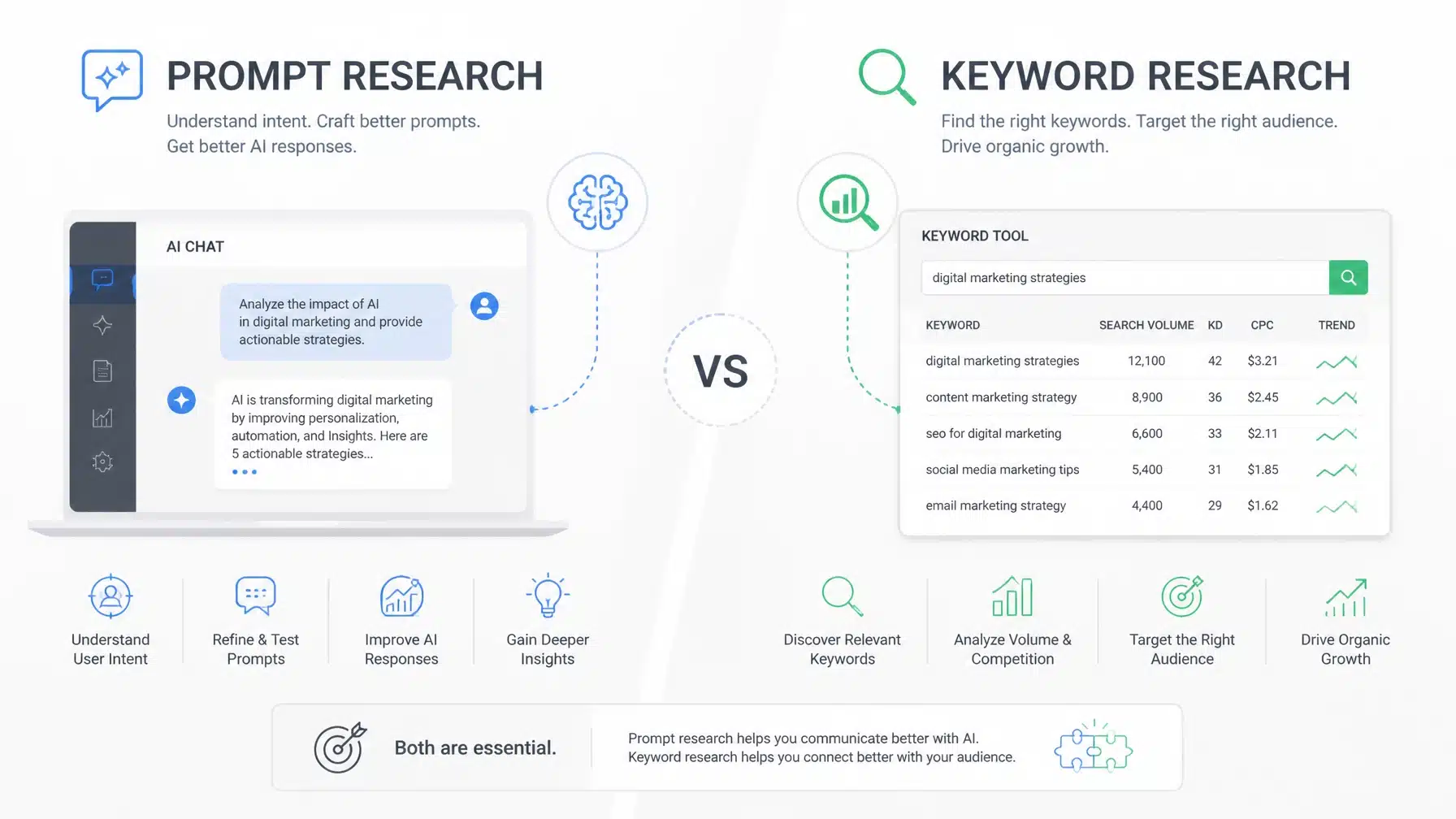
To understand why traditional SEO workflows fall short in conversational search environments, we must examine the structural differences between how keywords operate versus how prompts function.
| Dimension | Traditional Keyword Research | Prompt Research |
|---|---|---|
| Typical Query Length | 2–5 words, fragmented phrases | 10–25+ word natural-language questions |
| Intent Signal | Implicit; must be inferred (e.g., "enterprise CRM") | Explicit; states constraints, budget, and exact use cases |
| Data & Metrics | Search volume, CPC, keyword difficulty, click-through rates | Citation frequency, brand mention rate, share of AI recommendations |
| Optimization Target | Ranking a specific landing page on a traditional SERP | Getting your domain cited as a trusted source within AI-generated answers |
| Underlying Engine | Classic deterministic index matching | Generative synthesis and probabilistic reasoning |
Keyword research has always treated searchers as transactional actors querying a database. You look for high volume, manageable competition, and commercial intent. But when a prospective buyer opens an AI assistant, they do not type "best project management software." Instead, they input:
"What is the best project management tool for a remote marketing team of 15 people with a strict $500 monthly budget and native time tracking?"
That single conversational input carries explicit constraints that traditional keyword metrics cannot capture. Prompt research focuses on mapping these multi-turn, highly contextual questions to structured answers. If your content is engineered solely around short-tail keywords, generative engines will bypass your pages in favor of competitor assets that directly address the user's specific parameters. To dive deeper into how modern search architectures handle these expanded queries, review our detailed analysis on what fan-out queries mean for your search visibility.

2. Adapting Your Keyword Research Workflow for the Generative Era
You do not need to throw away your keyword research tools. Instead, your team must upgrade its research pipeline by transforming static keyword lists into living behavioral frameworks. Here is how leading organizations adapt their keyword workflows for AI search:
Shift from Term Clustering to Question Clustering
Traditional keyword clustering groups terms by root nouns or similar search volumes. Prompt research requires grouping queries by buyer goals and situational constraints. Take a high-intent commercial keyword like "cloud security audit" and expand it into the conversational questions buyers actually submit to generative engines:
- "How often should a mid-market SaaS company conduct a cloud security audit?"
- "What are the core compliance requirements for a SOC 2 cloud security review?"
- "Which automated tools streamline cloud security audits without disrupting engineering velocity?"
Mine First-Party Data for Natural Language
Keyword tools show you what people typed, but internal data reveals how they talk. Modern prompt research relies heavily on qualitative data sources that capture authentic buyer language:
- Customer Support Tickets: The exact phrasing frustrated users use when describing a friction point.
- Sales Discovery Call Transcripts: The precise comparative questions prospects ask sales reps during evaluation stages.
- Community Q&A Platforms: Unfiltered threads on Reddit, GitHub, and niche industry forums where buyers articulate their exact operational bottlenecks.
By integrating these data streams into your content calendar, you ensure your publishing schedule reflects real conversational patterns rather than algorithmic estimates. For organizations looking to build out internal capabilities, our expert SEO tools support and training services help teams master modern generative optimization frameworks from the ground up.
3. Operationalizing Visibility with CiteMetrix and Buyer Prompt Panels
Knowing what your buyers are asking AI is only half the battle; tracking whether generative engines actually recommend your brand is where strategy meets execution. This is where specialized platforms enter the picture.
Platforms like CiteMetrix utilize fixed, repeatable sets of buyer-relevant queries: known as prompt panels: to track how AI models (such as ChatGPT, Perplexity, and Gemini) cite and reference your brand over time.

What Are Buyer Prompt Panels?
A buyer prompt panel is a curated library of 20 to 50 core questions that represent your target audience's journey across different funnel stages:
- Category Queries: "What are the top-rated enterprise expense management tools for remote teams?"
- Problem-Aware Queries: "How can finance leaders reduce SaaS subscription waste across department silos?"
- Comparison Queries: "What are the key operational differences between [Competitor A] and our platform for mid-market CFOs?"
How Citation Tracking Changes Measurement
Instead of tracking static blue-link rankings in Google Search Console, tracking through CiteMetrix yields critical generative metrics:
- Citation Rate: The exact percentage of prompt panel runs where your domain is cited as an authoritative source.
- Source Page Attribution: Which specific URLs on your site are being pulled into AI answers, allowing you to optimize your highest-performing assets.
- Competitive Share of Recommendations: Understanding which competitor domains dominate AI citations for your core product categories.
To explore how these tracking mechanisms integrate into a broader enterprise strategy, read our comprehensive guide on how an AI citation tracker strengthens your search visibility.
4. A Practical Methodology for Building Prompt-Optimized Content
Transforming your content strategy to win in conversational search requires a structured, repeatable methodology. Follow these four actionable steps to align your editorial workflow with AI search engines:

Step 1: Audit Your Existing Content for AI Extractability
Generative models do not read web pages the way human readers do: they parse code, structured headings, and concise paragraphs to extract direct answers. Review your top-performing blog posts and product pages:
- Does the opening paragraph immediately answer the core user question within 40 to 60 words?
- Are complex comparisons structured cleanly using markdown tables or bulleted lists?
- Do you include proprietary data, original research, or unique expert commentary that AI models prefer to cite?
Step 2: Build and Freeze Your Core Prompt Panels
Assemble a cross-functional team of sales, customer success, and content strategists to compile 30 definitive prompts your ideal buyers ask during evaluation. Freeze the wording so your tracking data remains consistent quarter-over-quarter. Run these prompts through generative engines manually or via tracking software to establish your baseline citation rate.
Step 3: Publish Definitive, Modular Content Hubs
Create comprehensive resource guides designed specifically around prompt clusters. Each section within a guide should serve as a self-contained answer to a specific sub-prompt. Use clear H2 and H3 headings that mirror natural conversational phrasing, making it effortless for AI web crawlers to index and quote your content.
Step 4: Continuously Monitor and Refine
Review your citation performance monthly. Identify prompts where competitors are consistently cited while your domain remains absent. Analyze the cited competitor URLs to discover what structural elements, data points, or schema markup contributed to their visibility: then update your own assets to close the gap.
Secure Your Brand's Authority in Conversational Search
The transition from keyword-driven search to conversational AI is not a temporary trend: it is a permanent structural evolution in how humanity accesses information. Brands that cling exclusively to traditional keyword rankings will watch their organic traffic erode as zero-click AI summaries absorb buyer intent at the top of the funnel.
By pairing traditional keyword research with rigorous prompt research, building structured buyer prompt panels, and optimizing your content for generative citations, you position your organization as the definitive authority in your niche.
Are you ready to adapt your search strategy for the generative era and ensure your brand is recommended by AI assistants? Book a consultation with our expert team today to audit your AI search visibility and build a future-proof content roadmap.