Let’s be honest: the era of "ten blue links" isn't just dying: it’s effectively a ghost. If you’ve spent the last decade perfecting your keyword density and backlink profile, you’ve done a great job for the 2010s. But it’s 2026, and the game has fundamentally changed.
According to the latest data, a staggering 58% of Google searches are now AI-powered. This isn't a "future trend" we need to watch out for; it’s the current reality. When users ask a question, they aren't looking for a list of websites to browse; they want a definitive answer right there at the top of the page. This is the AI Overview (AIO), and if your brand isn’t the one providing that answer: or at least being cited as the source: you are invisible to more than half of your potential audience.
Monitoring the "Machine" is no longer optional. It is essential for survival. At Expert SEO Consulting, we’ve pivoted our strategy to focus on how Large Language Models (LLMs) perceive and rank information. To do this effectively, we rely on CiteMetrix.
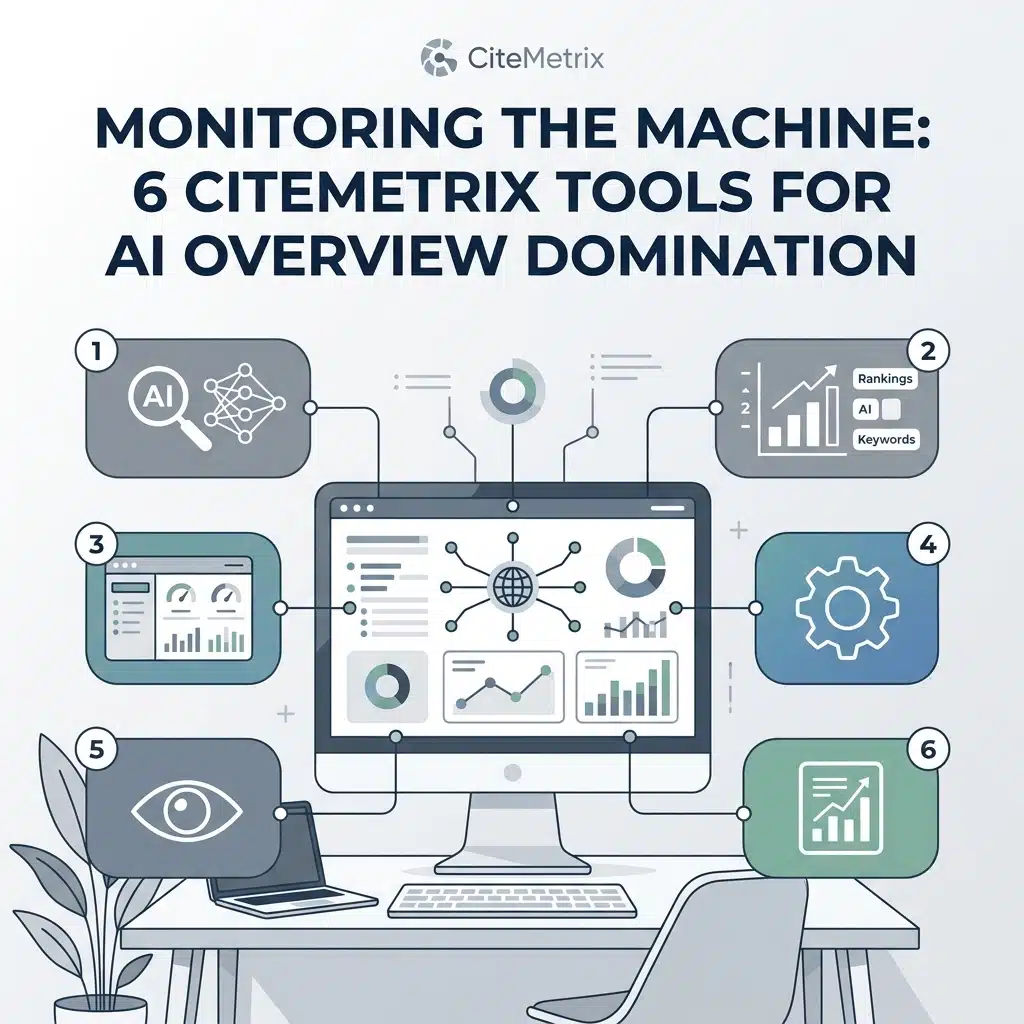
If you want to dominate the AIO landscape, you need more than just hope; you need data. Here are the six CiteMetrix tools you must use to monitor and master your niche’s AI Overviews.
1. AI Brand Monitor: Your Visibility Baseline
Before you can dominate, you need to know where you stand. The AI Brand Monitor is the foundational "command center" within CiteMetrix. Think of it as your brand’s radar in the AI atmosphere.
You enter your brand details, and the tool scans the landscape across major platforms: ChatGPT, Claude, Gemini, and of course, Google’s AI Overviews. It provides a real-time snapshot of how often your brand is mentioned when relevant queries are triggered.
If 58% of searches are AI-powered, and your brand monitor shows 0% visibility in those results, you have a massive problem. The AI Brand Monitor doesn't just show mentions; it tracks the context. Are you being mentioned as a leader or an afterthought? This tool sets the baseline for every AI SEO Audit we perform.

Description: A minimal flat design .jpg showing a digital dashboard with various AI model icons (ChatGPT, Gemini, Claude) and a central visibility percentage meter.
2. AI Citation Tracker: Tracking the "Digital Word of Mouth"
The Machine doesn't just pull facts out of thin air; it relies on citations to establish authority and accuracy. The AI Citation Tracker is arguably the most critical tool for understanding the "why" behind AI responses.
This tool identifies which specific pages are being used as sources for AI Overviews in your niche. If your competitor is consistently cited as the authority on "enterprise cloud security," the AI Citation Tracker will show you exactly which of their whitepapers or blog posts the LLM is feeding on.
By monitoring these citations, we can identify which types of content are "Machine-friendly." Is the AI preferring long-form data studies or short, punchy FAQ sections? Once you know what the Machine likes, you can feed it better than your competitors do.
3. ModelScore™: The Health Metric of the AI Era
Traditional SEO has Domain Authority. AI SEO has ModelScore™.
ModelScore™ is CiteMetrix’s proprietary composite health score. It’s far more sophisticated than just counting backlinks. It combines citation frequency, brand authority within the LLMs’ training data, and technical accessibility.
Think of ModelScore™ as a credit score for your brand’s relationship with AI. A low score indicates that LLMs find your content untrustworthy, inaccessible, or simply irrelevant. When we see a client’s visibility drop, we often turn to Forensic SEO techniques to dig into the technical reasons behind a plummeting ModelScore™. If your score is low, the Machine will bypass you every single time, regardless of how "good" your content feels to a human reader.
4. Share of Voice (SOV) Analysis: Finding the "Answer Gap"
In the old days, we tracked keyword rankings. In the AI era, we track Share of Voice (SOV).
The CiteMetrix Share of Voice tool compares your brand’s presence in AI Overviews against your top five competitors. This is where we identify the "Answer Gap." An Answer Gap occurs when there is a high-volume query in your niche that the AI is answering, but it’s using your competitor’s data: or worse, providing a subpar answer because your better data isn't being recognized.

Description: A minimal flat design .jpg illustration of two overlapping circles representing "Competitor Mentions" and "Brand Mentions," with a highlighted gap labeled "The Answer Gap."
Identifying these gaps is the fastest way to "AIO Domination." If we find a gap where the Machine is struggling to find a clear authority, we can create hyper-targeted content that specifically fills that void. This isn't just about being "better"; it’s about being the most "citable" source available.
5. AI Trust Audit: Ensuring Accuracy and Sentiment
The Machine is obsessed with trust. If an LLM cites you and that information turns out to be inaccurate or triggers a "hallucination," the model's safety filters will eventually learn to demote your source.
The AI Trust Audit tool within CiteMetrix analyzes the sentiment and accuracy of how your brand is portrayed. It checks for:
- Accuracy: Is the AI representing your pricing, features, or mission correctly?
- Sentiment: Is the tone surrounding your brand mentions positive, neutral, or skewed by old, negative reviews?
- Hallucination Risk: Is the AI making things up about you because your site's structure is confusing?
If the AI doesn't trust your data, it won't use it. Period. We use these audits to clean up the "digital footprint" that the Machine follows, ensuring that every citation is a positive reinforcement of your brand's authority.
6. Schema Advisor: Feeding the Machine the Right Language
While LLMs are getting better at reading "human" language, they still rely heavily on structured data to categorize information quickly. The CiteMetrix Schema Advisor is a remediation tool that connects your visibility findings to technical fixes.
It looks at the AI Overviews you want to win and tells you exactly what Schema markup is missing. Should you be using HowTo schema? FAQPage? Product?
The Machine is essentially a giant pattern-recognition engine. Schema Advisor ensures your website’s code is organized in the exact patterns the Machine is looking for. This technical foundation is often the difference between being a "source page" and being left in the archives. It’s a core component of any modern AI SEO Audit.

Description: A minimal flat design .jpg showing a magnifying glass over a block of code, with a "Checked" icon appearing next to it, symbolizing technical optimization.
Why This Matters Right Now
You might be thinking, "Can't I just wait for this AI thing to blow over?"
No. You can't.
The shift to AI-powered search is fundamental and irreversible. When 58% of searches are being filtered through an AI lens, the traditional "SEO traffic" you're used to is being intercepted before it ever hits your site. If you aren't the answer in the AI Overview, you are losing more than half of your potential leads before they even know you exist.
Dominating the Machine isn't about "gaming the system." It’s about understanding the new language of authority. It’s about using tools like CiteMetrix to see what the Machine sees, identify where you are failing to communicate, and closing those Answer Gaps with surgical precision.
At Expert SEO Consulting, we don’t just watch the industry change: we lead the change. If your traffic has plateaued or you’ve noticed a dip in organic leads, it’s likely because the Machine has found a "better" source. It’s time to take your visibility back.
The Machine is always learning. Is it learning about you?
If you're ready to stop guessing and start dominating the AI landscape, let's talk. We specialize in identifying Answer Gaps and building the technical authority needed to win the citation game.
Book a consultation with Eric Richmond today and let’s put CiteMetrix to work for your brand.